


Views: 0 Author: Site Editor Publish Time: 2026-10-22 Origin: Site


You already know you need a baler for waste management or recycling. You are likely deciding whether the premium for a stainless steel unit is justified. Making the wrong choice creates severe operational bottlenecks. Standard carbon steel balers are cost-effective industry defaults. They work perfectly in standard warehousing. However, they fail rapidly in corrosive, highly sanitary, or wet environments.
This article provides an objective, evidence-based framework. We evaluate operational environments and strict compliance requirements between the two materials. You will learn how to match equipment metallurgy to your specific waste stream. We explore washdown protocols, marine exposure, and acidic byproducts. By the end, you will know exactly when an upgrade is necessary to prevent premature equipment failure.
Compliance Dictates Material: Food processing, pharmaceutical, and maritime operations often require stainless steel by default to meet FDA, USDA, or maritime sanitation standards.
Grades Matter: Not all stainless steel is equal; selecting between 304 and 316 grades is critical based on chloride (salt) exposure.
Application Scope: Stainless balers are available across all operational scales, from a Manual Stainless Steel Baler for small maritime vessels to a Heavy Duty Stainless Steel Baler for continuous industrial food-waste processing.
You must understand the mechanical baselines of both materials before purchasing. Each metal serves distinct operational realities. Misapplying them leads to catastrophic equipment failure or wasted capital.
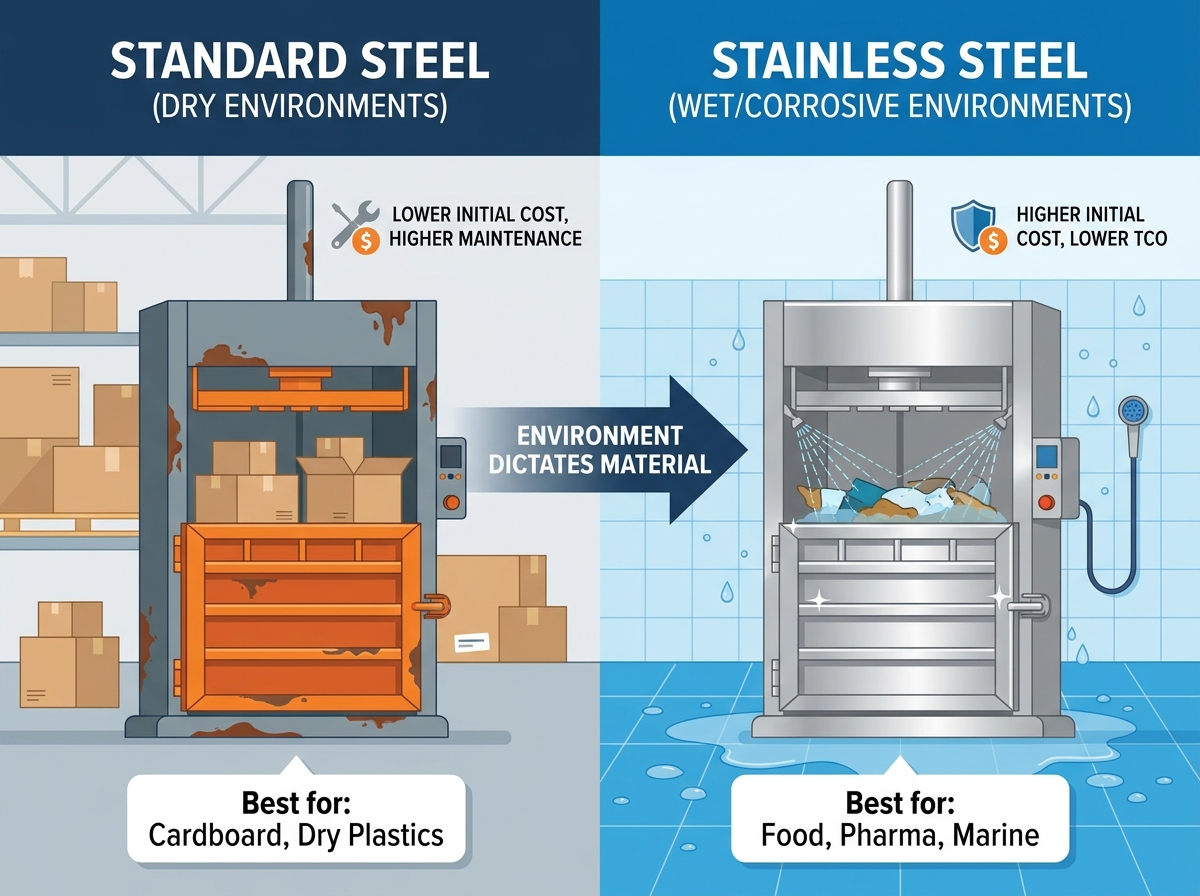
Manufacturers build standard balers from carbon steel. They coat these machines in industrial paint or epoxy. This approach works well for most conventional applications.
Pros: They require 30–50% lower upfront capital expenditure. Carbon steel offers extremely high structural yield strength. You can source these machines readily from most suppliers.
Cons: They remain highly susceptible to oxidation. Rust forms quickly when exposed to moisture, acidic waste, or salt. Baling friction causes paint to chip. Chipped paint can easily contaminate your processed materials.
Best for: You should use them in dry environments. They excel at processing dry cardboard (OCC) and clean plastics. They fit perfectly in indoor warehousing and standard retail backrooms.
A Stainless Steel Baler utilizes a specific alloy containing chromium. This creates a passive layer defending against harsh elements. It transforms how facilities handle aggressive waste.
Pros: They deliver exceptional corrosion resistance. The bare metal withstands harsh chemical washdowns effortlessly. The smooth surface prevents biological build-up. You never worry about chipping paint contaminating food-grade streams.
Cons: They demand a higher initial procurement cost. Manufacturers often require longer lead times for these highly customized units.
Best for: They are mandatory for wet waste and caustic environments. You need them in sanitary cleanrooms, food processing plants, and outdoor marine applications.
Your physical environment dictates your material choice. You cannot rely on preference. Strict regulatory frameworks and chemical realities govern equipment survival.
Identify if your facility utilizes high-pressure, caustic washdowns. Food processors use chlorine or quaternary ammonium compounds daily. Standard steel paint degrades quickly under these chemicals. Once the paint strips away, rust destroys the carbon steel frame.
Stainless machinery eliminates this risk. However, the metal frame is only the foundation. You must specify NEMA 4X enclosures. These waterproof electrical components must accompany any stainless build to survive continuous sanitation sprays.
Saline environments are brutally unforgiving. Standard steel deteriorates rapidly at sea. Airborne salt accelerates oxidation exponentially. If you operate offshore, you must avoid standard carbon steel completely.
Industry standards highly recommend 316-grade stainless for high-chloride exposure. It contains molybdenum. This specific addition prevents localized pitting corrosion caused by seawater. Grade 304 will eventually pit in offshore applications. You must verify the alloy grade before deployment.
Evaluate the actual material being baled. Some waste streams hide corrosive dangers. Consider aluminum cans containing residual soda. Think about chemical drums or wet agricultural waste.
Acidic residue attacks standard steel baseplates aggressively. The hydraulic cylinders also suffer. The acid eats through chrome plating, leading to seal failure. Stainless construction neutralizes these acidic threats. It keeps your operation running safely.
Manufacturers design anti-corrosive balers for every operational size. You must match the machine's throughput capacity to your facility's daily volume.
An Industrial Stainless Steel Baler serves high-throughput facilities. Large-scale food processors and beverage destruction facilities rely on them.
They focus heavily on automation. These units offer continuous feed capabilities via conveyors. Manufacturers build them using heavy-gauge 304 or 316 steel construction. They run constantly without structural fatigue. They handle massive volumes of wet, sloppy byproducts efficiently.
You need a heavy duty system for processing dense, difficult, or highly corrosive scrap. Specific manufacturing byproducts and marine waste require extreme crushing force.
These units feature reinforced cylinder housings. They utilize high-pressure hydraulics built specifically to withstand abrasive wet environments. They crush rigid drums and dense plastics without buckling.
Offshore rigs, commercial ships, and tight cleanrooms often lack floor space. A Compact Stainless Steel Baler provides the perfect solution.
They maintain a very small footprint. If you need mobility, a Portable Stainless Steel Baler allows easy relocation. Both options offer plug-and-play installation. They deliver this convenience without sacrificing critical anti-corrosive properties.
Some environments process very low volumes. Small pharmaceutical labs and niche chemical processors fit this category. Automation is unnecessary here. However, sanitation remains strictly critical.
These specialized spaces utilize manual controls. Operators load and compress materials carefully. The machine stays perfectly sanitary between uses. It passes strict compliance audits effortlessly.
Buying the wrong baler introduces massive physical risks to your facility. You must look beyond the initial purchase. Equipment failure disrupts operations and poses severe safety hazards.
Carbon steel degrades relentlessly in harsh spaces. If you place a standard steel baler in a wet processing room, it begins failing immediately. Structural rust compromises the frame. Welds weaken over time.
Many facilities find themselves replacing a standard steel baler every 2 to 3 years under these conditions. The machine simply dissolves. Upgrading to the correct alloy prevents this cycle. A proper stainless unit operates safely for decades in the exact same harsh environment.
Rust creates catastrophic secondary failures. Consider your hydraulic system. Standard cylinder rods use basic chrome plating. In wet environments, moisture bypasses compromised rod wipers.
Rust forms on the cylinder rod. When the rod retracts, it shreds the internal hydraulic seals. This introduces water and rust particles directly into your hydraulic fluid. Fluid contamination destroys pumps and manifolds rapidly. You face massive downtime to rebuild the entire hydraulic circuit.
A shiny steel frame tricks many buyers. The frame is only part of the solution. You must verify every single component on the machine.
Ensure the power unit matches the environment. Check the hinges and safety latches. Demand stainless steel cylinder rods instead of standard chrome-plated ones. Verify electrical panels carry appropriate waterproof ratings. A single non-compliant component creates a weak link. That weak link will rust and fail.
Deciding between materials requires strict logical parameters. Follow these guidelines to finalize your procurement strategy.
Opt for Standard Steel if: Your facility is climate-controlled and dry. Your waste stream remains entirely non-corrosive, like dry cardboard or shrink wrap. You face budget constraints prioritizing immediate capital savings over extreme durability.
Opt for Stainless Steel if: You face strict FDA or USDA sanitation audits. You operate in maritime conditions or on offshore platforms. You process wet, sloppy, or acidic waste daily. Your sanitation crew requires frequent high-pressure chemical washdowns.
Material Application Comparison Table
Environment Type | Recommended Material | Primary Justification |
|---|---|---|
Dry Warehousing (Cardboard) | Standard Carbon Steel | No moisture exposure; maximizes capital efficiency. |
Food Processing (Washdown) | 304 Stainless Steel | Resists caustic sanitation chemicals; prevents biological build-up. |
Marine / Offshore Rigs | 316 Stainless Steel | Molybdenum content resists severe chloride pitting from saltwater. |
Chemical Processing Labs | 304 or 316 Stainless Steel | Neutralizes acidic corrosion; ensures cleanroom compliance. |
Conduct a site audit: Measure daily moisture levels. Document the specific sanitation chemicals your crew uses.
Consult compliance officers: Review FDA, USDA, or Marine mandates governing your specific operational zone.
Request specific alloy quotes: Ask manufacturers for quotes detailing 304 versus 316 steel based on your salt and chemical exposure.
The choice between standard and stainless materials is rarely a personal preference. Environmental realities and regulatory compliance dictate your decision. Standard steel thrives in dry logistics hubs. Stainless steel dominates sanitary and corrosive environments.
Attempting to cut corners with carbon steel in a wet environment creates massive operational liabilities. The equipment will rust, contaminate products, and eventually fail. Conversely, over-specifying a marine-grade machine for a dry retail backroom wastes valuable capital.
Your goal is precise material alignment. Speak directly with an application engineer. Review your specific waste stream and environmental variables in detail before you issue a purchase order. Accurate planning ensures decades of safe, reliable baling.
A: Grade 304 serves as the industry standard for most wet and food-grade applications. It offers excellent general corrosion resistance. Grade 316 contains molybdenum. This addition makes it highly resistant to chlorides. You must use 316 for marine environments or areas exposed to strong industrial salts.
A: Epoxy or marine-grade paint offers temporary protection. However, the abrasive nature of baling inevitably scratches the paint. This exposes the carbon steel underneath to rapid, localized rust. It serves as a stopgap measure, not a permanent solution for harsh environments.
A: Not automatically. A true washdown-ready baler requires specific upgrades beyond the main frame. You must request stainless steel cylinder rods, waterproof NEMA enclosures for electronics, and sealed bearing housings. Always verify the complete bill of materials before purchasing.
A: Depending on the specific grade of steel, current commodity prices, and required electrical waterproofing, a stainless unit typically commands a 30% to 60% premium over its carbon steel equivalent. You are paying for advanced metallurgy and specialized waterproof components.


