


Views: 0 Author: Site Editor Publish Time: 2026-10-21 Origin: Site


Baling stainless steel presents a demanding engineering challenge for recycling operations. This metal possesses exceptionally high tensile strength and aggressive material "spring-back." Standard equipment built for aluminum or cardboard simply cannot handle these intense physical properties. Choosing inadequate machinery leads to severe operational headaches and distinct financial losses.
You will experience premature hydraulic wear, excessive maintenance downtime, and sub-optimal bale densities. These poorly compacted bundles ultimately reduce your scrap resale value and inflate transportation costs. Facility managers cannot afford to make purchasing decisions based on general specifications. You need equipment built for this specific alloy.
This guide provides a clear, technical framework for facility managers and procurement teams. You will learn how to evaluate equipment strictly on physical capability, expected return on investment, and daily operational realities. We will explore critical hydraulic requirements, facility constraints, and common procurement mistakes to avoid.
Stainless steel's high yield strength demands balers with specialized wear plates and higher-rated hydraulic cylinder forces.
Facility throughput (tons per hour) and spatial constraints dictate the choice between vertical, horizontal, or specialized compact models.
Total Cost of Ownership (TCO) evaluation must include expected liner replacement frequency and energy consumption per bale, not just initial capital expenditure.
Procurement should mandate material testing with the manufacturer prior to final vendor selection.
Stainless steel resists bending. It snaps back rapidly after compression. We call this the "spring-back" factor. Standard machines struggle heavily here. The material memory fights the compaction ram constantly. You need a Heavy Duty Stainless Steel Baler to overcome this resistance. These models provide superior ram pressure. They also feature highly rigid frame construction. Weak frames warp under extreme stress. A warped frame destroys hydraulic alignment permanently.
Next, consider shear force specifications. Cleanly shearing stainless offcuts requires massive tonnage. Standard mild steel sits around 120 Brinell hardness. Stainless alloys often exceed 200 Brinell. If your tonnage falls short, the motor stalls. The platen might bend entirely. You must verify minimum tonnage requirements. To ensure adequate hydraulic force, evaluate these three structural components:
Cylinder Bore Size: Larger internal diameters generate higher pushing force at the same pressure.
Operating Pressure (PSI): Systems must maintain consistent high pressure without blowing internal seals.
Platen Thickness: The pressing face must feature reinforced steel webbing to prevent bowing.
Finally, plan carefully for wear and tear mitigation. Abrasive steel edges quickly destroy standard baling chambers. You must mitigate this structural degradation proactively. Insist on replaceable wear liners inside the bale chamber. HARDOX steel or high-brinell equivalents work best. They protect the main chamber walls from deep gouges. You replace these liners routinely instead of scrapping the whole machine.
Volume strictly dictates your machinery scale. Match the equipment precisely to your actual daily output. Low-volume setups need practical, cost-effective solutions. Tool-and-die shops generate minimal daily scrap. Localized manufacturing lines see similar constraints. Here, a Manual Stainless Steel Baler often suffices perfectly. It keeps capital expenditures reasonable. It effectively manages scattered offcuts without drawing excessive power. Operators load it by hand during shift changes.
High-volume scrap yards face entirely different realities. Scrap aggregators process continuous material flows daily. Large manufacturing plants demand rapid, unbroken cycle times. You must upgrade to an Industrial Stainless Steel Baler. These robust machines handle relentless operational abuse.
Evaluate your required cycle times carefully. Compare the machine's pressing speed against your daily tonnage goals. A 40-second cycle yields vastly more than a 70-second cycle over an eight-hour shift. Consider your automation requirements as well. Automated hoppers feed material continuously. Integrated incline conveyors eliminate dangerous manual lifting. Auto-tie wire features reduce expensive labor overhead significantly. These automated upgrades streamline your entire facility workflow.
Table 1: Equipment Scale and Ideal Application Comparison
Machine Category | Volume Scenario | Target Operation | Key Automation Feature |
|---|---|---|---|
Manual Systems | Low (Under 1 Ton/Day) | Tool-and-die shops, local fabrication | Hand-fed doors, manual tie-off |
Semi-Automated Systems | Medium (1-5 Tons/Day) | Regional recycling centers | Conveyor feed, push-button ejection |
Industrial Systems | High (5+ Tons/Day) | Large scrap yards, major manufacturers | Auto-tie systems, continuous hopper feed |
Floor space often dictates heavy purchasing decisions. Real estate inside manufacturing plants costs serious money. Evaluate a Compact Stainless Steel Baler for tight factory layouts. These vertical models maximize upward space. They deliver high compression without dominating the production floor. You keep your forklift aisles clear and maintain safe walkways.
Some facilities operate dynamic, ever-changing workflows. Scrap generation points move frequently as product lines shift. Decommissioning sites require temporary equipment setups. Assess the operational validity of a Portable Stainless Steel Baler. These mobile units offer incredible layout flexibility. You can relocate them easily using standard heavy forklifts or skid steers. They adapt seamlessly to changing plant layouts.
Never ignore your existing infrastructure prerequisites. Heavy-tonnage machinery creates intense, rhythmic vibrations. You need reinforced concrete flooring underneath the unit. Standard thin warehouse floors will crack under the repeated pressure. Verify your electrical capacity early in the process. Most high-yield balers demand dedicated 3-phase power. Insufficient amperage will constantly trip your facility breakers. Low voltage can severely damage the baler motor over time.
Evaluate industrial equipment based on hard financial returns. Focus on mechanical efficiency and output quality. Calculate the energy cost per individual bale. Analyze the motor's kilowatt rating closely. Compare this rating against typical cycle speeds. Highly efficient motors compress metal faster using less electricity. This directly improves your facility's bottom line over a ten-year lifespan.
Optimize your scrap resale value aggressively. Smelters and recycling aggregators pay more for dense, uniform material. Higher bale density maximizes your outbound shipping weights. You fit more tonnage onto a single flatbed truck. Better compaction secures premium tier-pricing from local buyers. Loose, sloppy bales waste truck space and lower your profit margins.
Prioritize scheduled maintenance and parts availability. Evaluate every vendor strictly on this crucial metric. You must verify local or domestic parts access. Downtime destroys profitability faster than anything else. When reviewing vendors, use this essential checklist:
Proximity to certified service technicians.
Guaranteed emergency dispatch times.
Domestic stocking of proprietary hydraulic valves.
Immediate availability of limit switches and shear blades.
Always ensure facility safety and compliance. Machinery must meet strict OSHA or CE guidelines. Look for prominent, accessible emergency stops. Interlocking safety gates prevent catastrophic operator injuries during the compression cycle. Noise decibel limits matter deeply for indoor operations. Quiet hydraulic pumps protect worker hearing over long factory shifts.
Procurement processes hold hidden operational traps. Avoid these critical mistakes to protect your investment.
Under-speccing the hydraulic system ranks as the highest risk. Buyers sometimes choose cheap machines rated for general metals. They ignore the extreme yield strength of their specific materials. You must buy a specialized Stainless Steel Baler. Weak cylinders fail prematurely. Seals blow out under the intense back-pressure. You spend thousands repairing equipment unsuited for the task.
Ignoring chamber dimensions creates massive production bottlenecks. You must align the feed opening size with your largest scrap pieces. If scrap dimensions exceed the hopper opening, trouble starts immediately. Workers must manually pre-cut large steel sheets. Manual labor costs skyrocket when you deploy staff with plasma cutters just to feed a machine. This bottleneck slows down the entire recycling line.
Never skip the physical proof of concept. Buyers should never finalize a purchase blindly. Send a varied material sample directly to the manufacturer. Demand a live test run on video. Verify the resulting bale density yourself. If the machine cannot handle your specific alloy grade, walk away immediately. Reputable vendors welcome this testing phase.
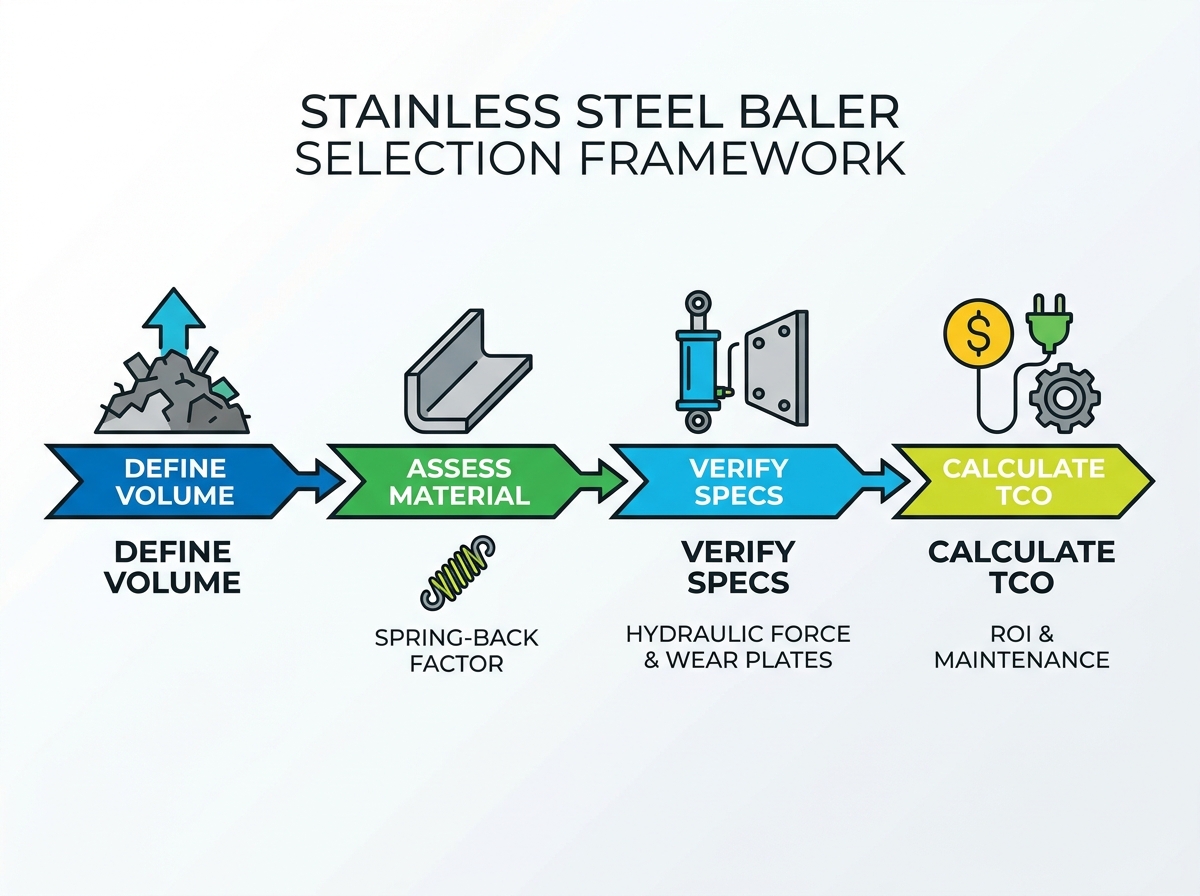
Summarize your purchasing framework clearly before signing contracts. Define your specific volume requirements first. Next, assess your material hardness and specific alloy grades. Always verify the hydraulic specifications and wear plate compositions. Finally, calculate your comprehensive return on investment based on energy usage and resale value.
Take immediate action today. Audit your current scrap generation volume accurately. Gather detailed data on typical piece sizes and daily tonnage. Then, request specific technical spec sheets from a shortlisted group of vendors. Focus heavily on shear force metrics. Demand proof of high-brinell wear plate composition to ensure long-term durability.
A: Minimum tonnage typically starts around 100 to 150 tons for thin offcuts. Thicker structural pieces demand 200 tons or higher. Force requirements vary heavily by material thickness and specific alloy grades. For instance, 316 stainless resists compression more aggressively than 304 stainless. Always consult the manufacturer to match tonnage to your exact scrap profile.
A: Replacement cycles depend entirely on throughput volume and material abrasiveness. High-volume operations baling jagged offcuts may need new liners annually. Lighter operations can see liners last several years. You must ask vendors for expected lifespan data. Ensure they base their estimates on your projected operational hours and specific material type.
A: Standard equipment carries severe risks. You will likely experience premature hydraulic failure and permanent structural warping. Standard balers lack the necessary frame rigidity. They cannot manage the fierce spring-back memory of stainless alloys. You should only use standard models if the manufacturer explicitly retrofits them. They need heavy-duty cylinders and high-tensile steel chambers.


