


Views: 0 Author: Site Editor Publish Time: 2026-11-02 Origin: Site


Investing in a Horizontal Metal Baler represents a massive capital expenditure for any industrial operation. It dictates your daily throughput, logistics planning, and ultimate profitability. Operating without the proper equipment severely limits your processing capabilities. You cannot afford guesswork during this procurement phase.
Procuring the wrong machine creates severe operational bottlenecks across your entire workflow. Under-specifying hydraulic power leads to frequent cylinder stalling during heavy compression cycles. Conversely, over-estimating your required throughput wastes valuable floor space and causes excessive maintenance downtime. An ill-fitted machine frustrates operators and destroys expected profit margins.
This guide bypasses fluffy marketing claims entirely. We provide a purely operational framework for your facility. You will learn how to evaluate, compare, and purchase the optimal baling system. You will discover exactly how to match technical specifications to your specific material profile. By analyzing continuous volume metrics, you secure the right equipment for your long-term success.
Horizontal metal balers are engineered for continuous, high-volume operations (typically exceeding 2 tons per hour), unlike their batch-fed vertical counterparts.
The decision between single-ram and two-ram models dictates material flexibility, bale density, and wire-tying automation capabilities.
True evaluation requires looking beyond maximum tonnage to continuous throughput, cycle times, and hydraulic cooling efficiency.
Defining your operational thresholds remains crucial. Transitioning from vertical machines requires careful volume analysis. Establishing baseline throughput metrics ensures you make the right transition at the right time.
Volume Thresholds
Vertical machines handle discrete batches exceptionally well. However, they fail miserably during continuous scrap flows. Labor costs for manual loading destroy profit margins quickly. You need an automated solution when daily volume exceeds manual sorting capacities. A continuous system becomes mandatory at this growth stage. It processes heavy material continuously without operator fatigue. You eliminate the constant starting and stopping inherent to vertical baling.
Logistics and Freight Economics
Hauling loose scrap wastes substantial money. You essentially pay freight companies to ship empty air. High-density horizontal bales solve this expensive logistical nightmare. They maximize trailer and container weights highly efficiently. Consider a standard shipping container filled with loose aluminum. You hit the volume limit long before reaching the maximum allowed weight. Compressing this material creates dense, uniform bricks. Now, you reach maximum payload weight effortlessly. This effectively cuts transportation costs per ton. You optimize every single freight invoice.
Material Consistency vs. Variability
Feed material reality dictates your machine selection. Continuous edge-trim feeds beautifully into automated hoppers. Heavy non-ferrous and bulky aluminum also process exceptionally well. You must feed the hopper consistently to maintain throughput. Use a heavy-duty conveyor or a material handler grapple. Uneven feeding creates low-density bales and jams the shear blades. Consistent hopper loading ensures maximum extrusion efficiency. You must audit your scrap stream before selecting a machine type.
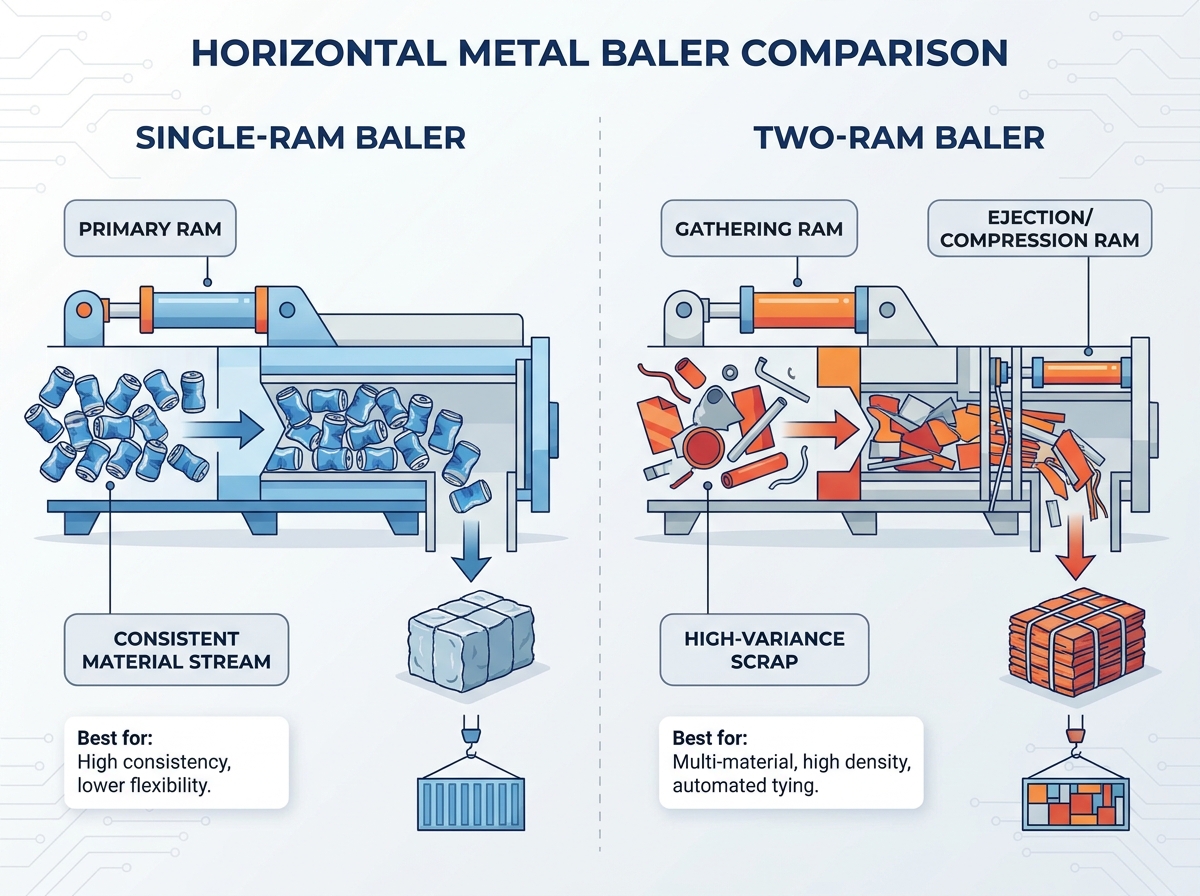
You must understand the two primary architectures. They serve entirely distinct industrial use cases. Confusing their applications leads to disastrous operational failures.
This architecture utilizes one primary hydraulic cylinder. It compresses material against a heavy closed door. Alternatively, it pushes material through a continuous extrusion chamber. The simplicity of this design minimizes moving parts.
Use this design for highly consistent material streams. Facilities processing exclusively aluminum cans benefit greatly. Identical stamping scrap also works perfectly in these machines. The uniform material flows predictably through the chamber. You achieve excellent density when the input remains identical daily.
However, you sacrifice material flexibility entirely. Switching between highly distinct scrap types causes severe problems. You might experience material bridging inside the hopper. The machine often produces uneven bale densities during material transitions. We recommend this architecture only for dedicated, single-material processing lines.
This design features two distinct hydraulic cylinders. A gathering ram compresses material forward initially. Then, a secondary ejection ram activates perpendicularly. It pushes the compacted material through the automated tying tier.
High-variance scrap yards absolutely require this architecture. You might handle copper, aluminum siding, and extruded profiles simultaneously. Light steel can enter the hopper during the same shift. The dual-ram action easily handles mixed material memories.
This machine produces higher-density, export-ready bales reliably. You do not need a separation door. It automates the wire-tying process far more efficiently. You gain massive operational flexibility. This design adapts to fluctuating market demands.
Comparison of Single-Ram and Two-Ram Architectures
Feature | Single-Ram Architecture | Two-Ram Architecture |
|---|---|---|
Material Variance | Low (Best for uniform streams) | High (Handles mixed scrap easily) |
Bale Density | Moderate to High | Maximum (Export-ready) |
Wire Tying | Often manual or semi-automated | Fully automated tier systems |
Space Requirement | Linear footprint | L-shaped footprint (Wider) |
Map technical specifications directly to operational outcomes. Do not let irrelevant metrics sway your decision. Focus entirely on what actually drives production.
Novice buyers only look at cylinder size. This represents a fundamental evaluation mistake. You must evaluate the operating pressure instead. Check the PSI or Bar rating carefully. Examine the pump displacement figures closely.
Operating pressure determines the final bale density. High pressure ensures the machine shears overlapping materials. It slices through hopper pinch points without stalling. Standard systems run around 3,000 PSI. Heavy-duty models push 4,000 PSI or more. Low-pressure systems jam constantly. They require dangerous manual intervention. This causes severe delays across your entire yard.
Downstream buyers dictate your size requirements. Match the extrusion chamber dimensions to their specific demands. Standard mill-size bales usually yield the best market prices. Discuss dimension tolerances thoroughly.
Correct sizing ensures maximum payload efficiency. You fit standard shipping containers perfectly. However, claimed "maximum density" assumes ideal material. We must warn buyers about real-world conditions. Memory-heavy metals resist compression strongly. Spring steel will drastically alter your final density numbers. Do not expect catalog specifications for tough, resilient materials.
Demand continuous processing rates from manufacturers. Ignore theoretical maximums completely. They never hold up in real industrial applications. Factor in your actual cycle times. Measure your specific hopper feed speed accurately.
Accurate evaluation prevents facility bottlenecks entirely. We advise buyers to assume a 20 percent efficiency loss. Real-world conditions always introduce unexpected loading delays. Operator changes and shift transitions slow things down. A fast ram cannot compensate for a slow conveyor. Planning for this buffer guarantees smooth daily operations.
Establishing authority requires acknowledging friction points. Actual installation poses significant challenges. Long-term use requires rigorous safety planning.
Buying a massive machine solves nothing if loaders cannot reach it. You must map out the exact turning radius. Forklifts and skid steers require ample maneuvering space. Poor planning causes daily traffic jams. Ensure sufficient space exists for staging finished bales. Clogged output zones stop production entirely. A Horizontal Metal Baler needs a dedicated ecosystem to thrive.
Mechanics need room to work safely. Emphasize the need for permanent catwalks. Establish clear lock-out/tag-out (LOTO) points immediately. You must leave physical clearance around the entire machine. Mechanics will eventually pull and replace main hydraulic cylinders. If concrete walls block this access, you face disastrous downtime. Plan your facility layout around maintenance accessibility.
Human error causes the highest risk of failure. Improper feeding destroys expensive machinery quickly. You must implement strict operational protocols.
Never drop unbreakable steel into a non-ferrous baler.
Train operators strictly on shear blade clearance parameters.
Enforce rigorous material grading protocols before feeding.
Conduct daily inspections of hopper safety gates.
Monitor hydraulic fluid temperatures during peak summer shifts.
Training on these specific points remains absolutely non-negotiable. Neglecting operator education guarantees catastrophic mechanical failures.
Provide a strict decision-making framework for the final phase. You must protect your investment aggressively. Do not accept vague promises from sales representatives.
Demand a Material Test: Never buy based on a glossy brochure. Demand practical proof. Require the manufacturer to run your specific scrap. They must test it through their actual machine. Measure the resulting bale weight yourself. This confirms their density claims directly.
Analyze the Wear Parts: Inspect the quote for detailed wear liner specifications. Look for AR500 steel or equivalent hardening. Check how the shear blades mount. Bolted liners allow quick, localized replacement. Welded liners require extensive, specialized maintenance downtime. Reversible shear blades double your cutting lifespan efficiently.
Service Level Agreements (SLAs) and Parts Availability: A 10-year warranty holds zero value without rapid support. The manufacturer must ship replacement parts quickly. A blown directional valve halts your entire yard. Verify they can deliver components within 24 hours. Check for stateside or local parts warehousing. Avoid brands relying solely on overseas shipping for critical spares.
Summarize your critical path clearly. First, audit your facility volume accurately. Next, choose the correct ram configuration. Single-ram suits uniform materials perfectly. Two-ram architectures handle mixed scrap brilliantly. Match technical specifications to actual logistics requirements. Ensure your chosen system shears material without stalling.
Take actionable next steps today. Consult a structural engineer for site preparation immediately. Heavy vibration requires proper structural planning. Finally, request a live material baling test from your shortlisted manufacturer. Ensure the equipment truly fits your operational realities before signing any purchase orders.
A: With rigorous preventative maintenance, a heavy-duty chassis easily lasts 15 to 20 years. You must perform regular oil analysis. Wear liner replacement remains critical. However, hydraulic pumps and motors endure immense stress. Expect to overhaul these specific mechanical components every 5 to 7 years to maintain peak performance.
A: Larger bale dimensions require much wider extrusion chambers. They also demand longer hydraulic cylinders. This significantly increases the required hydraulic fluid capacity. Consequently, the capital expenditure scales exponentially, rather than linearly. Bigger bales mean vastly larger, more expensive structural and hydraulic components across the entire machine.
A: Two-ram balers offer high versatility for multiple materials. However, you must exercise extreme caution. Feeding heavy ferrous structural steel into a machine designed for light non-ferrous aluminum causes catastrophic damage. It will shatter shear blades instantly. This improper usage completely voids manufacturer warranties and halts production.


