


Views: 0 Author: Site Editor Publish Time: 2026-11-03 Origin: Site


Investing in scrap compaction equipment represents a critical capital expenditure for any industrial facility. This choice directly impacts your operational throughput, manual labor requirements, and overall scrap metal revenue. You face significant operational risks if you select the wrong machine. Undersizing your baler leads to severe workflow bottlenecks and excessive labor costs as operators struggle to keep up. Conversely, oversizing wastes valuable capital and consumes heavily restricted floor space. We designed this article to provide a clear, engineering-focused breakdown. You will learn the distinct mechanical differences between continuous and batch processing compaction systems. We will help you match technical equipment specifications to your exact waste management volume and spatial constraints. By the end of this guide, you will possess the knowledge to confidently determine which system fits your operational reality.
Throughput is the ultimate decider: Horizontal balers are required for continuous, high-volume processing, while vertical balers suit intermittent, low-to-medium volume needs.
Space dictates feasibility: Vertical balers utilize vertical airspace to save floor space; horizontal balers require significant square footage for the machine and conveyor feeds.
Labor vs. CapEx tradeoff: The higher upfront cost of a horizontal metal baler is often offset by drastically reduced manual labor and automated tying/ejection.
Material matters: Not all balers handle shear-heavy scrap metal equally; cylinder force and structural rigidity must align with the specific metal type (e.g., light gauge aluminum vs. heavy ferrous scrap).
The orientation of your compaction equipment dictates your entire scrap processing workflow. You must understand how these machines operate fundamentally. Their mechanical design changes how material moves across your plant floor. Choosing incorrectly forces your team into inefficient operational habits.
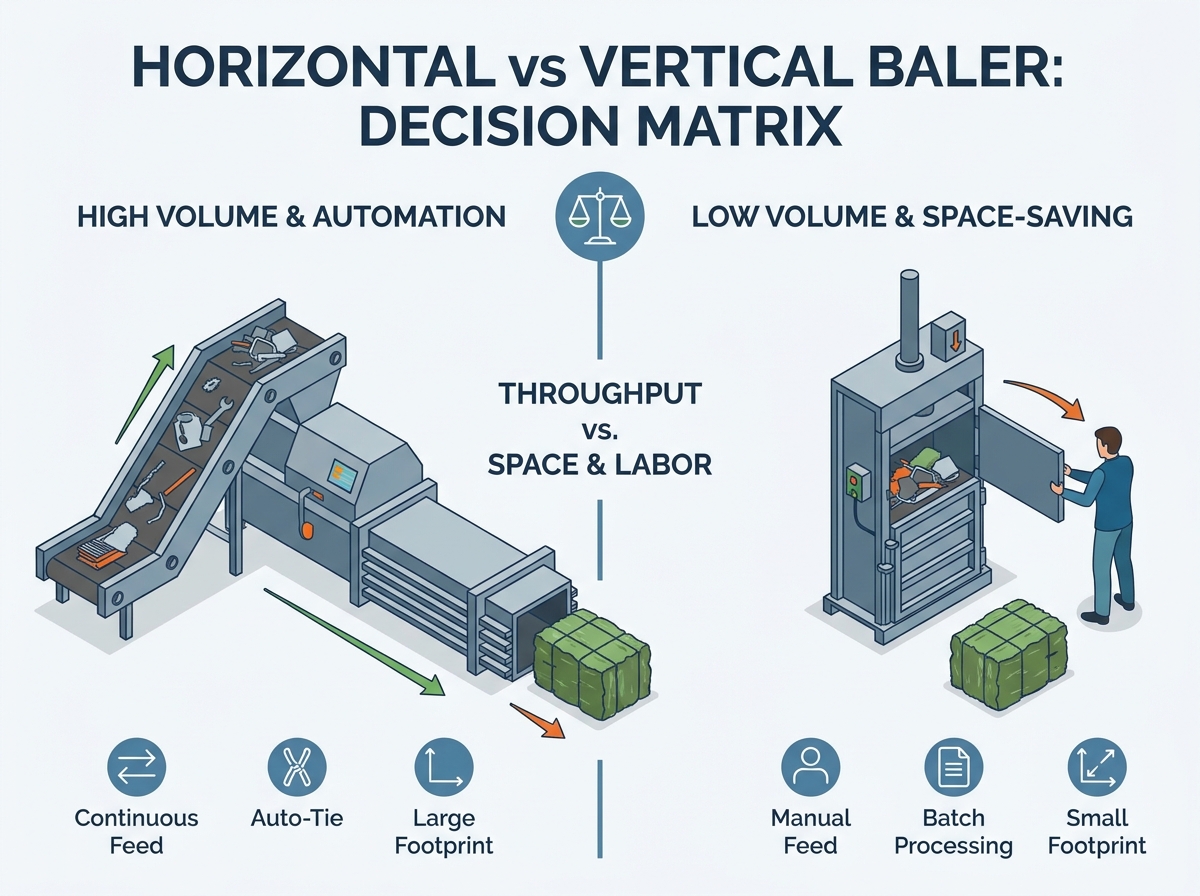
Vertical systems operate on a strict batch processing model. Operators must load materials manually from the front door. Once full, they close the heavy safety gate. The hydraulic platen then compresses downward from the top. It crushes the material into the lower chamber. After several compression cycles, the bale reaches its maximum size. Workers must manually thread wires through the chamber slots. They tie off the bales by hand. Finally, an ejection system pushes the finished bale out onto a pallet. These machines work best for intermittent feeding schedules.
A Horizontal Metal Baler fundamentally changes your operational speed. Facilities feed materials continuously into a large top hopper. You typically use incline conveyors, skid steers, or pneumatic cyclone systems for feeding. A massive horizontal ram activates automatically via optical sensors. It compresses the metal against a closed heavy-duty door. In open-end models, it forces material through an extrusion channel. These robust machines often feature auto-tying wire capabilities. Manufacturers build them specifically to keep pace alongside continuous production lines. They never force your upstream manufacturing processes to wait.
This equipment category represents the heavy-duty tier of industrial recycling. A Horizontal Metal Baler targets large scrap yards and high-output manufacturing plants. Regional recycling centers also rely on them daily. They thrive under relentless daily demands. You rarely see them sitting idle in high-volume environments.
Upgrading to this equipment class transforms your facility operations. You will notice immediate improvements across several operational metrics.
Automated Feeding & Tying: You eliminate the need for a dedicated operator. They no longer stop the machine to tie bales manually. This seamless automation drastically reduces your labor-per-ton processing costs.
Higher Ram Force & Shear Blades: Engineers specifically design the ram head incorporating hardened shear blades. They slice through oversized metal extrusions easily. This occurs smoothly during the forward compression stroke.
Consistent Bale Density: You produce heavier, highly compact mill-spec bales consistently. Dense bales maximize your outgoing freight payloads. They allow you to command much better market prices from smelters.
You must prepare for extensive footprint requirements. These systems demand significant floor space. The baler itself spans many feet in length. The required incline conveyor systems stretch even further. You must also allocate wide staging areas for incoming loose scrap. Outgoing finished bales require substantial forklift maneuvering space. Facility planning becomes a critical prerequisite.
These compact units serve distinct industrial niches. They suit retail distribution centers perfectly. Small-to-medium machine shops utilize them heavily. They fit operations treating scrap metal primarily as a byproduct. You choose them when waste management is not your primary business focus.
Choosing a vertical unit provides specific spatial advantages. They solve immediate accumulation problems quickly.
Minimal Footprint: They capitalize efficiently on your vertical height. You can tuck them neatly into tight warehouse corners. They sit comfortably near loading docks without blocking traffic.
Lower Initial Investment: You spend significantly less upfront capital. They cost a fraction of their horizontal counterparts.
Versatility: They handle mixed recycling streams effectively. You can switch operations quickly. One hour you compress cardboard. The next hour you compress light aluminum trim.
These machines remain highly labor-intensive by design. Operators must manually load loose material into the chamber. They wait idly for downward compression cycles to finish. They must tie the metal bales completely by hand. Process bottlenecks frequently occur. If your scrap volume surges unexpectedly, material piles up on the floor. Forklift drivers lose floor space rapidly. You trade automated efficiency for spatial conservation.
You must evaluate three core metrics carefully. We excluded long-term financial calculations to focus strictly on physical operational parameters. This matrix guides your technical equipment selection directly.
Volume dictates your primary mechanical choice. Follow a strict industry rule of thumb. Do you process more than two to three tons of scrap per day? If so, you require a continuous horizontal system. It maintains process flow constantly. It actively avoids severe labor drag on your workforce. Lower volumes justify batch processing easily.
Assess your physical building limitations objectively. Measure your available square footage precisely. Verify your ceiling height clearances. Evaluate your loading dock access routes. How will loose scrap move from the production floor to the baler? Horizontal units require wide forklift aisles. Vertical units require substantial overhead clearance for the hydraulic cylinder. Map these spatial constraints before purchasing anything.
Identify your specific metal scrap streams carefully. Examples include used beverage cans (UBCs), aluminum siding, copper wire, and steel turnings. Heavy ferrous scrap demands extreme hydraulic pressure. Ensure your chosen cylinder size matches the alloy yield strength. Verify the system PSI rating thoroughly. This matching prevents premature hydraulic burnout. It guarantees complete, tight bales.
Baler Comparison Chart
Feature | Vertical Balers | Horizontal Balers |
|---|---|---|
Processing Style | Batch (Intermittent) | Continuous |
Space Requirement | Low (Vertical Airspace) | High (Large Floor Footprint) |
Labor Intensity | High (Manual Loading/Tying) | Low (Automated Systems) |
Daily Volume Limits | Under 2 Tons | Exceeds 3 Tons Easily |
Material Handling | Light Metals, Plastics, Cardboard | Heavy Ferrous, Aluminum Extrusions |
Installing industrial compaction equipment introduces complex facility challenges. You must proactively manage several structural and compliance risks. Failing to prepare your facility leads to expensive installation delays.
Note the harsh structural realities immediately. Heavy-duty horizontal systems require reinforced concrete pads. Standard warehouse floors crack under their weight. The machine generates continuous structural vibration during operation. The ram exerts immense physical force. You often need eight to twelve inches of specialized concrete depth. Consult a structural engineer prior to installation.
Both machine styles typically demand robust 3-phase electrical power. Evaluate your existing electrical panels early in the process. High-horsepower motors draw significant startup amperage. You might need expensive electrical panel upgrades. Do this before committing to a massive horizontal system. Voltage drops cause severe hydraulic motor damage over time.
Safety regulations demand your full attention. Highlight OSHA machinery considerations constantly. You must implement strict lock-out/tag-out (LOTO) protocols. Install necessary pinch point physical guarding around the machine. Ensure rigorous operator training for all heavy compaction equipment. You must document this training legally. Unsafe operation causes severe workplace injuries.
Advise your procurement team on vetting manufacturers deeply. You must check for domestic replacement parts availability. Foreign parts cause weeks of operational downtime. Demand absolute warranty clarity in writing. Review their service technician response times strictly. You want a vendor guaranteeing rapid emergency repairs. This minimizes your future production downtime.
We must summarize the core selection logic clearly. The choice between a horizontal and vertical unit is not subjective. It is not about which machine looks "better" on paper. It is mathematically justified by your facility data. Your daily tonnage requirements dictate the size. Your local labor rates influence the automation needs. Your available floor space acts as a hard boundary.
Take decisive action today. Encourage your decision-makers to conduct a rigorous facility waste audit. Track your exact scrap metal tonnage for one month. Alternatively, request a site evaluation from a qualified equipment engineer. They will calculate exact equipment sizing for you. They match cylinder pressure to your specific scrap alloys. Rely on engineering data to secure your facility's operational efficiency.
A: Standard vertical models strictly handle light materials. They compress cardboard and plastic perfectly. Specialized vertical metal balers do exist for industrial use. However, they impose very strict limits on metal gauge thickness. Pushing them past these structural limits causes immediate mechanical failure. You risk bending the platen severely.
A: The price gap remains substantial. Vertical units generally fall in the lower five-figure range. Conversely, high-capacity horizontal machines range from the mid-five to six figures. This large variation depends entirely on the chosen features. Adding automated tying systems and aggressive shear capabilities increases the upfront price significantly.
A: Auto-tie functionality transforms your operational speed completely. It easily saves dozens of manual labor hours per week. Workers no longer thread wires by hand. This eliminates your largest process bottleneck instantly. This sustained, continuous throughput heavily justifies the initial purchase price for busy high-volume recycling centers.
A: Commercial industrial units commonly last ten to fifteen years. Many operate much longer. This lifespan depends entirely on your maintenance discipline. You must strictly adhere to hydraulic fluid replacement schedules. You must also conduct routine structural weld inspections. Neglecting these tasks destroys the machine prematurely.


