


Views: 0 Author: Site Editor Publish Time: 2026-10-23 Origin: Site


Managing waste in harsh industrial environments poses a serious challenge. Standard equipment often fails prematurely under high moisture. Corrosive chemicals accelerate structural decay rapidly. This constant degradation creates severe hidden problems for plant managers. Facilities face unexpected machine downtime. Contaminated materials pose serious safety hazards. Industrial operations need highly durable solutions to survive these daily rigors.
A purpose-built machine solves these exact operational issues. We designed this guide to examine how these specialized compactors operate. We detail the distinct structural configurations available today. We also provide a clear framework for thorough equipment evaluation. You will learn to match specific systems to your daily throughput needs. This ensures strict regulatory compliance across your entire processing operation.
Core Function: A stainless steel baler utilizes hydraulic pressure to compress loose waste into dense, manageable blocks, but features specialized construction (typically 304 or 316-grade steel) to withstand oxidation and chemical exposure.
Target Environments: Essential for facilities requiring washdowns, handling wet/organic waste, or operating in marine and chemical sectors.
Configuration Versatility: Available across multiple footprints, including compact, heavy-duty, portable, and manual setups to match facility volume constraints.
Evaluation Metric: Buying decisions should weigh initial capital expenditure against long-term operational longevity, maintenance frequency, and regulatory compliance.
An Industrial Stainless Steel Baler represents a premium category of waste compaction machinery. Manufacturers forge all critical contact points from anti-corrosive metals. They build the housing, chamber, and structural framing entirely from high-grade alloys. This creates a resilient machine capable of continuous compression cycles.
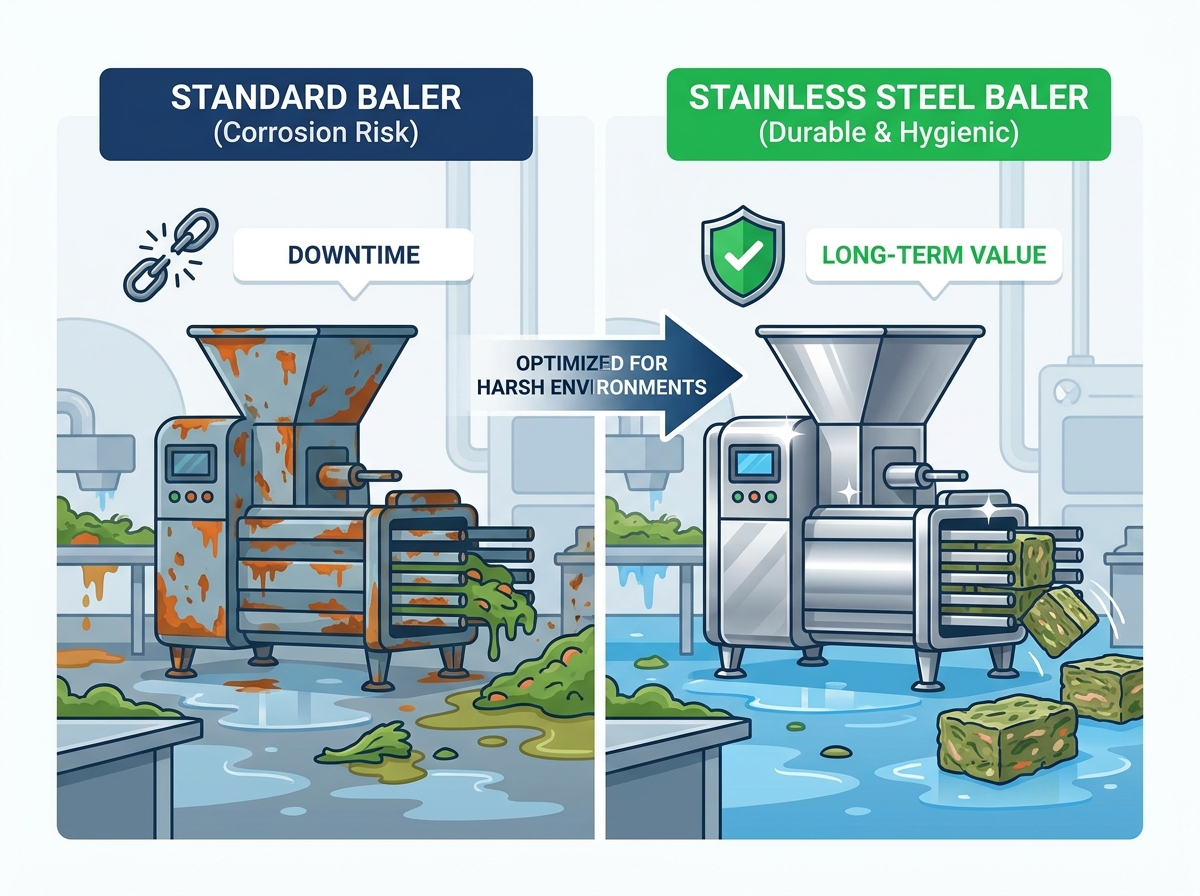
Standard mild-steel balers fail quickly in demanding environments. Regular painted steel rusts upon exposure to acidic liquids. Frequent washdowns strip away protective coatings instantly. Standard models suffer severe structural weakening over time. They also introduce dangerous rust particles into the processed materials. Stainless variants eliminate this dangerous cross-contamination risk. They maintain strict hygiene standards effortlessly.
Material science dictates the longevity of these machines. Engineers typically utilize 304-grade steel for standard moisture resistance. It contains chromium and nickel to prevent basic oxidation. Demanding facilities require 316-grade steel instead. This alloy includes molybdenum for superior chloride resistance. It performs exceptionally well in harsh marine and chemical processing environments.
Understanding the operation of a Stainless Steel Baler helps operators maximize efficiency. The compaction process relies on specialized fluid dynamics. It transforms bulky waste into uniform blocks.
Operators open the safety-interlocked chamber doors.
They feed loose materials into the specialized intake hopper.
The hopper design accommodates wet and hazardous materials safely.
Operators secure the heavy-duty latches before initiating the cycle.
The intake process dictates overall cycle speed. Well-designed hoppers prevent material bridging. They protect operators from sharp or hazardous waste during loading.
The system relies heavily on the main hydraulic cylinder. The cylinder drives a thick metal platen downward. This heavy platen crushes the material forcefully. Stainless construction prevents the platen guides from seizing up. Rust never forms along the internal tracking rails. The machine maintains smooth motion year after year.
Wet waste compression requires careful liquid containment. These machines feature built-in drainage channels. The channels route squeezed liquids away from the hydraulic components. This protects the sensitive seals from acidic degradation.
The machine holds the crushed material under immense pressure. Operators must secure the dense block manually or automatically. They thread wire, twine, or durable strapping through specific guide slots. They tie the straps tightly to maintain bale integrity. The system then utilizes automated ejection mechanisms. Internal kicker chains push the finished bale out smoothly. This completely removes the need for manual heavy lifting.
Modern compaction systems prioritize operator safety above all else. They incorporate multiple emergency stop buttons across the frame. Dual-channel safety interlocks monitor the chamber doors constantly. The machine simply refuses to cycle if doors remain unlatched. Facilities must perform routine diagnostic checks. This routine maintenance ensures continuous OSHA and CE compliance.
Different facilities generate distinct volumes of waste. Manufacturers engineer various configurations to solve specific spatial challenges.
A Heavy Duty Stainless Steel Baler processes immense material volumes daily. It serves high-volume recycling plants and chemical manufacturing centers perfectly. Large-scale scrap processing facilities rely on its continuous durability. It features high-tonnage hydraulic force. It often includes fully automated tying capabilities. The machine runs continuously without overheating.
A Compact Stainless Steel Baler solves strict floor space limitations. It operates perfectly inside commercial kitchens and pharmaceutical labs. Small manufacturing floors benefit greatly from its vertical orientation. It requires an exceptionally minimal footprint. It compresses cardboard, shrink wrap, and light aluminum cans easily. It fits into extremely tight spaces securely.
A Portable Stainless Steel Baler offers maximum operational flexibility. It serves marine vessels and remote offshore rigs efficiently. Multi-zone manufacturing floors move it between different production lines. It features heavy-duty casters or integrated forklift slots. It utilizes simple plug-and-play power connections. Engineers design it specifically to handle constant saltwater exposure.
A Manual Stainless Steel Baler fits highly specialized, low-volume environments. Laboratories handling hazardous yet low-quantity waste prefer this design. It functions without complex electrical or hydraulic dependencies. It relies entirely on simple mechanical leverage. It requires very little routine maintenance overall.
Baler Configuration Guide
Baler Category | Ideal Environment | Key Attributes |
|---|---|---|
Heavy Duty | Recycling plants, large chemical processing | High tonnage, continuous operation, automated tying |
Compact | Commercial kitchens, pharmaceutical labs | Minimal footprint, vertical orientation, highly efficient |
Portable | Marine vessels, multi-zone facilities | Integrated casters, plug-and-play power, mobile |
Manual | Specialized laboratories, low-volume zones | No electrical dependency, mechanical leverage |
Certain industries cannot compromise on equipment durability. They face strict regulatory oversight constantly. Their harsh environments destroy standard machinery within months.
Sanitation drives every decision in food production. Plant managers mandate heavy chemical washdowns daily. Standard machines harbor dangerous bacteria in rusted crevices. High-grade alloys prevent bacterial growth on machinery surfaces completely. They help facilities maintain strict FSMA regulatory compliance easily.
The open ocean destroys unprotected metal rapidly. Saltwater corrosion ruins standard hydraulic systems almost immediately. Offshore rigs also struggle with severe space limitations. Specialized marine-grade balers resist chloride pitting effectively. They compact waste efficiently to comply with MARPOL offshore regulations.
Chemical plants generate highly reactive waste streams. They process acidic and basic byproducts constantly. These harsh materials instantly compromise standard painted steel. Pharmaceutical operations require strict GMP compliance continuously. Premium alloy construction prevents dangerous chemical reactions inside the chamber.
Agricultural processing generates exceedingly wet waste. Baling materials with high liquid content presents unique structural challenges. Facilities need built-in drainage systems to route fluids. Standard steel drainage channels rust and clog quickly. Corrosion-resistant channels remain clear and functional indefinitely.
Selecting the right compactor requires careful operational analysis. Facilities must evaluate their specific workflow parameters accurately.
You must match hydraulic pressure to daily waste volume accurately. Engineers measure this pressure in total tonnage. Evaluate your maximum hourly waste generation closely. You must avoid over-speccing the machine unnecessarily. An oversized machine wastes valuable floor space. Conversely, under-speccing creates severe operational bottlenecks quickly.
The choice between 304 and 316 steel matters significantly. You must audit your specific waste streams thoroughly. Identify any acidic or chloride-rich chemicals present. Specify 316-grade alloy if your process involves high salt content. Specify 304-grade alloy for standard food packaging and high-moisture sorting.
Facilities should focus heavily on equipment lifespan. Premium machines deliver exceptional long-term reliability. They completely eliminate recurring repainting requirements. They prevent rust-related structural repairs entirely. You experience significantly reduced machine downtime. Your facility maintains steady production uninterrupted.
You must choose a responsive equipment manufacturer carefully. Check their inventory for accessible replacement seals. Verify they supply hydraulic fluids suitable for extreme environments. Food-grade and fire-resistant fluids must remain readily available. Responsive technical support prevents minor issues from escalating.
Successful deployment requires extensive site preparation. Operators must understand the maintenance protocols clearly.
You must verify your facility power requirements first. Heavy systems require stable 3-phase electrical connections. Portable units often utilize standard single-phase power. Evaluate your flooring stability before installation begins. You must also prepare necessary drainage infrastructure. Wet-waste baling demands proper fluid routing systems.
Proper training determines overall safety and efficiency. Even premium machines require strict standard operating procedures. Operators must load the chamber evenly every time. Uneven loading causes severe mechanical strain over time. We highly recommend conducting mandatory monthly safety workshops.
Proactive care keeps the machine running flawlessly. Implement these strict maintenance protocols immediately:
Perform routine inspections of hydraulic hoses and main cylinder seals.
Execute approved cleaning protocols to maintain the stainless passivation layer.
Apply food-grade or marine-grade grease to all heavy hinges.
Clear the internal drainage channels of compressed debris weekly.
Test the emergency stop relays and door interlocks monthly.
A stainless compactor functions as a critical compliance asset.
It offers unmatched durability in highly corrosive environments.
Matching machine capacity to throughput prevents operational bottlenecks.
Proper alloy selection guarantees long-term structural integrity.
Consistent preventative maintenance ensures operator safety permanently.
You must take practical steps to secure your facility. Conduct a comprehensive waste audit this week. Document your daily material volumes and chemical exposures accurately. You should consult with a dedicated baling system engineer soon. They will determine the exact specifications required for your environment.
A: They typically require a higher initial capital investment than standard mild-steel models. This premium reflects the significant cost of high-grade raw materials and specialized manufacturing techniques. The superior alloy construction demands specialized welding processes. The exact percentage varies based on whether you select 304 or 316-grade steel.
A: Coatings offer extremely limited protection in high-friction environments. Heavy materials scratch and chip the paint during normal loading. Moisture penetrates these microscopic chips immediately. Hidden rust forms beneath the remaining paint layer. Eventually, the structural integrity fails entirely. Solid alloy construction eliminates this risk completely.
A: You must utilize proper washdown chemicals regularly. Operators must avoid harsh chlorine-based cleaners entirely. Chlorine aggressively attacks and pits the protective metal surface. You should use approved alkaline cleaners instead. Routine cleaning removes acidic debris and preserves the natural chromium oxide passivation layer.
A: Yes, they easily compress standard dry materials like cardboard. However, they are often heavily over-engineered for basic dry environments. Standard facilities rarely need such extreme corrosion resistance. You should only deploy them for dry waste if the machine sits inside a strict, washdown-mandated hygiene zone.


