


Views: 0 Author: Site Editor Publish Time: 2026-11-08 Origin: Site


Purchasing industrial machinery requires serious financial consideration. For scrap yards, recycling facilities, and manufacturing plants, managing capital expenditure remains a daily challenge. Buyers often default to comparing upfront sticker prices when sourcing new equipment. They mistakenly assume all machines perform equally under pressure. This oversight consistently leads to acquiring under-specced equipment, which heavily bottlenecks daily production. Conversely, buying over-specced units needlessly bloats the facility budget and ties up crucial operating capital. We need a better approach to procurement. This article provides an objective, evidence-based framework for evaluating machine pricing. You will learn how to accurately measure value through cutting capacity, operational reliability, and long-term durability. We explore different capability tiers to help you make an informed, strategic choice for your specific material stream. By focusing on production throughput rather than initial price tags, you secure better returns on your investment. Let us examine the true drivers of machinery value.
Upfront costs for alligator shears range from $3,000 for entry-level units to over $25,000 for heavy-duty, high-tonnage industrial models.
Total Cost of Ownership (TCO) is heavily influenced by blade durability, hydraulic cycle times, and electrical consumption, not just the initial purchase price.
Safety compliance (OSHA-standard guarding) and operator fatigue mitigation (foot-pedal controls) are non-negotiable features that impact the final price.
Matching the shear’s cutting force and blade length to your specific material stream (e.g., copper wire vs. heavy rebar) is the most reliable way to secure long-term value.
An inexpensive machine might look attractive on your initial procurement spreadsheet. However, it often costs you significantly more within just 18 months of installation. Bargain equipment frequently suffers from extended downtime due to inferior component quality. You might face frequent blade flips to maintain sharp cutting edges. Hydraulic fluid leaks also disrupt your workflow, requiring constant cleanup and fluid replacement. These daily operational headaches quickly erase any initial savings you achieved at purchase. To understand real value, you must shift your evaluation metric. Stop looking strictly at the "cost per unit." Instead, calculate your "cost per processed ton." This approach accounts for actual production capabilities and labor efficiency. It highlights how efficiently your team processes scrap over a standard shift. A machine that costs twice as much but processes three times the material ultimately delivers a much lower cost per processed ton. Duty cycles play a major role in this calculation. Intermittent-use machines work fine for occasional tasks or secondary workstations. Continuous operations demand much more from the equipment. Running full eight-hour shifts requires robust cooling systems to keep fluid viscosities stable. You also need heavier motors to prevent critical overheating during summer months. These industrial-grade components justify a higher price point because they guarantee your facility stays operational during peak processing hours.
18-Month Expense Chart: Bargain vs. Premium Machine
Expense Category | Bargain Machine Strategy | Premium Machine Strategy |
|---|---|---|
Initial Purchase Price | $4,500 | $12,000 |
Maintenance & Consumables | $3,200 (Frequent repairs) | $800 (Standard upkeep) |
Labor Lost to Downtime | $6,500 | $500 |
Total Estimated Expense | $14,200 | $13,300 |
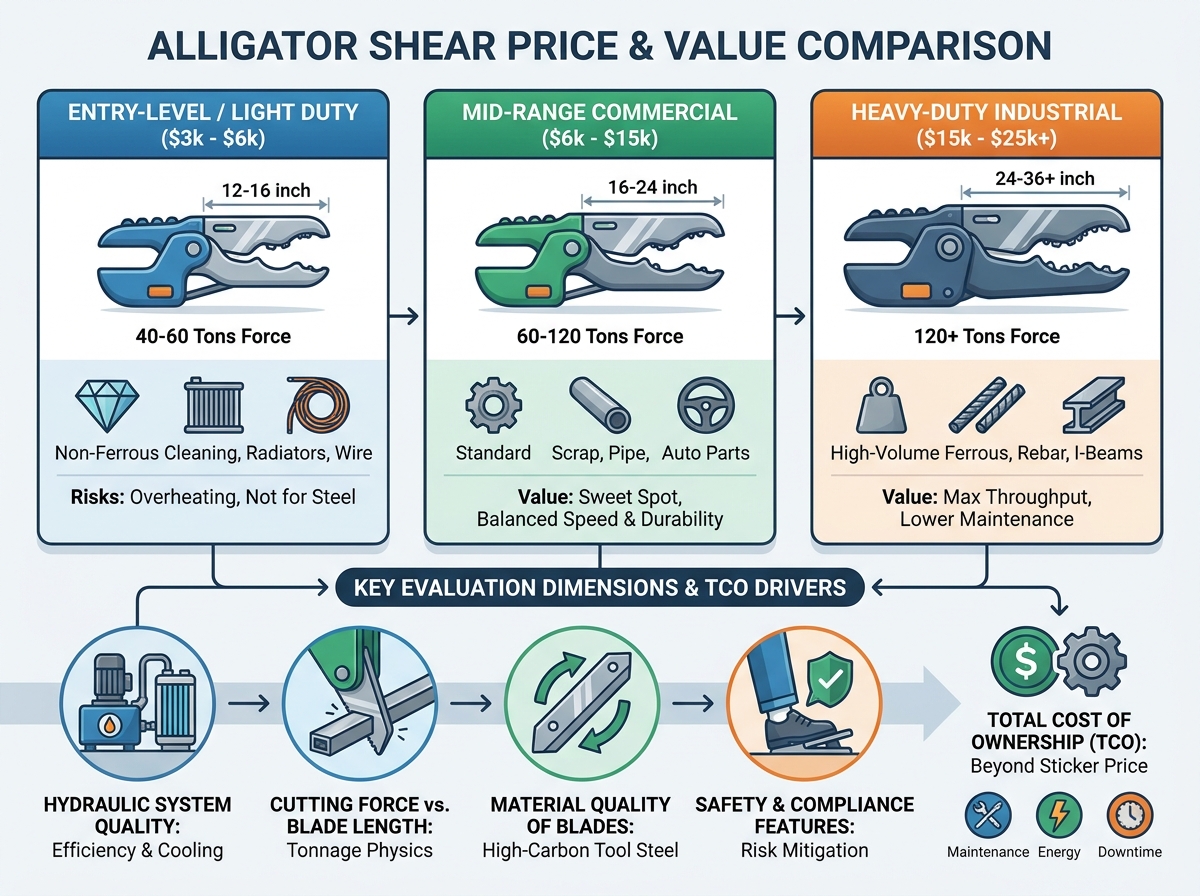
Understanding market pricing requires looking closely at capability tiers. Manufacturers categorize their equipment based on physical size, required power infrastructure, and maximum cutting force. We break down the three primary categories below to help you identify where your business requirements fit.
Entry-level models serve a very specific purpose in the recycling ecosystem. They typically feature 12-inch to 16-inch blades. Cutting force hovers around 40 to 60 tons. Many offer single-phase power options, which makes them incredibly easy to plug in and operate without calling an electrician. These machines work best in small recycling operations or auto salvage yards. They excel at non-ferrous cleaning tasks. You can easily process radiators, light aluminum extrusions, and copper wire. However, buyers face distinct risks. You cannot use them for structural steel or thick bar stock. They also remain highly prone to overheating under sustained, heavy loads. Pushing an entry-level unit past its intended capacity usually results in blown seals or a burned-out motor.
Mid-range units represent the reliable industry standard. They carry 16-inch to 24-inch blades. Their cutting force increases significantly, usually ranging between 60 and 120 tons. You will typically need a dedicated three-phase power supply to run these heavier motors efficiently. Standard scrap yards rely heavily on this tier. Operators use them to process varied materials daily. This includes steel pipe, automotive parts, heavy cables, and medium-gauge structural metals. The mid-range category offers a strong value proposition. It forms the sweet spot for most businesses. You get an excellent balance of rapid cycle speed and long-term mechanical durability, ensuring consistent daily output.
Industrial operations demand maximum power and unyielding reliability. Heavy-duty models feature massive 24-inch to 36-inch blades. Some custom units stretch even larger for specialized applications. Cutting force easily exceeds 120 tons. They include advanced hydraulic cooling systems and heavy mechanical hold-down mechanisms to stabilize large metal chunks. You need this equipment for high-volume ferrous processing. It easily slices through heavy rebar, structural I-beams, and thick steel plate. The value proposition here centers entirely on maximum throughput. They guarantee incredible longevity. You experience much lower maintenance frequencies, even when operating under harsh environmental conditions or continuous three-shift schedules.
Alligator Shear Capability Comparison by Price Tier
Category | Estimated Price Range | Blade Length | Cutting Force | Primary Material Applications |
|---|---|---|---|---|
Entry-Level | $3,000 – $6,000 | 12" – 16" | 40 – 60 Tons | Radiators, light aluminum, copper wire |
Mid-Range | $6,000 – $15,000 | 16" – 24" | 60 – 120 Tons | Steel pipe, car parts, heavy cables |
Heavy-Duty | $15,000 – $25,000+ | 24" – 36"+ | 120+ Tons | Heavy rebar, I-beams, ferrous scrap |
Several technical components dictate the final cost of your equipment. Recognizing these internal factors helps you evaluate supplier quotes accurately, ensuring you compare comparable machinery.
The hydraulic system acts as the beating heart of your Alligator Shear. Generic hydraulic cylinders often lower the initial price tag, making a machine look like a steal. However, they struggle immensely during intense production shifts. Premium systems utilize integrated oil coolers. They also feature high-efficiency, variable-displacement pumps. These advanced setups maintain consistent pressure cut after cut. They prevent the fluid from degrading due to excessive heat buildup, which protects the entire system from premature wear.
Understanding cutting physics is vital before purchasing. Longer blades require exponentially more tonnage. You need this immense force to maintain cutting efficiency all the way at the blade tip. A 24-inch blade needs vastly more pressure than a 12-inch blade to cut the exact same piece of metal. Upgrading blade length means the manufacturer must upgrade the entire hydraulic infrastructure to match. This physical reality directly increases manufacturing costs, explaining why large-blade machines cost substantially more.
Blade construction impacts your daily operational expenses directly. Standard carbon steel blades cost less upfront. Unfortunately, they dull rapidly when processing hard metals like steel or iron. High-carbon, high-chrome reversible tool steel blades represent a premium upgrade. They cost more initially. Yet, they retain their sharp edge much longer under heavy abuse. Their reversible nature gives you multiple fresh cutting edges per blade, drastically reducing your annual replacement budget.
Protecting your workforce remains non-negotiable in any industrial setting. Modern safety features naturally add to the manufacturing cost. Mechanical hold-downs prevent material from violently kicking back at the operator during a cut. Robust safety guards keep hands far away from the active cutting zone, complying with strict OSHA standards. Shielded foot pedals prevent accidental activation from dropped debris. These additions might raise the sticker price. However, they successfully mitigate massive liability risks and reduce the likelihood of devastating workers' compensation claims.
Your procurement budget must extend beyond the machine itself. Facility preparation and ongoing maintenance require careful financial planning to prevent negative surprises.
Stepping up to a mid-range or heavy-duty model brings specific power challenges. These powerful machines typically require a dedicated 3-phase, 480V power supply. Many smaller facilities or rural scrap yards only have single-phase electricity installed. Upgrading your electrical panel requires hiring licensed commercial contractors. You might also need to run new heavy-gauge wiring across your yard. You must factor these installation fees into your total budget before finalizing any machinery purchase.
Heavy equipment requires consistent upkeep to function properly over time. You must factor in the recurring costs of consumables. Your facility needs a steady supply of premium hydraulic fluid to top off the tank. You must purchase replacement filters regularly to keep contaminants out of the pump. Blade regrinding and replacement schedules also draw heavily from your annual maintenance budget. Ignoring these recurring expenses often leads to catastrophic machine failure and massive repair bills.
Buying unbranded, heavily discounted imported equipment carries severe operational risks. These machines often lack any domestic parts availability. If a simple hydraulic seal fails, you cannot buy a replacement at your local parts store. You might wait several weeks for international shipping just to get a proprietary O-ring. This scenario leads to extended downtime. Your production halts completely while waiting for minor components. Always weigh the low purchase price against the looming threat of operational paralysis.
Selecting the perfect model requires a highly structured approach. Follow this logical sequence to match equipment capabilities directly to your operational needs.
Audit Your Material Stream: Take a close look at your daily scrap intake. Determine the maximum thickness of your toughest material. Assess its tensile strength and overall daily volume. Cutting soft copper wire requires vastly different specs than processing thick iron pipe. This data dictates your absolute minimum tonnage requirements.
Calculate Required Cycle Time: Speed directly impacts your profitability. Assess how many cuts per minute your operators need to stay productive. Faster cycle times generally require higher-priced, high-flow hydraulic systems. Calculate if the increased processing speed justifies paying the premium price.
Evaluate Vendor Support: Never buy from a supplier lacking local infrastructure. Prioritize manufacturers or distributors who guarantee domestic stock. They must supply replacement blades quickly. They should also inventory seal kits, electrical relays, and hydraulic components in regional warehouses.
Request a Demo or Material Test: Spec sheets only tell half the story. Never buy based solely on printed marketing brochures. Send samples of your toughest scrap directly to the manufacturer. Request a video-recorded test cut. This proves unequivocally that the machine handles your specific materials easily.
Making a smart purchasing decision requires looking far past the initial price tag. Your decision-making framework must prioritize daily throughput. You must also weigh safety compliance and guaranteed parts availability. An inexpensive machine loses its appeal quickly if it constantly breaks down and stalls your production line.
Focus your budget on hydraulic reliability and heavy-duty blade materials.
Ensure your facility meets the strict electrical requirements before signing purchase orders.
Verify that your chosen vendor maintains domestic replacement parts for rapid shipping.
Always validate cutting capabilities through physical material testing before committing funds.
We strongly recommend mapping your specific material stream to the appropriate tonnage tier first. Understand your daily processing volume and the exact hardness of your scrap. Calculate your long-term operational expenses carefully, factoring in blade replacements and downtime risks. Once you establish these clear metrics, you can confidently request formal quotes from vetted industry suppliers and secure the best value for your business.
A: Blade lifespan depends entirely on the material you cut. Processing clean copper yields longer life than cutting dirty steel. You should look for four-way reversible blades. These allow you to rotate the edge when one side dulls. In standard daily use, expect three to six months of performance per edge before needing replacement or regrinding.
A: Buying used equipment carries significant mechanical risks. You might inherit degraded hydraulic cylinders. Fatigued jaw pins often plague older machines, causing inaccurate cuts. These hidden defects lead to expensive repairs. We recommend purchasing used machinery only if it comes factory-refurbished. Ensure a certified technician fully inspects the unit before delivery.
A: Consistent maintenance prevents unexpected breakdowns. You must perform daily greasing of all primary pivot points. Operators should conduct weekly hydraulic fluid checks to ensure proper levels and watch for contamination. You also need to perform regular blade gap adjustments. Maintaining the correct gap prevents material from folding between the blades, which damages the machine.
A: Yes, you can cut these hardened materials. However, they demand specific equipment specifications. Stainless steel and heavy rebar require much higher tonnage. You also need specialized blade hardness ratings. Cutting these metals with an under-specced machine often results in catastrophic jaw failure. Always verify capacity with the manufacturer first.


