


Views: 0 Author: Site Editor Publish Time: 2026-11-07 Origin: Site


Scrap yards and foundries face a constant operational challenge every day. Handling, transporting, and processing oversized or entangled scrap metal drives up your overhead costs significantly. Facilities need efficient ways to size-reduce bulky metal stock. Enter the Alligator Shear. Many industry professionals also call it a crocodile shear. This hinged, hydraulically powered cutting machine tackles long and unwieldy materials with exceptional force. It easily slices through structural steel, pipes, and various non-ferrous metals.
We designed this guide to move your team beyond basic machinery definitions. You will gain a concrete framework for evaluating, comparing, and procuring the right machine. Our goal is to help you maximize your operational profitability. Properly sizing your scrap transforms transportation logistics entirely. Denser scrap loads directly translate to cheaper freight and higher profit margins per truckload. You will learn exactly how to match machine specifications to your daily material throughput.
Alligator shears provide targeted, high-force cutting for non-ferrous metals, rebar, and foundry castings, significantly reducing scrap transport costs.
Selecting the right equipment requires aligning blade length and hydraulic cutting force (tonnage) with your specific material thickness and volume.
While highly versatile for targeted cuts, high-volume operations may need to weigh alligator shears against larger guillotine or hydraulic baler-shear solutions.
Understanding the mechanical operation of these machines helps you appreciate their industrial value. The system relies on a heavy-duty hydraulic lever-action design. A powerful hydraulic cylinder drives a pivoting upper jaw downwards. This upper jaw acts against a rigid, stationary lower bed. This simple pivoting motion creates highly concentrated shear force near the fulcrum. The mechanical advantage allows the machine to slice through thick metals smoothly.
Many yards rely heavily on manual cutting techniques. Operators frequently use acetylene torches and abrasive saws to reduce large metal pieces. These legacy methods introduce serious business bottlenecks. Manual cutting is notoriously slow. It also exposes workers to sparks, fumes, and severe injury risks. Furthermore, manual reduction demands intense labor hours. This labor-intensive approach makes profitable scrap processing nearly impossible at scale.
You should frame a successful implementation around three specific operational metrics. First, look for significantly increased tons-per-hour processed. The machine must outpace manual labor exponentially. Second, expect radically reduced manual labor hours. One operator feeding the machine replaces multiple workers wielding torches. Finally, you must achieve denser scrap loads. Compact, uniform metal pieces stack tightly in shipping containers. This density ensures you ship metal, not empty air.
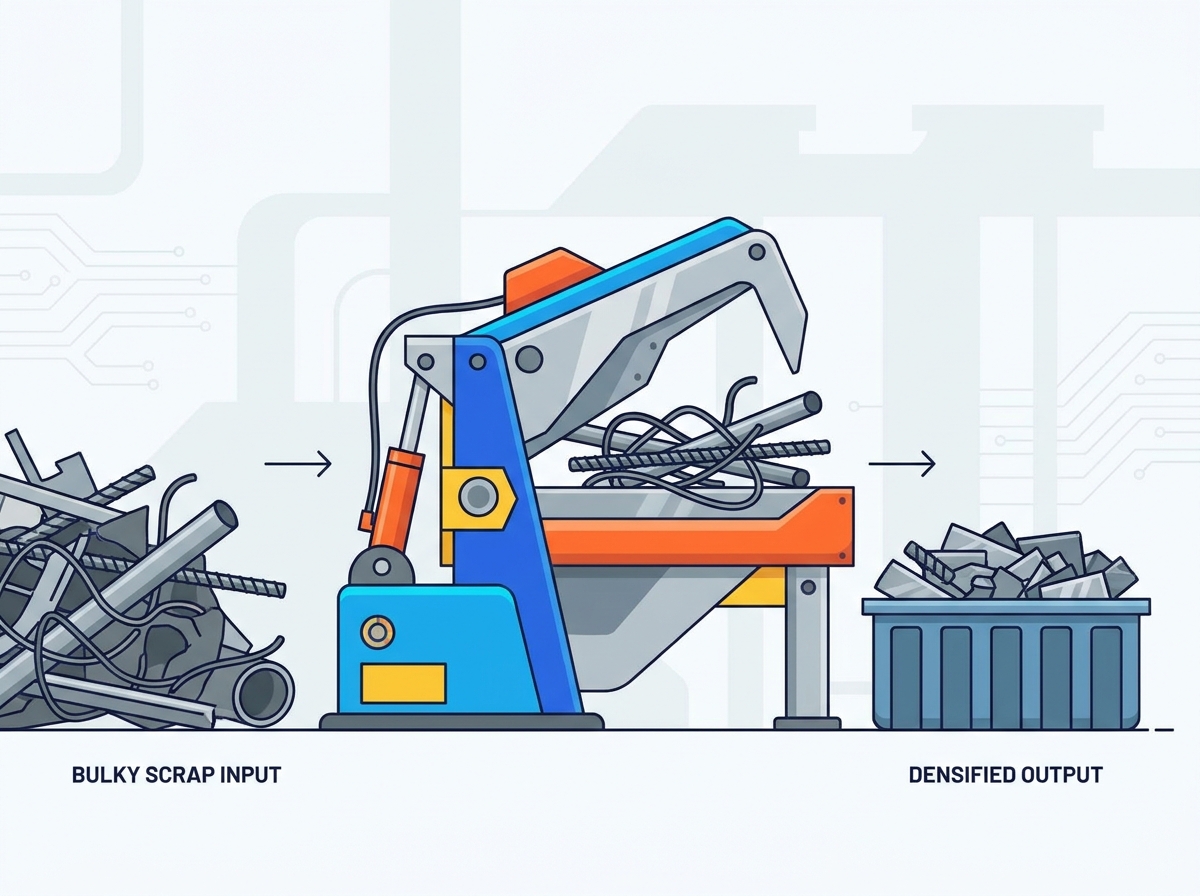
Different industrial sectors utilize these machines to solve unique material handling challenges. Their versatility makes them indispensable across various processing environments. We can categorize their primary applications into three main industrial sectors.
Scrap yards represent the most common environment for this machinery. Operators use them extensively for cleaning and separating mixed scrap materials. A typical use case involves separating distinct metal types to maximize recycling value.
Material Separation: Operators easily shear away steel bolts from valuable aluminum profiles. This purification step ensures higher market prices for the sorted aluminum.
Dimensional Sizing: Workers size down extrusions, metal pipes, and thick rebar. The machine quickly reduces long stock into furnace-ready dimensions.
Profile Processing: Yards process awkward aluminum window frames and structural beams into manageable chunks.
Foundries deal with a unique set of metallurgical challenges. Fresh castings emerge from molds with excess metal attached. Operators must remove these gates, runners, and risers efficiently. Torch cutting induces severe thermal stress into the metal. This heat can warp or damage the final cast product. Shearing provides a cold-cutting alternative. The machine snaps off the excess metal cleanly. It leaves the primary casting completely unaffected by heat zones.
Niche recyclers rely on targeted shearing power to extract high-value components. These facilities process complex, multi-material items. The precision of the Alligator Shear allows operators to dissect valuable parts carefully.
Catalytic Converters: Slicing open steel shells to access valuable precious metals inside.
Radiators: Trimming steel ends off aluminum and copper heat exchangers.
Copper Cables: Cutting heavy-duty industrial cables into short sections for easier wire stripping.
Facility managers often debate between purchasing a pivoting shear or investing in a large guillotine shear. Both machines cut metal, but they serve entirely different operational scales. You must evaluate them based on your facility's spatial constraints and production targets.
Space limitations frequently dictate equipment choices in busy yards. Alligator models offer a distinctly smaller footprint. They consume minimal floor space compared to stationary guillotine setups. Furthermore, many models feature forklift pockets. This occasional mobility allows you to move the machine directly to the scrap pile. Conversely, guillotine shears require massive permanent concrete foundations. You must bring the scrap to the guillotine, increasing internal yard traffic.
Consider the nature of your daily processing tasks. A pivoting shear delivers single-operator, targeted precision. The operator holds the material and places the exact cut line under the blade. This control works perfectly for cleaning mixed metals. A guillotine shear operates differently. It relies on bulk, automated feeding systems. Loaders dump tons of mixed metal into a hopper, and the guillotine chops it blindly. Guillotines win on pure volume, but they fail at precision sorting.
Equipment budgets play a crucial role in procurement decisions. The pivoting shear serves as an excellent, lower-barrier entry point. Mid-sized operations can significantly boost capacity without draining capital reserves. For massive recycling centers, these smaller machines serve as vital supplementary stations. While the guillotine handles bulk reduction, operators use the smaller shears for specialized, high-value metal cleaning.
You must recognize the volume threshold indicating an upgrade requirement. If your operators run the shear continuously for eight hours but still face massive backlogs, you have outgrown the machine. When your yard transitions from processing hundreds of pounds per day to several tons per hour, automated hydraulic guillotine shears become necessary.
Use the chart below to contrast the core differences between these two machine categories.
Feature Category | Pivoting Shear | Guillotine Shear |
|---|---|---|
Operation Style | Manual feed, precise targeting | Automated bulk hopper feed |
Space Requirement | Compact, often movable | Massive, permanent installation |
Primary Use Case | Non-ferrous sorting, cleaning pieces | Bulk ferrous reduction, high volume |
Initial Investment | Low to Moderate | Extremely High |
Procuring the right machine requires strict attention to technical specifications. You cannot guess the required capacity. You must align the machine's engineering with your exact material profile. Evaluate the following technical parameters carefully before contacting manufacturers.
Tonnage represents the raw hydraulic cutting force generated at the jaw. You must match the machine’s tonnage to your toughest materials. Consider the maximum tensile strength and the thickest diameter of your target scrap. A 40-ton machine easily snaps thin aluminum extrusions and light copper pipes. However, if you process heavy steel rebar or thick foundry runners, you need significantly more power. Cutting 2-inch solid steel bar typically requires machines rated above 120 tons. Under-sizing the tonnage leads to stalled blades and frequent hydraulic relief valve triggering.
The blade length dictates the physical size of the material you can process per stroke. Longer blades allow operators to cut wide sheets or bundle multiple thin pipes together. However, remember the physics of a lever. The cutting force is strongest near the hinge and weakest at the tip. Do not buy a long blade assuming you can cut thick steel at the very end of the jaw. The jaw opening (gape) determines how bulky an item you can insert. We strongly warn against under-sizing the jaw opening. If the jaw cannot open wide enough to accept irregular castings, the machine becomes useless for your operation.
Electrical infrastructure dictates your power supply choices. Evaluate your facility's current electrical capabilities. Small, single-phase motors suit light-duty shops processing thin metals sporadically. However, commercial scrap yards require robust power. Three-phase industrial motors provide the continuous, high-cycle operation needed for daily production. Three-phase systems run cooler and offer better energy efficiency during heavy use. Some manufacturers also offer diesel-driven models for remote yards lacking reliable grid power.
When the heavy upper jaw bites into thick metal, the material naturally tries to tip or violently kick upward. This kickback poses a severe danger to the operator. Therefore, material retention devices are absolutely essential. Discuss the necessity of automatic or mechanical hold-down clamps with your vendor. A mechanical hold-down is a heavy, adjustable bar bridging the lower bed. An automatic hydraulic hold-down engages the material milliseconds before the main blade makes contact. These devices prevent dangerous material kickback and ensure perfectly clean, square cuts.
Integrating heavy hydraulic machinery into your workflow requires strict operational discipline. You must prioritize proactive maintenance and uncompromising safety standards. Ignoring these realities leads to machine downtime and severe workplace hazards.
Consumable components require regular attention to maintain cutting efficiency. The heavy steel blades endure massive friction and impact stress. Highlight to your maintenance team that high-quality shears use 4-edge reversible blades. When one edge dulls, you do not throw the blade away. Operators simply unbolt it, rotate it to a fresh edge, and reinstall it. This design extends consumable life fourfold. Furthermore, you must maintain precise blade gap adjustments. If the gap between the upper and lower blades becomes too wide, thin metals will fold and jam rather than cut cleanly. Regular gap calibration is critical.
Never compromise on machinery safety features. These machines generate enough force to sever solid steel instantly; human limbs offer no resistance. Outline critical safety features during your procurement phase. The machine must include heavy-duty metal guards over all moving hydraulic parts. Emergency stop (E-stop) buttons must be immediately accessible. Furthermore, demand shielded foot-pedal controls. A sturdy metal hood over the pedal prevents accidental activation if someone drops heavy scrap onto it. Emphasize strict alignment with CE or OSHA safety standards in your region.
Processing unpredictable scrap streams carries inherent risks. Address the dangers of processing undocumented or hidden scrap. Operators occasionally encounter ultra-hardened steel components, like tool steel or specialized alloys. Attempting to cut these materials can fracture the shear blades violently. Worse, operators might accidentally feed closed cylinders (like small gas shocks or sealed pipes) into the jaws. Compressing sealed cylinders can cause dangerous explosive ruptures. You must train operators strictly. They need to identify un-cuttable alloys and safely vent any tubular structures before shearing to prevent machine damage and injuries.
Integrating a Alligator Shear into a recycling or foundry workflow provides immediate strategic value. You drastically improve processing efficiency, enhance worker safety over manual torching, and exponentially increase the density of your scrap loads. This machinery transforms unwieldy metal chaos into neatly packaged, high-value commodities ready for the furnace.
We recommend a specific shortlisting action for your next steps. Begin by carefully calculating your required daily throughput in tons. Document the maximum thickness and hardness of your toughest materials. Finally, gather physical sample materials from your yard. Provide these specific samples to equipment manufacturers for live testing before you finalize any purchase. This verification step guarantees the machine will handle your real-world processing demands.
A: Cutting capacity depends entirely on the machine's hydraulic tonnage and the material's structural grade. Small 40-ton models can cut 1-inch mild steel round bars easily. Heavy-duty industrial models generating over 120 tons can cleanly slice through 4-inch solid mild steel round bar. Always verify capacity with the manufacturer.
A: Replacement frequency relies on your daily duty cycles and the material hardness. Processing abrasive metals wears edges faster. However, most modern machines feature rotating multi-edge blades. You can rotate the blade to a fresh edge three times before requiring a total replacement, greatly extending operational lifespan.
A: Processing hardened steel pushes equipment limitations and risks violent jaw fracturing. Standard blades handle mild steel and non-ferrous metals. If you frequently process stainless steel or high-tensile alloys, you must request specialized, hardened blades and purchase a machine with significantly larger tonnage.
A: Operators must wear robust PPE, including steel-toed boots, heavy leather gloves, and impact-rated face shields. Proper feeding techniques require keeping hands far from the bite zone while using hold-downs to prevent material kickback. The machinery itself must feature functional safety guards and shielded foot pedals.


