


Views: 0 Author: Site Editor Publish Time: 2026-11-16 Origin: Site


For high-volume recycling operations and scrap yards, the choice between processing methods directly dictates downstream profitability and potential operational bottlenecks. Upgrading your heavy machinery requires choosing between cutting and compacting (shearing) or strictly compacting (baling). This vital decision impacts your transportation density, mill acceptance rates, and overall operational efficiency. Every scrap yard must closely align its output with the specific receiving criteria of local foundries and steel mills. Unmet density or size requirements often lead to rejected loads or severe price downgrades. This guide provides an evidence-based framework for evaluating a Scrap Metal Baler Shear against traditional horizontal and vertical balers. You will discover exactly how to evaluate material suitability, plan for proper facility integration, and maximize mill acceptance value. We will also explore the critical implementation risks you must avoid when scaling your yard.
Process Difference: Traditional balers strictly compress materials into manageable blocks, whereas baler shears compress and then cut heavy, oversized scrap to exact steel mill specifications.
Material Match: Baler shears are mandatory for heavy ferrous metals, structural steel, and End-of-Life Vehicles (ELVs). Traditional balers are optimal for non-ferrous metals, light aluminum, and thin gauge steel.
Cost Dynamics: While a scrap metal baler shear requires a higher initial capital expenditure (CapEx) and foundation preparation, it yields a faster ROI for high-tonnage yards through increased material value and reduced transport costs.
Evaluation Focus: Buyers must prioritize hydraulic system reliability, hourly throughput (tons per hour), and localized maintenance support over baseline sticker price.
Scrap yards face a demanding business environment today. You must align your facility output perfectly. Local foundries and steel mills enforce strict receiving criteria. They reject loads if you miss density requirements. They also issue severe price downgrades for oversized materials. Unmet size requirements destroy your profit margins quickly. You must choose the right processing logic to protect your operations.
We highly recommend the shearing route for aggressive size reduction. This method combines cutting power and high-density packing. It transforms mixed, bulky, or rigid metals into uniform pieces. The industry calls this heavy-melting scrap (HMS). You need this capability when handling oversized structural steel. A heavy-duty shear processes these rigid materials efficiently.
Alternatively, the baling route focuses purely on volume reduction. It optimizes your material for straightforward logistics. This method works best when your input material remains thin. If your metal already meets acceptable thickness limits, baling makes sense. You simply densify the material for transport. The machine does not cut the metal at all. It merely crushes the material into a tight, secure block.
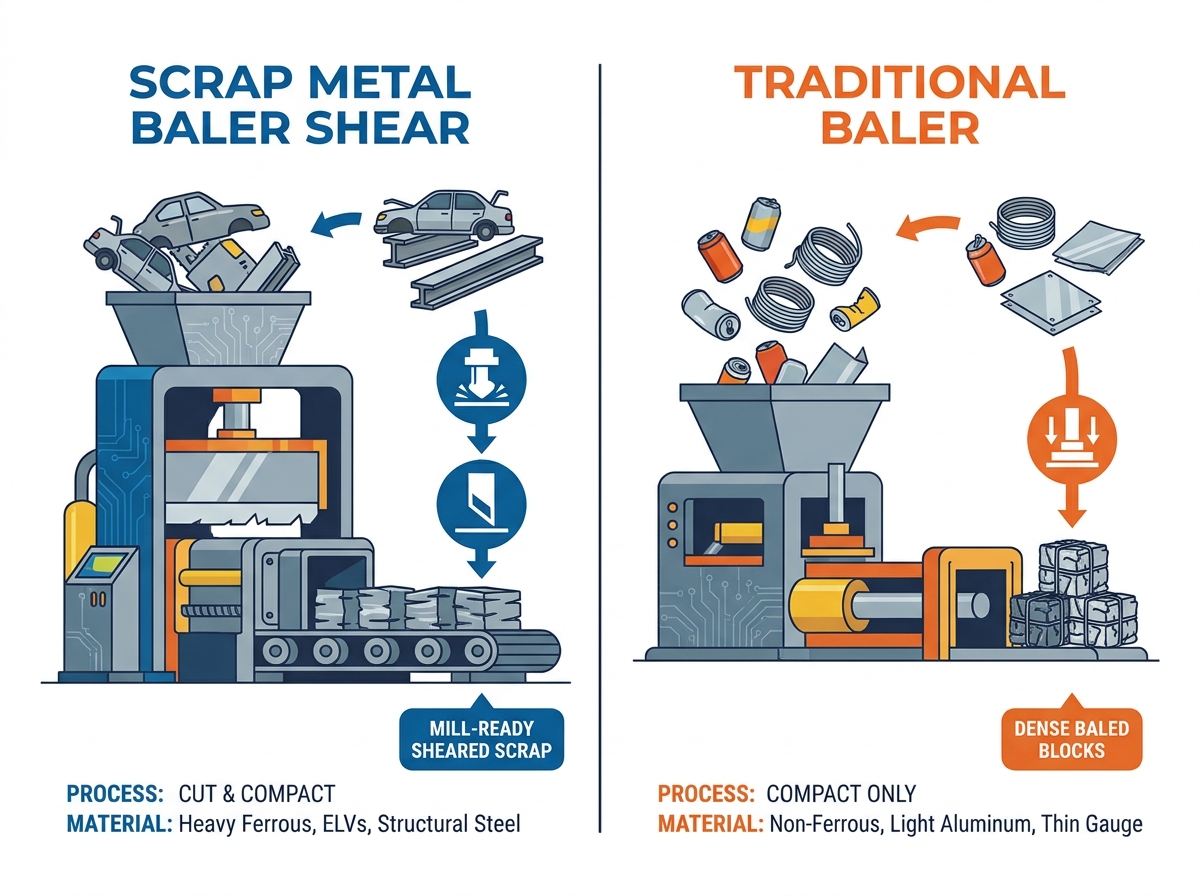
These heavy-duty machines represent massive engineering achievements. They feature a robust pre-compression box. They also utilize a massive guillotine-style shear head. This combination makes them unstoppable in a busy yard. The pre-compression box folds and crushes bulky material first. Then, the shear head slices the compressed log into exact lengths.
You must evaluate specific performance metrics before buying. First, look at the sheer cutting force. We measure this metric in tons. Most industrial units range from 500 to over 1000 tons of force. Second, analyze the blade cycle times carefully. Faster cycle times directly increase your hourly throughput. You need to know exactly how many tons per hour the machine handles.
These machines excel in high-volume processing environments. Consider these ideal use cases:
Automotive recycling operations rely on them heavily. Processing End-of-Life Vehicles (ELVs) requires immense crushing and cutting power.
Demolition scrap yards use them daily. They slice through heavy rebar and thick plates easily.
Facilities handling structural I-beams require this exact machinery to meet mill standards.
Yards processing heavy pipe cannot operate efficiently without a reliable shearing system.
However, you must consider the inherent limitations. These units demand a massive initial capital investment. You also need significant specialized foundation work. The intense vibrations require deep, engineered concrete pads. Furthermore, you must maintain rigorous blade maintenance schedules. Dull blades ruin efficiency and damage the hydraulic system. If you run a high-volume yard, a Scrap Metal Baler Shear remains essential despite these demands.
Sometimes you only need straightforward compaction. Traditional balers provide this exact functionality perfectly. These hydraulic presses crush lightweight metals efficiently. They form dense, tie-secured, or friction-locked cubes. You can stack these cubes easily for transport.
Horizontal balers handle continuous, mid-to-high volume processing. They suit operations processing light gauge metals daily. Many facilities use them for aluminum cans (UBC). They also work beautifully for copper wire and thin siding. A conveyor belt usually feeds material into the hopper continuously. The ram compresses the material automatically. You achieve excellent throughput without immense cutting force.
Vertical balers serve a completely different purpose. They fit perfectly into low-volume, space-constrained environments. Small recycling drop-off centers love them. Retailers and light manufacturing plants use them constantly. However, they require highly manual operation. An operator must load the chamber by hand. They must also tie off the bale manually.
You should choose traditional equipment under specific conditions. If your facility processes primarily non-ferrous metals, choose standard balers. If you handle light manufacturing offcuts exclusively, avoid shearing equipment. Cutting forces prove entirely unnecessary for thin, pliable metals. You save significant capital by avoiding over-engineered machinery.
You must compare these systems across three crucial operational dimensions. Throughput scaling dictates your daily revenue limits. Your available site footprint determines installation feasibility. Finally, mill acceptance standards dictate your top-line revenue.
Baler shears provide massive throughput and scalability. They are capable of processing 10 to 50+ tons per hour. Manufacturers build them for aggressive scaling. Traditional balers typically max out at much lower tonnages. Their processing speed depends heavily on hopper feeding limits. You cannot push rigid steel through a standard horizontal baler.
Site infrastructure plays a massive role in your decision. You must compare the massive footprint of stationary shears against smaller options. Shears require engineered concrete foundations. These foundations absorb extreme vibrations and support massive operational weights. Conversely, horizontal balers offer a relatively plug-and-play nature. Many smaller horizontal units arrive skid-mounted. You can place them on standard warehouse flooring.
Output value remains the most critical comparison point. Sheared heavy scrap often commands a premium per ton at the mill. Steel mills prefer dense, uniformly cut pieces. They melt faster and increase furnace efficiency. Light baled scrap does not command this premium. Baled sheet metal serves a different metallurgical purpose downstream.
We present a clear comparison chart below to simplify your decision-making process.
Feature Matrix |
Baler Shears |
Traditional Balers |
|---|---|---|
Throughput Capacity |
10 to 50+ tons per hour |
Lower volume, hopper dependent |
Site Footprint |
Massive, requires concrete pad |
Smaller, often skid-mounted |
Primary Material |
Structural steel, ELVs, heavy pipe |
Non-ferrous, light gauge metal, UBC |
Processing Method |
Pre-compress and guillotine cut |
Pure hydraulic compaction |
Output Value |
Premium mill pricing for HMS |
Standard market pricing |
Purchasing heavy recycling machinery carries significant operational risk. Scrap yards often make expensive errors during the procurement phase. You must navigate these pitfalls carefully to protect your facility.
Many operators severely under-specify their equipment. They buy a machine based entirely on current capacity. They fail to forecast three to five years of business growth. A Scrap Metal Baler Shear represents a decade-long investment. You must buy a unit capable of handling tomorrow's tonnage. Upgrading a foundational machine too early destroys capital efficiency.
Hydraulic component quality represents another massive risk. You face severe danger if you opt for unbranded hydraulic valves and pumps. Unbranded components fail quickly under extreme pressure. We emphasize the necessity of standard, locally accessible components. Brands like Rexroth or Parker ensure reliability. Standard parts prevent catastrophic downtime. You can source replacement seals and valves locally within hours.
You must also never ignore your local climate and environment. High-volume processing generates intense friction and heat. Extreme cold weather thickens hydraulic fluid dangerously. You must specify oil heaters if you operate in freezing climates. High heat environments require robust cooling systems. Overheated oil damages pump seals permanently.
Thorough vendor vetting remains non-negotiable. You must evaluate manufacturer warranties rigorously. Confirm exact parts availability before signing any contract. Request verifiable case studies detailing similar operating environments. A reputable manufacturer will gladly connect you with existing customers.
Forecast your facility volume for the next five years.
Demand a complete breakdown of hydraulic component brands.
Inspect local vendor support and service response times.
Ignoring the climate requirements for hydraulic cooling or heating.
Buying unbranded hydraulics to save money upfront.
Failing to pour a properly engineered concrete foundation.
Your choice of processing equipment directly shapes your yard's future. The decision is ultimately dictated by your primary material type and downstream buyer requirements. Heavy structural steel demands immense cutting power. Light aluminum cans require simple compression.
Operations dealing in heavy structural steel and auto bodies must invest in a heavy-duty shear to remain competitive. You cannot process these materials efficiently otherwise. Conversely, facilities handling exclusively light or non-ferrous materials should maximize capital efficiency. A standard horizontal baler serves this exact purpose perfectly.
We advise you to take immediate action. Conduct a thorough site audit this week. Calculate your average daily tonnage by exact material grade. Document the physical space available in your yard. Finally, request detailed performance projections from shortlisted equipment manufacturers. Proper planning ensures you deploy the right machinery for long-term success.
A: These heavy-duty machines typically last 10 to 15 years or more. You must adhere strictly to maintenance schedules to achieve this lifespan. Regular wear-liner replacements and routine hydraulic fluid changes are absolutely mandatory. Neglecting daily blade inspections will shorten the machine's life significantly.
A: Yes, it can process non-ferrous metals easily. However, using this massive machine for aluminum is often overkill. It proves much less capital-efficient than using a dedicated horizontal baler. You waste massive amounts of hydraulic energy cutting soft materials.
A: You must pour a heavily engineered concrete pad. This foundation absorbs extreme vibrations during the cutting cycle. It also supports the massive operational weight of the machine safely. Standard warehouse flooring will crack and fail immediately under these heavy stresses.
A: Container shears focus entirely on continuous cutting. They lack the pre-compression baling box functionality. Manufacturers design them specifically for high portability and lower initial costs. A baler shear compresses bulky material first, offering much denser final output for mills.


