


Views: 0 Author: Site Editor Publish Time: 2026-11-18 Origin: Site


Heavy-duty metal fabrication and scrap processing demand serious capital investments. Equipment failures quickly derail operations. Mismatched machinery often cripples daily production schedules. Operational leaders face a constant challenge today. You must balance continuous throughput demands against rigid facility footprints. Selecting the wrong cutting equipment often leads to severe operational bottlenecks. We built this guide to solve this exact problem. This article delivers an evidence-based, vendor-neutral evaluation framework. We compare various equipment configurations and automation levels. You will learn how to contrast these machines against alternative shear types. By the end, you will confidently identify the exact model your facility needs.
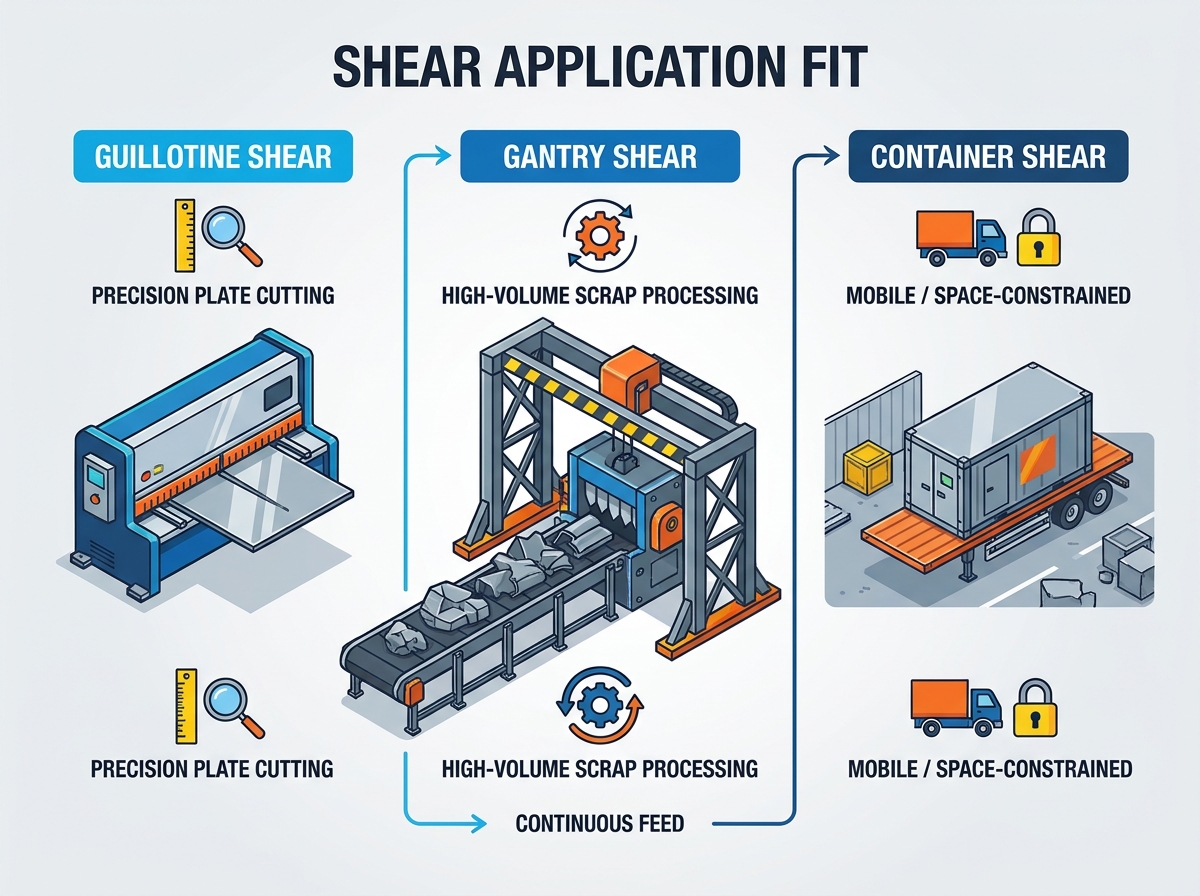
Application fit dictates the model: Gantry shears excel in high-volume, continuous heavy scrap and structural steel processing, unlike guillotine shears which prioritize precision plate cutting.
Automation impacts Total Cost of Ownership (TCO): CNC models reduce labor dependency and increase yield consistency, but require higher initial capital and specialized maintenance compared to manual models.
Infrastructure is a hidden cost: True ROI calculations must account for the required feed systems (conveyors), foundation reinforcement, and heavy power draw.
Capacity vs. Reality: Over-speccing tonnage wastes capital; under-speccing creates severe operational bottlenecks and premature wear.
Every equipment investment begins with assessing the specific materials you process daily. Facility managers often struggle to align machinery capabilities with their actual scrap streams. We must define the ideal use case before comparing specific models. A Gantry Shear serves a very specific industrial purpose. It acts as the primary volume reduction tool for bulky, mixed, or oversized structural scrap.
These massive machines handle heavy I-beams, tangled rebar, and thick steel plate offcuts. They thrive in environments demanding continuous feeding. Operators load materials continuously onto integrated conveyors. The machine automatically advances, compresses, and shears the metal into manageable lengths. You choose this equipment when your primary goal is maximizing tons processed per hour. Precision takes a back seat to sheer brute force.
Many fabricators confuse these two distinct machine types. They serve entirely different operational goals.
Hydraulic Guillotine Shears: These machines deliver straight, precise cuts. You use them primarily on sheet metal or specific plate fabrication tasks. They require exact material alignment. Guillotines produce clean edges ready for welding or assembly.
Gantry Shears: These units are built for brute force. They handle mixed batches of irregular scrap. You do not worry about clean edges or exact dimensional tolerances. They focus entirely on high-capacity volume reduction.
Scrap yards often debate between stationary and mobile processing solutions. Both machines reduce scrap volume, but their deployment strategies differ drastically.
Container Shears: These units are fully enclosed and highly mobile. You do not need a dedicated feeding mechanism. Operators simply drop scrap into the box. They are ideal for varied site locations. Space-constrained scrap yards prefer them due to their compact footprints.
Gantry Models: These are massive, stationary installations. They require dedicated feeding mechanisms like conveyors or heavy-duty hoppers. However, they offer vastly superior continuous volume processing. Large-scale operations rely on them to process hundreds of tons daily without interruption.
Once you confirm the machine type, you must evaluate control systems. The automation level directly dictates your daily processing rhythm. It also determines your reliance on skilled labor.
Manual systems remain popular in emerging markets and smaller regional yards. They offer straightforward mechanical operation. Operators manually control the feeding, clamping, and shearing cycles via hydraulic levers or simple button arrays.
Pros:
They require significantly lower upfront capital.
Hydraulic troubleshooting remains simpler. Maintenance teams usually understand manual valves easily.
They present a viable option for lower-volume operations.
Cons:
Production rates depend highly on operator skill and stamina.
Cycle times vary wildly throughout an eight-hour shift.
Long-term labor costs accumulate quickly. Finding skilled operators remains challenging.
Modern high-capacity facilities lean heavily toward Computer Numerical Control (CNC) configurations. These systems remove human hesitation from the processing cycle. Sensors monitor hydraulic pressure, material position, and blade stroke.
Pros:
They guarantee predictable, consistent cycle times.
The software ensures integrated feed-and-cut synchronization.
You gain precise length control over the processed scrap.
They severely reduce operator fatigue.
Cons:
The initial purchase price is notably higher.
Complex electronics require clean power environments.
Facilities potentially face reliance on OEM software support for troubleshooting.
To calculate the labor-to-throughput tipping point, you must analyze your local labor rates against your required daily tonnage. If manual operator fatigue costs you 15% of your daily yield, an automated upgrade often pays for itself within two years. We recommend using a structured matrix to guide this choice.
Table 1: Automation Comparison Decision Matrix
Operational Factor |
Manual Systems |
CNC Automated Systems |
|---|---|---|
Initial Capital Investment |
Low to Moderate |
High |
Daily Throughput Consistency |
Highly Variable |
Extremely Consistent |
Maintenance Complexity |
Basic Hydraulic Knowledge |
Advanced Diagnostics Required |
Ideal Processing Volume |
Under 50 Tons/Day |
Over 100 Tons/Day |
Operator Skill Requirement |
High (Experience needed) |
Low (Monitoring focused) |
Evaluating heavy equipment requires looking past the marketing brochures. You must scrutinize the mechanical specifications. Small differences in engineering dictate huge variances in daily productivity. Let us break down the most critical evaluation dimensions.
Many buyers fall into the "bigger is always better" trap. They purchase a 1000-ton machine for materials a 500-ton model could easily process. You must match the rated cutting force to your thickest expected materials. Over-speccing wastes precious capital and consumes excess electricity. Under-speccing causes constant hydraulic relief valve tripping. It creates severe operational bottlenecks. Calculate your required tonnage based on the yield strength and cross-sectional area of your toughest daily scrap.
A powerful cutting head means nothing if you cannot feed it efficiently. Address the reality that these machines require robust material handling. Evaluate the compatibility of in-feed conveyors. Look closely at the lateral squeeze functions. A quality lateral squeeze compacts loose, bulky scrap before it reaches the blade. This compaction maximizes the density of each cut. It directly increases your hourly output.
Strokes per minute (SPM) determine your ultimate processing speed. However, manufacturers often list the "empty" cycle time. You must analyze how hydraulic pump configurations impact the SPM under actual load. High-quality systems feature regenerative hydraulic circuits. These circuits speed up the cylinder return stroke. They ensure the blade moves quickly when not actively cutting metal.
Safety and efficiency depend on excellent material control. You must evaluate the effectiveness of the hold-down mechanisms. When the blade slices through thick steel, the material desperately wants to tilt or kick back. Heavy-duty hydraulic clamps must secure the scrap firmly against the bed. Proper clamping prevents dangerous material movement. It also protects the blades from uneven wear and catastrophic chipping.
Buying the machine represents only half the battle. Installing and operating it uncovers hidden realities. Facility managers often overlook crucial infrastructure requirements. You must prepare your site thoroughly before the equipment arrives.
These massive machines generate incredible kinetic energy. You cannot simply bolt them to a standard warehouse floor. We highlight the absolute necessity for reinforced concrete foundations. The concrete must absorb continuous heavy-duty hydraulic shock. Failure to pour a proper, engineered foundation leads to structural cracking. Eventually, the machine will lose alignment, destroying the cutting guides.
Your processing line operates as a single ecosystem. Address the risk of mismatched equipment immediately. A high-capacity machine is only as fast as the loader feeding it. If your material handler takes five minutes to grab and load a pile of scrap, a machine with a one-minute cycle time sits idle. You must synchronize the capacities of your excavators, cranes, and conveyors to match the shear's appetite.
Heavy processing destroys wear parts. You must evaluate the maintenance access before purchasing. Discuss the accessibility of the main blades. Can your technicians rotate or replace them safely within a single shift? Furthermore, investigate the availability of standard hydraulic seals. Proprietary, custom-sized seals trap you into expensive OEM purchases and long shipping delays.
Massive hydraulic pumps demand massive electrical current. You must assess your facility electrical limits. These heavy-duty motors create massive power draws during startup. If your local grid cannot handle the amperage spikes, you will experience constant breaker trips. Upgrading facility transformers adds significant delays and expenses to your installation project.
Navigating the procurement phase requires discipline. Sales representatives will highlight their best features. You must force the conversation back to your operational realities. Build a structured procurement framework to objectively compare vendors.
Do not guess your material mix. You must document the reality of your scrap yard.
Identify the top materials constituting 80% of your daily volume.
Measure the maximum thickness of these frequent materials.
Determine the average daily tonnage you realistically process.
Establish your baseline capacity requirements using this hard data.
Do not focus solely on the initial sticker price. Project your capital and operational expenses over a standard 5 to 7-year life cycle. You must factor in the upfront price first. Then, calculate the expected blade replacement frequency. Add the estimated monthly power consumption based on your local utility rates. Finally, incorporate operator wages. A cheaper manual machine might cost exponentially more in operator wages and lost productivity over five years.
Never take a vendor's word at face value. Demand verifiable case studies from similar large-scale metal fabricators. Call those references. Ask them about equipment reliability during winter months or extreme heat. Prioritize vendors offering local parts availability. Responsive technical support matters far more than bottom-dollar import pricing. A cheap machine waiting three weeks for a replacement hydraulic valve will destroy your quarterly profitability.
Choosing the right heavy-duty cutting equipment dictates your long-term operational success. We recommend a highly strategic approach. You must align your typical material volume, your facility infrastructure, and your labor dynamics with the correct equipment configuration. Carefully evaluate the differences between manual systems and CNC automation.
We encourage buyers to prioritize feed system integration. Do not get distracted by pure tonnage metrics. A well-fed 600-ton machine will out-produce a starving 1000-ton machine every single day. Look closely at your foundation limits and electrical capacity before signing a purchase order. Build a strong relationship with a vendor who provides verifiable local support.
Take action today to streamline your processing capabilities. Schedule a comprehensive site audit with your operations team. Request a detailed operational expense analysis from your short-listed vendors. Finally, download detailed technical spec sheets to compare hydraulic flow rates and blade cycle times objectively.
A: Yes. Unlike container shears, gantry models rely on continuous in-feed conveyors or hoppers to maximize their cutting efficiency. This continuous feeding system allows them to process massive volumes of scrap without stopping, making them ideal for high-capacity industrial yards.
A: Guillotine shears are designed for precise, dimensional cuts on flat steel plates. They prioritize clean edges. Gantry models are built for heavy-duty volume reduction of bulky scrap and structural steel. They prioritize brute force and maximum continuous throughput over dimensional accuracy.
A: Base it on the maximum thickness and tensile strength of the material that makes up the top 20% of your hardest daily processing load. Once you identify that requirement, add a 15-20% safety margin to ensure you do not constantly trigger hydraulic relief valves.
A: Yes, if your operation processes high volumes continuously. In these environments, consistent cycle times and severely reduced labor dependencies quickly offset the higher initial capital expenditure. CNC models also reduce operator fatigue and minimize mechanical wear through precise sensor monitoring.


