


Views: 0 Author: Site Editor Publish Time: 2026-11-17 Origin: Site


Heavy-duty scrap yards face a massive operational bottleneck every single day. Facility managers must constantly balance high-volume throughput alongside processing costs and operator safety. Manual labor simply cannot sustain modern industrial demands. Outdated, undersized machines often fail under heavy workloads, causing crippling downtime.
You need reliable, scalable solutions. The Gantry Shear serves as a baseline requirement for expanding industrial metal recycling capabilities. Upgrading to this equipment marks a crucial shift away from labor-intensive, lower-capacity cutting methods. It introduces the raw, unyielding power required to process heavy structural scrap, obsolete industrial machinery, and thick metal plates efficiently.
However, investing in such massive machinery requires looking far beyond basic specification sheets. This guide provides an evidence-based framework for evaluating core equipment features. You will learn how to calculate realistic operational benefits and mitigate common procurement risks. We will explore how to align specific machine capabilities directly with your yard requirements.
Throughput over Speed: Gantry shears generate ROI not just through cycle speed, but through continuous feeding capabilities and high-tonnage processing of dense materials like steel plates and heavy structural scrap.
Application-Specific Sizing: Cutting force (tonnage) must be strictly mapped to the specific yield strength and thickness of the target materials to avoid premature equipment failure.
Alternatives Exist: Facility layout and mobility requirements dictate whether a stationary gantry shear or a portable container shear is the correct investment.
Many recycling centers begin operations using basic tools. They rely heavily on alligator shears or manual torch cutting. These manual methods work adequately for low volumes or highly specialized sorting. However, at scale, they create severe operational friction.
Alligator shears demand manual feeding piece by piece. This tedious process drives up labor costs astronomically. It exposes operators to pinch points, sharp metal edges, and severe safety liabilities. Processing a single ton of material takes hours instead of minutes.
Manual torch cutting poses entirely different challenges. It remains notoriously slow and highly labor-intensive. Operators burn through expensive oxygen and acetylene gases continuously, shrinking profit margins. The sizing remains highly inconsistent. Poorly sized scrap lowers your market payout because steel mills prefer uniform density. Furthermore, torch cutting produces hazardous fumes and sparks. It creates constant fire risks across your entire yard.
When should you upgrade? Volume and density act as your primary triggers. Processing 50 to 100 tons of structural steel daily changes your operational math entirely. A heavy-duty machine becomes mandatory at these thresholds. If your yard constantly battles backlogs of oversized material, you desperately need better processing equipment.
You must measure your upgrade success through tangible metrics. Focus strictly on these measurable outcomes:
Cost-per-ton reduction: Track the exact amount of electricity and labor required to process each ton of steel. Automation lowers these input costs significantly.
Increased scrap density: Denser scrap fills shipping containers perfectly. You ship less air and more metal, maximizing your freight efficiency and transport ROI.
Reduced reliance on manual labor: Fewer hands handling the material means fewer workplace accidents. It also dramatically lowers your weekly payroll expenses and reliance on temporary staffing.
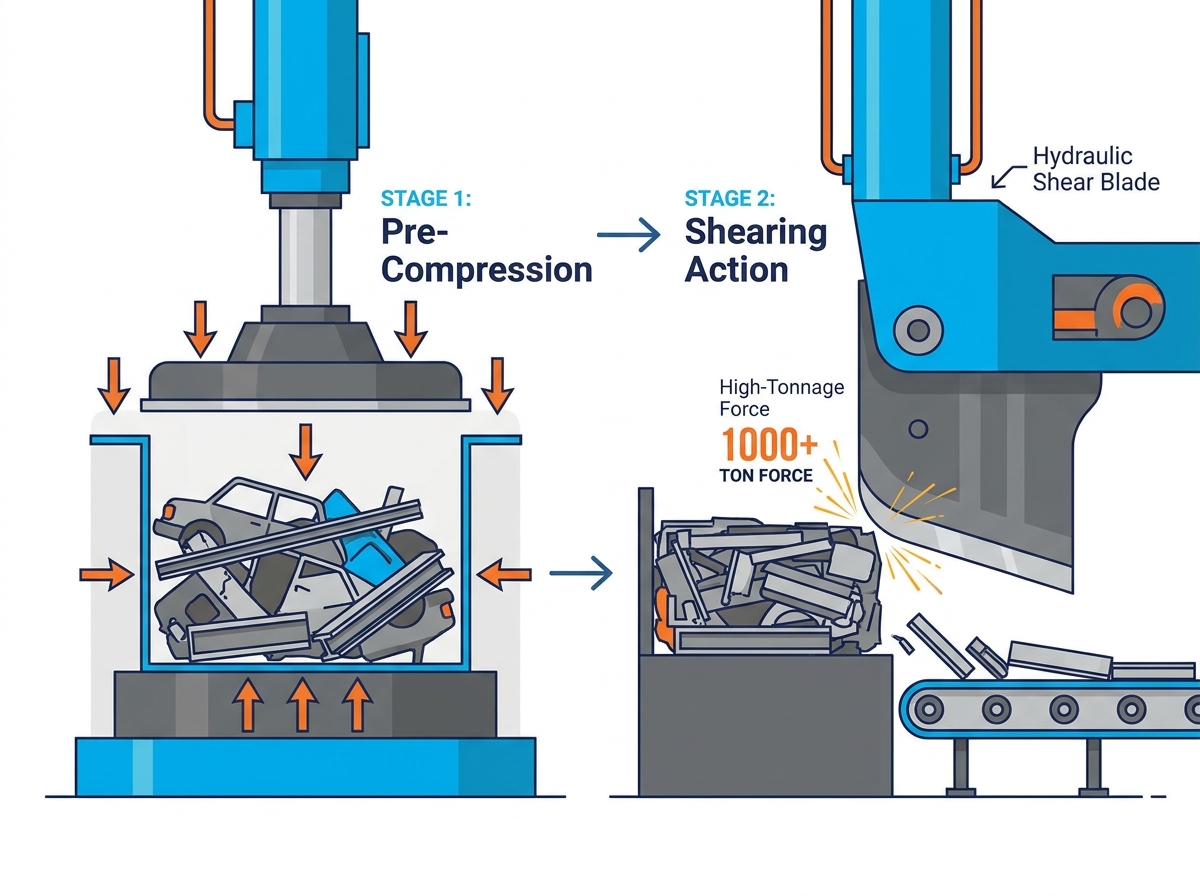
Industrial metal requires immense force for clean separation. The pre-compression system tackles this physical challenge first. Bulky scrap often resists standard cutting techniques. Scrapped car bodies and heavy structural beams contain awkward void spaces. The pre-compression system applies intense lateral and vertical pressure before the actual shearing begins.
This dual-axis compression prevents the material from slipping. It densifies the bulky scrap into a tight, manageable bundle. The main shear blade can then execute a clean, highly efficient cut. Slippage destroys blades and jams heavy machinery. A robust pre-compression box eliminates this risk entirely.
Hydraulic power dictates your ultimate cutting force. The main cylinder pressure drives the entire operation. High-pressure hydraulic circuits push specialized alloy blades through high-tensile materials effortlessly. A well-designed hydraulic system maintains maximum force without stalling mid-cut. Stalling damages internal seals and ruins your daily throughput rates.
Continuous feeding mechanisms separate elite machines from average models. Automated feed hoppers keep material flowing steadily toward the cutting zone. Heavy-duty conveyor integrations push scrap continuously. This continuous batch processing reduces equipment idle time drastically. Manual loading leaves your expensive machine waiting for the next piece. Automation ensures your blades keep moving, cutting, and producing revenue.
Facility layout often dictates your final equipment choice. Stationary machines demand massive structural footprints. They require deep, reinforced concrete foundations. These specialized foundations absorb immense kinetic energy during the downward shearing cycle. Once installed, the machine stays permanently anchored. You must bring all scrap material directly to the installation site using a coordinated fleet of material handlers.
Conversely, container shears feature an enclosed, box-like design. They operate on a completely different logistical model. They often include mobility options. You can move them across a large yard using heavy transport or roll-off trucks. They do not require specialized concrete footings. You can place them on any level, compacted surface. This mobility allows you to process material directly at the scrap pile, saving massive amounts of internal transport time.
Processing methodology also differs significantly between the two designs. A stationary model provides continuous, high-force vertical shearing. It handles extremely long, oversized structural beams easily. You simply feed the long beam through the open chamber. Container models rely on batch-based, horizontal compaction. You load the box, close the heavy lids, compress the material horizontally, and then the shear head cuts the compacted log into smaller chunks.
Equipment Selection Matrix: Gantry vs. Container Models
Evaluation Criteria |
Stationary Gantry Shear |
Mobile Container Shear |
|---|---|---|
Primary Material |
Ultra-thick steel plates, oversized structural beams. |
Mixed scrap, lighter metals, standard automotive scrap. |
Facility Footprint |
Requires dedicated, permanent operational zones. |
Highly flexible; easily relocated across the yard. |
Foundation Needs |
Deep, reinforced concrete footings required. |
Minimal prep; sits on level, compacted ground. |
Feeding Style |
Continuous inline feeding. |
Batch-based loading and processing. |
Material compatibility matters deeply during the procurement phase. You must match equipment tonnage strictly to specific material grades. A 500-ton machine handles light non-ferrous metals and standard mixed scrap beautifully. It cycles quickly and efficiently.
However, heavy melting steel requires massive power. Processing thick steel plates or heavy I-beams demands 1000-ton capabilities or higher. Do not over-specify your machine unnecessarily. Buying excessive tonnage wastes valuable capital upfront. Conversely, under-specifying causes excessive wear and tear. Pushing a small machine too hard guarantees premature failure and broken frames.
Evaluate component durability rigorously. Check the exact alloy composition of the cutting blades. Standard steel dulls quickly, while high-grade tool steel lasts longer. Inspect the guiding blocks for robust design. Ask your vendor about wear-liner replacements. High-friction areas require easily accessible, replaceable liners to protect the main structural frame.
Energy efficiency impacts your monthly overhead directly. Modern hydraulic systems use variable displacement pumps. These intelligent pumps adjust energy consumption based on the required cutting force. They prevent high cycle speeds from causing disproportionate electricity consumption. Traditional fixed-displacement pumps waste energy by running at maximum output constantly.
Never ignore safety and compliance standards. Physical guards must protect all moving parts and access panels. Emergency stop integrations must be highly visible and accessible from multiple angles. Verify machine compliance against regional industrial safety regulations. Look specifically for CE, OSHA, or ISO certifications to ensure operational safety.
Purchasing the equipment represents only step one. Site preparation constraints introduce complex timelines. You must pour reinforced concrete foundations properly. These structures require specialized engineering to handle extreme vibration. The concrete must cure fully before installation begins, which adds weeks to your timeline.
You must also secure high-voltage electrical drops. Most heavy-duty machinery requires industrial-grade power supplies. Upgrading your local electrical grid takes months of coordination with utility providers. Furthermore, you must plan for crane access. The shear frame arrives in massive, heavy sections. Mobile cranes must assemble these pieces safely on site.
Vetting the fabrication shop requires absolute skepticism. Look beyond glossy marketing brochures. Demand hard evidence of their manufacturing processes. Favor companies featuring in-house machining capabilities. Outsourced assembly often leads to severe quality control nightmares down the line.
Verify the availability of critical spare parts before signing anything. Replacement blades, hydraulic seals, and wear liners must ship quickly. Ask for transparent warranty terms. Request documented proof of post-sale technical support availability. A responsive service team saves you thousands of dollars during unexpected breakdowns.
Finally, prioritize operator training requirements. Your crew needs comprehensive instruction on daily hydraulic maintenance. They must learn safe loading practices to avoid jamming the chamber. Proper jam-clearing protocols prevent catastrophic downtime. Untrained operators will break even the toughest machinery within weeks.
A heavy-duty Gantry Shear represents a foundational infrastructure investment for any growing metal processing facility. It requires rigorous alignment between your actual facility capacity, your primary material type, and the final equipment specifications. Guessing on these metrics leads to poor performance.
Always evaluate vendor claims critically. Measure their promises against your actual operational footprint realities and long-term maintenance requirements. Focus on securing reliable post-sale support and robust component durability over flashy features.
We highly encourage you to conduct a thorough site audit immediately. Assess your current scrap volume honestly. Consult your internal engineering teams to determine exact tonnage requirements. Complete this rigorous internal review before requesting any formal vendor quotes.
A: The main structural frame should easily last several decades. However, overall lifespan depends heavily on regular maintenance. Blades and wear liners are standard consumables requiring routine replacement. Consistent lubrication and hydraulic fluid monitoring ensure the core system functions reliably for years.
A: Yes, it processes both materials effectively. However, using massive 1000-ton cutting force on light aluminum scrap is highly inefficient. You waste energy and time. Operators must batch lighter non-ferrous materials correctly to maximize chamber density before cutting.
A: Blade lifespan depends entirely on material hardness and total processed tonnage. Cutting heavy, abrasive steel wears blades quickly. Operators must monitor cut quality daily. Dull blades cause material tearing, which places dangerous stress on the main hydraulic cylinders and frame.
A: Stationary models require specialized, deep concrete footings. Engineers design these custom foundations to absorb massive hydraulic shock and equipment vibration. Installing the machine on standard, unprepared concrete will shatter the floor and misalign the shearing frame.


