


Views: 0 Author: Site Editor Publish Time: 2026-11-19 Origin: Site


Purchasing industrial metal processing equipment is a major capital expenditure. It directly impacts your operational throughput and facility profitability in scrap recycling and metal fabrication. Choosing the wrong machine carries significant operational risks for your business. If you under-size your equipment, you face daily processing bottlenecks and deal with excessive mechanical wear. Conversely, over-sizing wastes valuable capital upfront and leads to highly inefficient power consumption during operation. Finding the perfect balance requires careful planning.
This guide provides an evidence-based framework to help you thoroughly evaluate technical specifications. You will discover how to identify hidden implementation risks and accurately measure vendor capabilities. Rely on these actionable insights to match your specific material flow to the right technology. Use this roadmap to eliminate guesswork, streamline your procurement process, and ensure a verifiable operational return on investment.
Align tonnage with material density: Selecting the right cutting force (e.g., 500-ton vs. 1000-ton) requires profiling your heaviest, most frequent scrap or steel plate materials.
Assess site infrastructure first: Gantry shears demand specific foundational requirements and significant power loads that often exceed standard facility baselines.
Compare alternatives objectively: High-volume stationary applications favor gantry shears, whereas operations requiring mobility or processing lighter, uniform scrap may benefit from container shears.
Before you contact equipment manufacturers, you must analyze your current operational shortfalls. Identifying your exact pain points ensures you purchase a solution rather than just a machine.
Every scrap yard or fabrication shop faces specific workflow restrictions. You must determine the core issue slowing down your production line. Do you struggle with processing speed during peak hours? Perhaps your current equipment lacks the force to handle oversized materials like heavy structural steel or thick plates. High labor costs often stem from relying on manual torch cutting. Pinpointing these exact bottlenecks helps you set clear expectations for your new equipment.
You cannot select appropriate cutting equipment without categorizing your feed stock. Metals behave differently under immense pressure. Group your exact materials into distinct categories.
Heavy Melting Scrap (HMS): Identify the thickness and length of mixed structural pieces.
Precise Steel Plates: Note the maximum width and tensile strength of flat stock.
Mixed Metals: Consider the presence of non-ferrous materials or tangled rebar.
Documenting these material profiles ensures your selected machine can handle daily variations without jamming.
Vague goals lead to poor equipment selection. Define clear success criteria using hard numbers. You should establish a required tons-per-hour (TPH) target for your busiest shifts. Determine your ideal scrap density post-processing. Calculate your maximum acceptable cost-per-ton for processing operations. These metrics provide a quantifiable baseline to judge vendor proposals.
Industrial machinery must align with regional safety frameworks. Outline your local environmental regulations regarding hydraulic fluid containment. Check municipal noise limits to see if you need soundproofing enclosures. Review operator safety mandates required by occupational health authorities. Your chosen equipment must meet or exceed these regulatory standards.
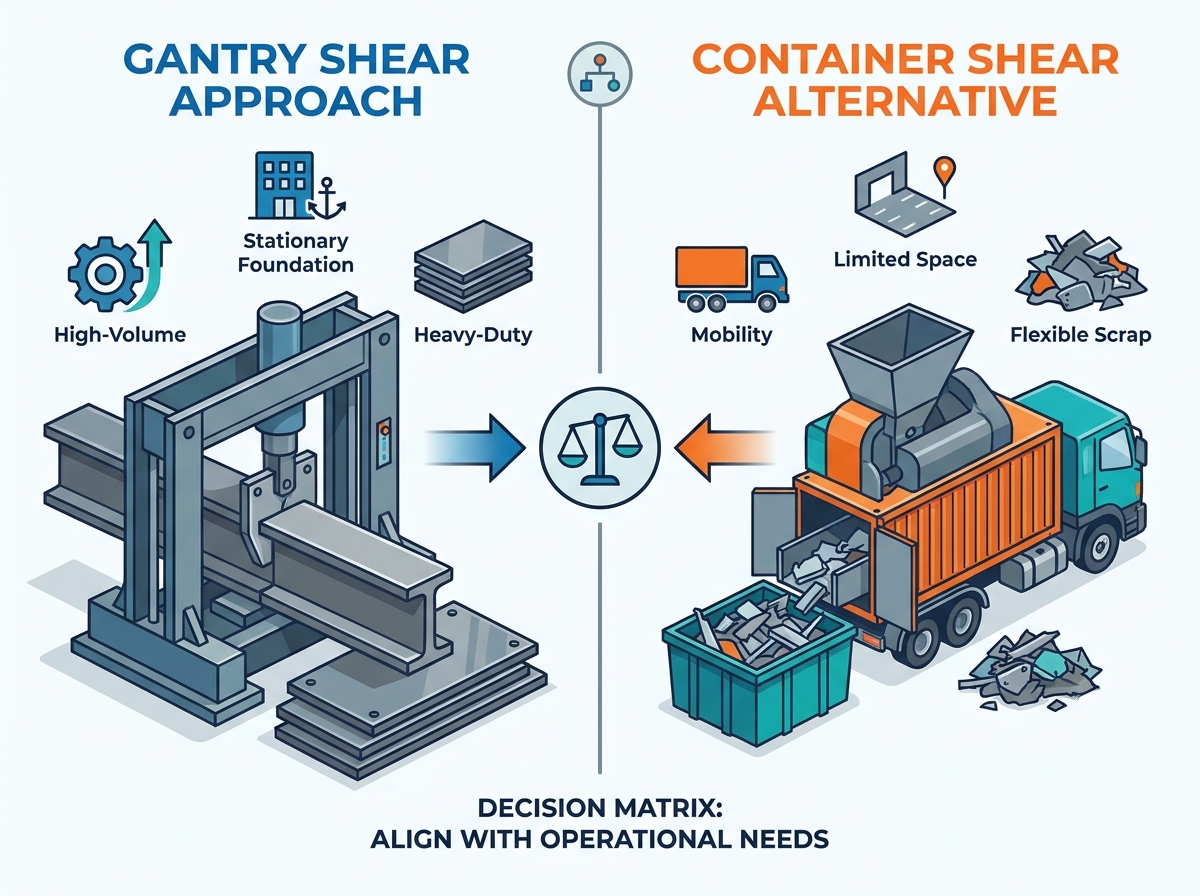
Recycling facilities generally choose between two primary shear designs. Understanding the strengths and limitations of each helps you avoid costly operational mismatches.
A heavy-duty Gantry Shear serves as the central processing hub for major recycling yards. These massive machines excel at high-volume, continuous feeding operations. They easily cut through ultra-thick steel plates and heavy structural beams.
However, this raw power requires specific trade-offs. You must construct a dedicated, reinforced concrete foundation to support the machine. These units completely lack mobility. They also involve higher initial installation complexity due to their sheer size and power grid demands.
Container shears offer a completely different operational footprint. These enclosed, box-like shears work best for distributed recycling operations. They fit perfectly in limited-space yards and sites requiring frequent equipment relocation. They process lighter, uniform scrap very efficiently.
The primary trade-offs involve capacity limits. Container shears generally deliver lower maximum cutting forces. They also feature restricted feed opening sizes compared to a massive gantry-style machine. You cannot process large structural I-beams in a standard container shear without pre-cutting them.
Equipment Selection Heuristics
Evaluation Criteria |
Gantry Shear |
Container Shear |
|---|---|---|
Site Permanence |
Requires permanent, reinforced concrete foundation. |
Highly mobile; can be relocated easily. |
Material Volume |
Ideal for continuous, high-tonnage daily throughput. |
Suited for moderate volume and batch processing. |
Capital Availability |
Requires substantial upfront capital for unit and site prep. |
Lower initial barrier to entry and setup costs. |
Material Size |
Handles oversized, bulky structural steel. |
Limited by the physical dimensions of the feed box. |
Once you choose a specific machine style, you must evaluate its technical capabilities. Focus on three critical dimensions to ensure long-term reliability and adequate production speed.
Hydraulic shear tonnage directly dictates material thickness limits. A 500-ton machine might easily cut standard rebar, but it will stall on solid steel billets. You must cross-reference the machine's maximum cutting force against the yield strength of your toughest materials. Always aim for a force rating slightly above your hardest daily material.
Do not confuse theoretical throughput with realistic cycle times. Manufacturers often publish maximum idle cycle speeds. Real-world throughput depends heavily on loading and unloading inefficiencies. You must account for the time it takes an excavator to grab, lift, and drop material into the hopper.
Evaluate the physical size of the feeding box. The hopper width must accommodate your primary loading equipment. If you use a massive excavator grapple, a narrow feed box will cause spills. Material jamming at the hopper entrance destroys your daily throughput metrics.
You must decide between electric motor configurations and diesel power units. Your choice depends entirely on your facility setup and local energy costs. Electric models dominate stationary indoor facilities. They provide quieter operation and eliminate localized diesel emissions. Diesel units offer complete independence. They work perfectly in expanding yards lacking upgraded high-voltage power grids.
Hydraulic system architecture dictates heavy-duty endurance. Look for high-pressure piston pumps rather than standard gear pumps. Piston pumps withstand continuous, demanding cycles much better. Robust cooling systems represent another non-negotiable feature. Overheated hydraulic fluid quickly destroys seals and reduces cutting force.
Prioritize machines featuring variable displacement pumps. These intelligent pumps automatically adjust power draw based on actual load resistance. When the blade meets heavy resistance, pressure increases. When idling, the pump destrokes to save energy. This feature dramatically improves your overall energy efficiency.
A Gantry Shear endures violent shock loads every single day. Assess the primary frame construction carefully. Demand heavy welded steel plates and stress-relieved structures. Stress-relieving treatments prevent microscopic cracks from spreading through the frame during continuous heavy impacts.
Review the shear blade specifications rigorously. Blade hardness dictates your replacement schedules. Look for 4-edge reversible blades. When one edge dulls, your operators can simply flip the blade to a fresh edge. This extends blade life by 400 percent. Also, evaluate the physical ease of replacement. Complicated blade changes cause excessive maintenance downtime.
Analyze how the machine handles mixed scrap. Uniform scrap processes smoothly. Mixed scrap often contains unpredictable densities. The machine must power through awkward angles without jamming the ram or causing uneven blade wear. Heavy-duty lateral guides help keep the cutting head perfectly aligned during awkward cuts.
Buying the machine is only the first step. Installing and operating heavy processing equipment introduces distinct facility challenges. Plan for these implementation realities early to prevent costly delays.
Heavy shears require massive, custom-engineered concrete foundations. You cannot simply place them on standard warehouse floors. The foundation design must absorb extreme dynamic forces. Detail the necessity of deep reinforced concrete pads. You must include proper vibration dampening materials in the sub-base. Furthermore, ensure adequate driving clearance around the pad. Your loading excavators and transport trucks need wide turning radiuses to operate safely.
Electric shears conceal hidden installation costs. You must upgrade your facility power grids to handle massive energy spikes. Large electric motors draw incredibly high starting currents. If your local grid lacks capacity, you will experience brownouts. Consult a commercial electrician early. You may need to install heavy-duty transformers and specialized soft-start motor controllers.
Human error causes more machine failures than mechanical defects. You must enforce comprehensive vendor-supplied training for all operators. Untrained staff often misfeed long materials, causing catastrophic blade jams. Operators must never bypass safety lockouts to clear jams manually. Proper training prevents catastrophic hydraulic failures and severe workplace injuries. Establish a culture where operators respect the equipment's raw power.
Heavy machinery demands rigorous upkeep. Set realistic expectations for your maintenance team. They must execute daily inspection routines before starting the machine. Missing standard lubrication cycles destroys expensive bronze wear pads rapidly. Hydraulic fluid management remains critical. You must conduct regular fluid sampling to detect microscopic metal contaminants before they destroy your main piston pumps.
Selecting the right manufacturing partner matters just as much as the machine specs. You need a vendor capable of delivering reliable equipment and steadfast long-term support.
Never trust sales brochures unconditionally. Request specific reference sites or verifiable case studies. Ask for references matching your exact material profile. A shear performing well in precise manufacturing scrap reduction might struggle in a dirty, mixed-metal yard environment. Call these references directly. Ask them about unexpected downtime and real-world throughput.
The best vendors gladly prove their machine's capabilities. Advise your team to shortlist vendors willing to process a sample of your heavy-duty metal. Send them a batch of your toughest structural scrap. Watch the machine process it. This physical test proves actual cycle times and verifies clean cut quality. If a vendor refuses a material test, eliminate them from your list.
Downtime drains your profitability rapidly. Compare vendor warranties line by line. Scrutinize parts availability closely. Identify whether spare parts ship domestically or require international freight. International shipping introduces crippling lead times during a breakdown. Examine technician response times guaranteed in the SLA. You need assurance that expert help will arrive promptly when major failures occur.
Create a standardized Request for Proposal (RFP) matrix. List all your baseline metrics, safety requirements, and performance expectations. Focus your RFP on actual throughput guarantees and post-installation support parameters. Distribute this standardized document to your shortlisted vendors. Comparing uniform responses makes your final decision objective and clear.
Selecting the ideal metal shearing equipment requires deep operational introspection. It is rarely about simply purchasing the machine boasting the highest hydraulic tonnage. Success comes from matching the machine's specific capacities to your unique material profile and site infrastructure realities.
Decision-makers must prioritize vendor transparency above baseline pricing. A cheaper machine quickly becomes a financial burden if it lacks robust post-sale support or suffers frequent breakdowns. Focus on acquiring verifiable performance data and demanding ironclad service agreements.
Before you send a single email to a vendor, take action internally. Begin your site infrastructure audits today. Finalize your heavy material profiling. Building this foundational knowledge guarantees you will navigate the procurement process with absolute confidence.
A: A high-quality heavy-duty shear typically lasts 10 to 15 years, or roughly 20,000 to 30,000 operational hours. Lifespan depends heavily on strict adherence to maintenance schedules. Regular blade rotation, immediate wear pad replacement, and meticulous hydraulic fluid care drastically extend the machine's operational life. Neglecting routine maintenance can reduce this lifespan by more than half.
A: Tonnage calculation matches your maximum material thickness and the metal's tensile strength against the machine's shear force. Consult mechanical engineering tables for the shear strength of your specific steel grade. Once you calculate the exact force needed to sever your thickest piece, add a 15 to 20 percent buffer. This safety margin prevents severe machine strain.
A: Neither is universally better; they serve different environments. Electric models offer significantly lower operating costs, emit zero localized exhaust, and produce less noise. They are perfect for permanent, indoor, or grid-connected stationary facilities. Diesel models provide necessary independence. They work best in off-grid locations, mobile processing sites, or rapidly expanding yards lacking upgraded electrical infrastructure.
A: You should expect realistic lead times ranging from 3 to 8 months. This timeline factors in custom manufacturing, international shipping, and customs clearance. Furthermore, constructing and curing the reinforced concrete foundation takes several weeks. Final commissioning, hydraulic testing, and operator training add another week to your timeline before full production begins.


