


Views: 0 Author: Site Editor Publish Time: 2026-11-11 Origin: Site


Purchasing industrial recycling equipment requires moving beyond basic marketing claims. You must align actual machine specifications with your daily operational demands. Every scrapyard faces unique material challenges, and a one-size-fits-all approach rarely succeeds. Undersizing your machinery leads to frequent equipment failure and severe material bottlenecking. Conversely, oversizing degrades your return on investment through excessive power consumption and wasted floor space. You need a rigorous, specification-driven evaluation framework to make the right choice.
This guide will help procurement and operations managers shortlist the ideal Alligator Shear. We will evaluate material types, exact throughput needs, and baseline capacity limits. You will learn how to assess blade dynamics, drive systems, and critical safety features. Our goal is to equip you with the technical knowledge necessary to choose equipment matching your precise workflow requirements.
Tonnage vs. Material: Advertised cutting capacities typically assume mild steel; actual capability drastically shifts based on material yield strength and cross-sectional density.
Blade Dynamics: Jaw length and blade geometry dictate not just what can be cut, but where in the jaw the maximum force is applied.
Hydraulic Superiority: Modern hydraulic shears offer integrated overload protection and stroke control, critical for minimizing downtime and preventing catastrophic failure.
Compliance & Safety: Safety guarding and foot-pedal configurations are non-negotiable specifications for OSHA/CE compliance and operator risk mitigation.
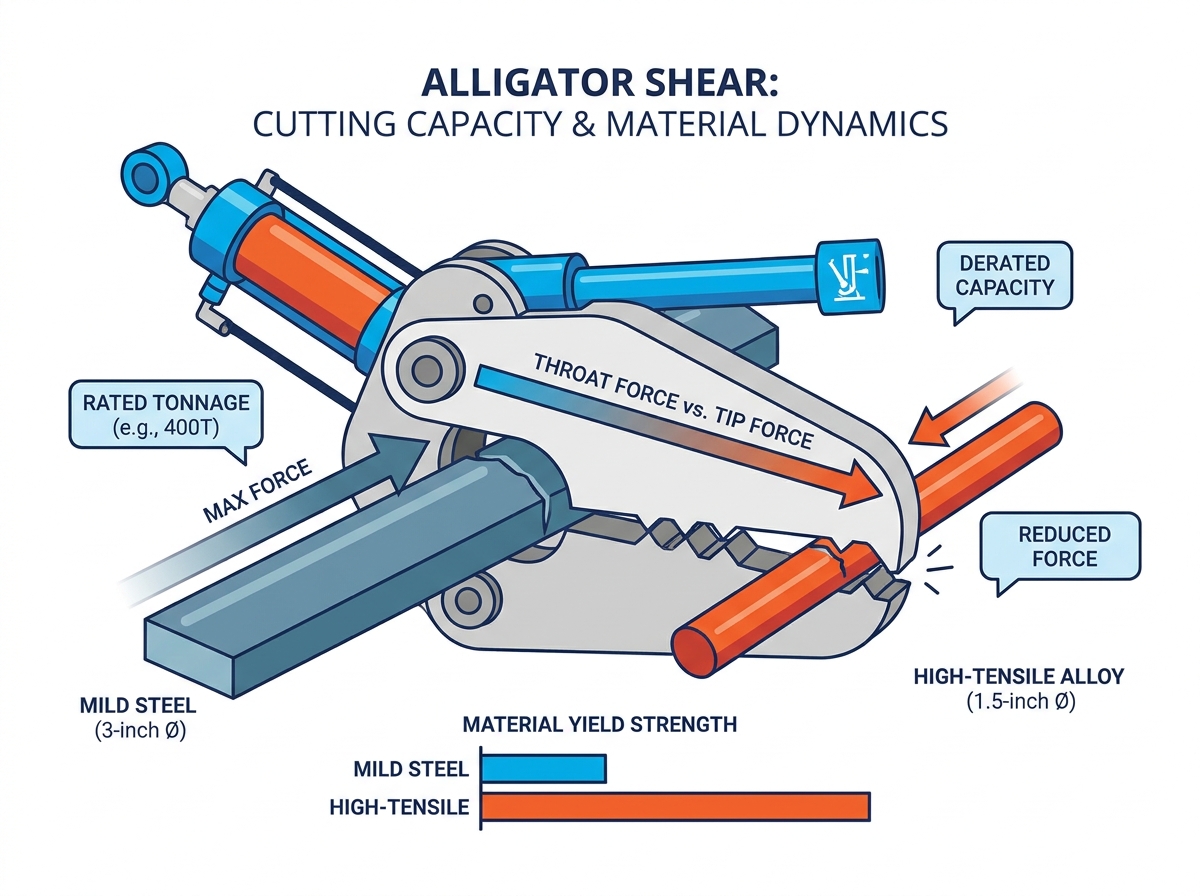
Understanding tonnage ratings is the first step in properly sizing an industrial shear. Manufacturers typically rate machine cutting force in tons. However, this single number often obscures the functional reality of leverage. You must distinguish between throat force and tip force. The throat is the area closest to the pivot point. It provides the highest cutting force due to simple mechanical leverage. The tip sits at the far end of the blade. Because it sits further from the fulcrum, the tip exerts significantly less force. When you review a 400-ton capacity rating, understand it applies almost exclusively to the deepest part of the throat.
You also face a significant assumption gap regarding material yield strength. Most equipment builders quote maximum cutting thickness based on standard mild steel, which features a yield strength of roughly 450 N/mm². Scrapyards process much more than mild steel. If you process high-tensile materials like stainless steel alloys, titanium, or thick-walled pipes, you must derate the machine's capacity. Attempting to cut heavy stainless steel based on mild steel capacity charts will stall the motor or damage the machine.
Material Yield Strength Derating Reference
Material Type | Approximate Yield Strength (N/mm²) | Capacity Derating Multiplier |
|---|---|---|
Standard Mild Steel | 400 - 450 | 1.0x (Baseline) |
Aluminum / Copper | 70 - 250 | 1.2x to 1.5x (Increased Capacity) |
Stainless Steel (304/316) | 500 - 600 | 0.75x to 0.8x |
High-Tensile Alloys / Titanium | 800+ | 0.5x to 0.6x |
Hold-down mechanisms represent another crucial specification. High-tonnage applications generate immense kinetic energy. When the blade strikes heavy scrap, the material often tries to flip upward violently. This movement is known as kickback. Automated or mechanical hold-downs prevent material kickback entirely. Active hold-downs clamp the material securely against the base just before the blade engages. This clamping action ensures a clean cut rather than bending the scrap, and it protects operators from unpredictable flying debris.
Blade length and jaw opening specifications directly dictate operational versatility. Typical industrial blades range from 12 inches up to 36 inches in length. Blade length limits the maximum dimensions of the scrap being processed. However, buyers often face a notable trade-off. Longer blades offer larger jaw openings for bulky items, but they inherently decrease the available cutting force at the tip. You must balance the physical size of your incoming scrap against the required shearing force. Do not buy a 36-inch blade if a 24-inch model covers 95% of your daily material stream, as the shorter blade concentrates power more efficiently.
Metallurgy plays a pivotal role in operational longevity. High-quality blades use hardened tool steel designed specifically for impact resistance and edge retention. Cheaper materials chip easily when they encounter hidden concrete or hardened bolts mixed into standard scrap. You should prioritize machines utilizing 4-edge reversible blades. This single specification yields massive maintenance savings. Instead of buying a new blade when the cutting edge dulls, maintenance staff simply unbolt it, rotate it 90 degrees, and bolt it back down. A 4-edge reversible setup directly quarters your parts replacement costs and slashes maintenance downtime.
Clearance adjustment is equally vital for a functioning Alligator Shear. If the gap between the upper and lower blades becomes too wide, the machine will fold thin or non-ferrous materials instead of cutting them. Folding causes brutal material jams. Ensure the machinery features an accessible shim system or heavy-duty adjustment bolts to maintain tight blade tolerances.
Follow these steps to ensure proper blade clearance maintenance:
Disconnect the power supply and lock out the machine.
Clean the blade area thoroughly using compressed air and wire brushes to remove grit.
Use a specialized feeler gauge to measure the gap between the upper and lower blades at multiple points along the jaw.
Adjust the heavy-duty bolts or insert specific brass shims behind the blade seat to narrow the gap.
Manually cycle the machine slowly (if possible) or jog it under power to verify the blades bypass each other without colliding.
Modern recycling operations heavily favor hydraulic drive systems over older mechanical alternatives. Mechanical shears rely on massive spinning flywheels and mechanical clutches. When a mechanical shear encounters an un-cuttable piece of hardened steel, the kinetic energy has nowhere to go. This often results in shattered castings, broken blades, or snapped linkages. Hydraulic systems prevent this destructive scenario entirely. They deliver smoother operation and feature built-in hydraulic relief valves. If operators feed an oversized or hardened object into the jaw, the hydraulic fluid pressure spikes. The relief valve instantly opens, safely bypassing the fluid and stalling the jaw before any structural damage occurs.
You must evaluate motor specifications and daily power draw carefully. Standard industrial electric models require a 3-phase, 400V or 480V electrical supply. Pay attention to the kilowatt (kW) or horsepower (HP) ratings. A larger motor provides faster cycle times and better force recovery, but it will increase baseline energy consumption per cycle. You need to map these electrical requirements against your facility's existing infrastructure. Upgrading a scrapyard's electrical panel to handle a massive motor often costs as much as the machine itself.
Consider the physical implementation reality of your site. Remote scrap yards or satellite collection sites often lack reliable heavy-duty electrical grids. In these scenarios, evaluate the availability of diesel-driven alternatives. Diesel power packs offer ultimate mobility. You can move the machinery across the yard directly to massive scrap piles, eliminating the need to transport scrap repeatedly via forklift. While electric models provide cleaner, quieter baseline performance inside warehouses, diesel remains indispensable for expansive outdoor yards.
Cuts Per Minute (CPM) represents a primary metric for operational efficiency. Machine specifications usually cite cycle times ranging between 10 to 30 CPM, depending heavily on the stroke length and the hydraulic pump size. A high-volume yard generally demands faster cycle times to maintain profitability.
However, you must apply a skeptical check to raw CPM numbers. High cycle speeds only yield high throughput if your material handling capabilities can keep pace. The machine speed must match operator workflow. If an operator takes ten seconds to maneuver a cumbersome pipe into position, a machine capable of cutting every two seconds offers no practical advantage. Investing in extreme CPM metrics without optimizing your loading and removal processes creates expensive, artificial bottlenecks.
Adjustable stroke control drastically improves real-world efficiency. If you spend a week processing small-diameter copper wire or narrow aluminum extrusions, waiting for a massive jaw to open fully wastes time. By adjusting the limit switches, you can restrict the jaw opening to a narrow gap. Limiting the stroke cuts the cycle time in half, doubling operator output on smaller materials without upgrading the motor.
You should also verify continuous versus single-cycle operating modes. The safest operations utilize manual single-stroke modes for complex, bulky items requiring precision positioning. The operator dictates every cut via the foot pedal. Conversely, automatic continuous modes suit uniform, high-volume scrap. Once engaged, the jaw cycles repeatedly at a steady rhythm, allowing the operator to simply push material forward along the cutting table. The best equipment offers simple toggle switches to alternate between these modes.
Safety guarding systems serve as your primary defense against workplace injuries. Heavy-duty metal guards must cover the moving jaw's pivot areas and all mechanical linkages. Pinch-point accidents frequently result in severe hand injuries or amputations. Robust steel enclosures keep stray hands and loose clothing away from the crushing mechanisms. Ensure any machine you evaluate meets strict OSHA or CE compliance standards for physical guarding.
Control mechanisms require equally strict evaluation. Foot-pedal specifications matter immensely in a messy yard environment. Look for fully shrouded pedals. A heavy steel shroud prevents accidental actuation if a heavy pipe or piece of debris falls onto the pedal switch. Furthermore, specify the requirement for instant-stop or auto-return functionalities. If an operator slips, panics, or lifts their foot off the pedal, the jaw must instantly freeze or automatically return to the open position. Machines lacking this feature pose extreme risks.
Finally, consider the ergonomic footprint and working height specifications. Manual feeding demands repetitive lifting and twisting. Standard working heights usually sit around 30 to 36 inches off the ground. This height aligns with the natural waistline of most operators. A table positioned too high strains the shoulders during heavy lifting, while a table too low stresses the lower back. Protecting operator ergonomics directly reduces daily fatigue, leading to higher sustained throughput and fewer workers' compensation claims.
Selecting the optimal Alligator Shear demands rigorous attention to mechanical specifications rather than generalized marketing claims. To maximize your investment, keep these final action items in mind:
Balance Force and Material: Always match the machine's throat cutting force with the specific yield strength of your toughest daily scrap material.
Optimize Blade Length: Avoid overspending on unnecessary blade length; select a jaw size that covers your core volume to maintain maximum tip force.
Prioritize Hydraulics: Specify hydraulic systems for their built-in relief valves, which prevent catastrophic machine failure during overloads.
Verify Site Infrastructure: Account for local electrical phase availability and facility footprint constraints before finalizing the specification sheet.
Test Before Buying: Gather a sample of your toughest baseline scrap and request a documented test cut or video demonstration from the manufacturer prior to issuing a purchase order.
A: It depends entirely on the machine's tonnage and the material. A standard 400-ton shear might cut 3-inch mild steel round bar, but only 1.5-inch high-tensile alloy. Always check the manufacturer's capacity chart for specific metals.
A: Frequency depends on material abrasiveness and daily volume. Cutting clean copper extends life, while dirty steel with concrete residue degrades blades rapidly. Utilizing 4-edge reversible blades allows operators to rotate the blade 3 times before requiring a full replacement.
A: Hydraulic shears provide consistent force throughout the cut and feature pressure relief valves. If a piece of hardened steel is accidentally fed, the machine will stall rather than breaking the casting or shattering the blade, minimizing catastrophic repair costs.
A: Yes, for safety and accuracy. An active hold-down clamps the material just before the blade engages, preventing the scrap from violently flipping upward (kickback) and ensuring the blade shears rather than bends the metal.


