


Views: 0 Author: Site Editor Publish Time: 2026-11-14 Origin: Site


Upgrading processing equipment remains a high-stakes capital expenditure for recycling facilities of all sizes. Inefficient scrap processing directly causes bottlenecked yards. It inflates daily transport costs and accelerates excessive wear on secondary machinery. You need reliable, heavy-duty solutions to process volume efficiently. This guide explains exactly what a Scrap Metal Baler Shear is and how it functions under pressure. We explore how its dual-action capability transforms your operational economics. You will learn to evaluate technical specifications against actual yard requirements. We focus entirely on realistic throughput, maintenance demands, and measurable metrics rather than theoretical maximums. By the end of this guide, you will understand how to select the right machine. You will know how to maximize payload density and keep your processing lines moving without interruption.
A Scrap Metal Baler Shear combines high-density compaction with heavy-duty shearing, eliminating the need for two separate pieces of equipment.
The primary evaluation metrics are compression ratio, shear force (tons), and actual cycle times, which dictate true operational throughput.
Total Cost of Ownership (TCO) is heavily influenced by maintenance realities, particularly the wear on shear blades, liner plates, and hydraulic systems.
Selecting the right machine requires aligning the required bale size and material type (e.g., End-of-Life Vehicles vs. industrial offcuts) with the machine's stated capacity capabilities.
A standard scrap baler serves a single distinct purpose. It compresses loose material into dense geometric blocks. It uses powerful hydraulic rams to crush metal from multiple sides. This compaction process works exceptionally well for light-gauge materials. However, a standard baler cannot cut or resize thick, structural metals.
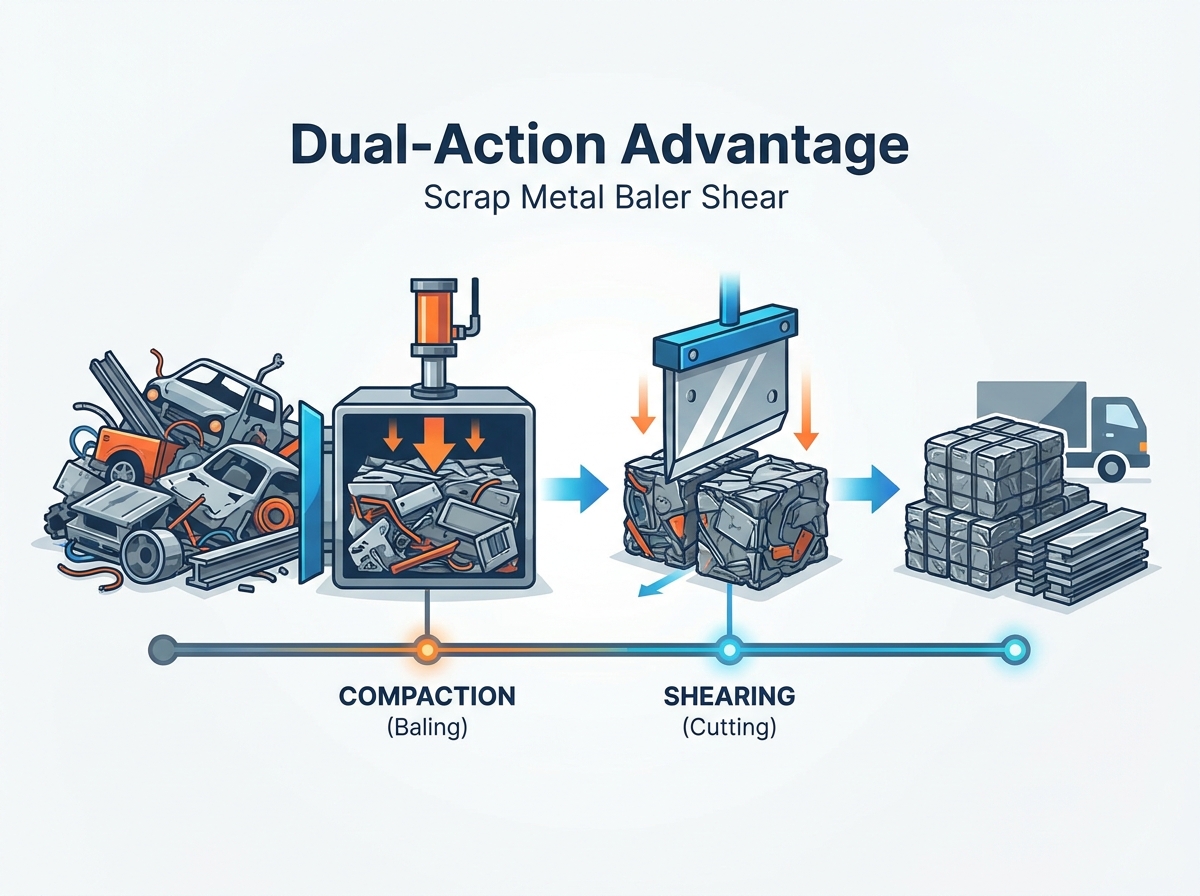
This is where a Scrap Metal Baler Shear changes the processing dynamic. It integrates a heavy-duty guillotine cutting mechanism directly into the compaction chamber. First, it folds and compresses the bulky scrap. Then, it shears the dense log into smaller, uniform chunks. This dual-action process condenses oversized, awkward scrap effectively. You get mill-ready dense bales or manageable sheared cuts directly from one single machine.
You might wonder when to choose a dedicated car baler instead. A car baler is sufficient if you only process flattened auto bodies. It effectively crushes thin sheet metal into large rectangular bales. However, a baler shear becomes mandatory when you handle mixed material streams. If you process heavy structural steel alongside lighter gauge metals, compaction alone fails. The shearing action breaks down rigid I-beams and thick plates safely and efficiently.
Feature | Standard Scrap Baler | Scrap Metal Baler Shear | Dedicated Car Baler |
|---|---|---|---|
Primary Function | Multi-axis compaction | Compaction and guillotine shearing | High-volume vehicle flattening |
Material Suitability | Light to medium gauge metals | Heavy structural steel, mixed scrap | End-of-life vehicles (ELVs) |
Output Format | Dense bales only | Dense bales or sheared chunks | Large car-sized bales |
Processing Flexibility | Low | High | Moderate |
You must evaluate specific engineering metrics before purchasing equipment. Not all machines perform equally under constant industrial stress.
Higher compression ratios directly reduce your transportation costs. The machine packs more material into less volume. This maximizes payload weight per truck or rail container. You send fewer trucks to the mill, which significantly lowers daily freight expenses. Steel mills also expect standard bale sizes. Common sizes include 16-inch by 16-inch or 24-inch by 24-inch blocks. Confirm the machine produces dimensions acceptable to your specific downstream buyers.
Hydraulic shear force defines the true power of the machine. Manufacturers measure this force in tons. A 600-ton shear cuts very differently than a 1,000-ton unit. The shear force limits dictate the maximum thickness and yield strength of the scrap. If you feed material exceeding these limits, the machine will stall. Frequent stalling damages the hydraulic rams and accelerates blade wear. Match the shear force to your heaviest expected scrap streams.
Modern machines rely heavily on Programmable Logic Controllers (PLCs). Automation and control systems eliminate much of the manual operator error. PLCs optimize cycle times by managing ram speeds and pressure thresholds dynamically. They monitor sensor feedback loops in real-time. This prevents the hydraulic pumps from overexerting themselves during difficult cuts. They also provide vital diagnostic data directly to a touchscreen interface. You can track fluid temperatures, pressure drops, and daily cycle counts. This data empowers you to schedule preventive maintenance long before catastrophic failures occur.
A robust Scrap Metal Baler Shear handles a diverse range of materials daily.
End-of-Life Vehicles (ELVs) represent a highly complex mix of metals. Auto recycling requires processing steel frames, aluminum components, and wiring harnesses simultaneously. The machine's pre-compression wings fold the vehicle chassis inward. The main ram then compacts the irregular shapes into a tight log. Finally, the shear cuts the log into dense slices. This exposes the mixed metals for easier downstream sorting.
Heavy Melting Scrap (HMS) and structural steel demand extreme mechanical force. Processing rigid I-beams, heavy rebar, and demolition scrap is brutal work. The machine traps long, rigid pieces safely inside the chamber. The heavy-duty hold-down clamp secures the material firmly. The guillotine blade then shears the steel into specific lengths. This converts awkward demolition debris into high-value, furnace-ready scrap.
Despite their massive power, these machines have strict limitations. You must establish operational safety by acknowledging what they cannot process.
Highly explosive materials: Never process sealed gas cylinders, fuel tanks, or munitions. Compaction generates extreme friction and sparks, risking fatal explosions.
Certain non-compressibles: Avoid feeding large chunks of solid concrete or heavy rock hidden in demolition scrap. They severely damage the structural chamber walls.
Heavy cast iron: Cast iron is brittle rather than malleable. Shearing thick cast engine blocks risks shattering the shear blades instantly.
Industrial scrap processing degrades equipment rapidly. You must prepare for the harsh realities of daily maintenance.
Consumables wear out predictably. Shear blades and heavy-duty liner plates take the blunt impact of every cycle. Processing abrasive demolition scrap or oversized materials accelerates this wear dramatically. You will notice dull blades causing jagged, uneven cuts. Jagged cuts force the hydraulic system to work much harder. This generates excess heat throughout the hydraulic lines. You must rotate, shim, and replace blades strictly according to physical condition. Never rely just on calendar days. Liner plates also require regular hard-facing welding. This prevents structural chamber damage from repetitive gouging.
Hydraulic system integrity dictates your overall uptime. The system pumps hundreds of gallons of specialized fluid at extreme operating pressures. Strict fluid management remains non-negotiable for yard operators. You must monitor fluid cleanliness using advanced filtration systems. Contaminated oil rapidly destroys expensive directional valves and main pumps. Cooling systems must operate flawlessly. They prevent fluid degradation during intense summer months. Regular seal inspections are mandatory. A blown main cylinder seal causes catastrophic downtime. It also creates severe environmental hazards in your yard.
Infrastructure and power requirements demand careful preliminary planning. These machines possess massive physical footprints. They require heavy, custom-engineered concrete foundations to absorb constant extreme vibrations. High-voltage electrical needs often require major facility upgrades. You must finalize power routing and footprint considerations long before the installation crew arrives.
Buying processing equipment requires a disciplined, analytical approach. You must filter manufacturer marketing claims through harsh operational reality.
First, align your throughput expectations with reality. Buyers must look past theoretical maximum capacity claims. Theoretical claims assume perfect material flow and zero operator hesitation. Instead, calculate expected throughput based on your specific average scrap mix. Factor in loader efficiency and scheduled maintenance breaks. Real-world throughput often sits 20% to 30% below glossy brochure maximums.
Next, evaluate vendor Service Level Agreements (SLAs). Post-sale support matters far more than the initial purchase price. Investigate local parts availability and technician dispatch times. A cheaper machine with poor parts availability costs much more in unplanned downtime. You need vendors who stock proprietary cylinders, valves, and blades in your immediate geographic region.
Use this straightforward 3-step decision tree logic for shortlisting:
Define the primary material and required output format. Determine your dominant scrap stream (e.g., ELVs vs. HMS). Confirm the exact bale size or cut length your buyers demand.
Determine required tonnage and shear force. Base this on the thickest, hardest material you process weekly. Do not buy a 500-ton shear if you regularly process heavy structural I-beams.
Evaluate the vendor warranty and maintenance network. Demand written guarantees regarding replacement parts delivery timelines. Speak directly to current customers about real-world service response times.
A Scrap Metal Baler Shear serves as your yard's primary production engine. It directly dictates your overall profitability by maximizing material density and processing volume. The dual-action ability to both compress and cut transforms awkward scrap into premium mill-ready products. The right machine removes operational bottlenecks and lowers freight expenses.
To move forward effectively, implement these action-oriented next steps. Conduct a formal yard audit to identify your biggest processing delays. Calculate your current cost-per-ton of processing with your existing equipment. Request detailed technical spec sheets from at least three shortlisted manufacturers. Finally, demand customer references to verify actual uptime and service reliability. Taking these steps ensures your capital investment yields long-term operational success.
A: A high compression ratio packs more metal into a smaller volume. This creates extremely dense bales. Dense bales allow you to maximize shipping weights per truck or railcar. You send fewer shipments, significantly cutting freight costs. Furthermore, steel mills pay premium prices for high-density scrap because it melts more efficiently in their furnaces.
A: There is no generic timeframe for blade maintenance. The interval depends entirely on the material processed. If you shear clean aluminum, blades may last several months. If you process abrasive demolition scrap or thick steel, you might need to rotate or shim blades every 300 to 500 operating hours. Monitor cut quality daily.
A: Yes, these machines handle non-ferrous metals like aluminum and copper. However, you must adjust the hydraulic pressure settings. Non-ferrous metals are softer. Over-compressing them can damage the material or jam the chamber. Using the PLC to lower the compaction force ensures you produce optimal bales without unnecessary equipment strain.
A: Installation is a multi-week process. Pouring the custom concrete foundation and allowing it to cure properly takes three to four weeks. Once the foundation cures, machine assembly, hydraulic hookups, and electrical wiring require one to two weeks. Final commissioning and operator training usually take an additional three to five days.


