


Views: 0 Author: Site Editor Publish Time: 2026-11-13 Origin: Site


Investing in industrial recycling equipment requires significant capital expenditure. You cannot afford to make a blind decision. A Scrap Metal Baler Shear acts as a primary revenue-generating asset for your business. The cheapest upfront price might seem appealing at first glance. However, budget options often result in lower long-term profitability if cycle times lag or durability falls short. Buyers frequently face confusing quotes and hidden operational expenses. It becomes difficult to compare machines directly across different manufacturers. We will decode the actual pricing tiers to help you navigate this complex process. You will learn about the hidden operational costs and essential evaluation metrics. This guide gives you the exact tools needed to confidently benchmark quotes and secure the best deal.
Base Price vs. TCO: Upfront machinery costs only represent 60-70% of the Total Cost of Ownership; site prep, power consumption, and maintenance make up the rest.
Tonnage Dictates Price: The jump from a 400-ton shear to an 800-ton shear drastically alters both the purchase price and foundation requirements.
New vs. Used Reality: Used equipment offers significant upfront discounts but requires rigorous inspection of hydraulic cylinders and PLC systems to avoid crippling downtime.
Automation Premium: Fully automated, continuous-feed systems cost more initially but drastically reduce labor costs for high-volume steel mills and scrap yards.
Buyers often receive wildly different quotes from manufacturers. They struggle to compare them apples-to-apples. One supplier might quote $150,000 while another demands $300,000 for seemingly similar equipment. This section normalizes your evaluation criteria. It breaks down exactly what drives the cost of these heavy-duty machines.
Hydraulic tonnage dictates the core capability of your equipment. A 500-ton shear processes lighter materials like aluminum siding or thin sheet metal. Upgrading to a 1000-ton machine allows you to cut heavy I-beams and thick structural steel. This massive jump in force directly correlates to raw material costs during manufacturing. Builders must use thicker steel plates, larger hydraulic cylinders, and heavily reinforced frames to withstand 1000 tons of pressure. Higher tonnage also increases processing speed. It allows your crew to clear scrap piles faster. You pay a premium for this sheer power. However, increased throughput often justifies the higher initial investment.
Control systems heavily influence pricing. Manual or semi-automatic operation requires an operator to pull levers and monitor every cycle. This keeps the initial purchase price low. Unfortunately, it drives up daily labor expenses. Fully automated, continuous-feed models cost significantly more upfront. They rely on complex Programmable Logic Controllers (PLCs) to manage the feed, clamp, and cut cycles independently. This advanced automation drastically reduces labor dependency. One operator can manage a continuous-feed system from a remote cabin. They load material into a hopper while the machine handles the rest. This automation premium pays off rapidly for high-volume scrap yards.
The origin of internal components dictates both upfront cost and long-term reliability. Premium manufacturers use name-brand hydraulic valves and motors. Brands like Bosch Rexroth or Parker Hannifin command a higher price tag. They guarantee better aftermarket part availability. Generic or proprietary components lower the initial invoice. Yet, they pose a severe risk later. If a generic valve fails, you might wait weeks for a replacement shipped from overseas. Name-brand parts ensure local technicians can service your equipment immediately. You are essentially buying peace of mind alongside the hardware.
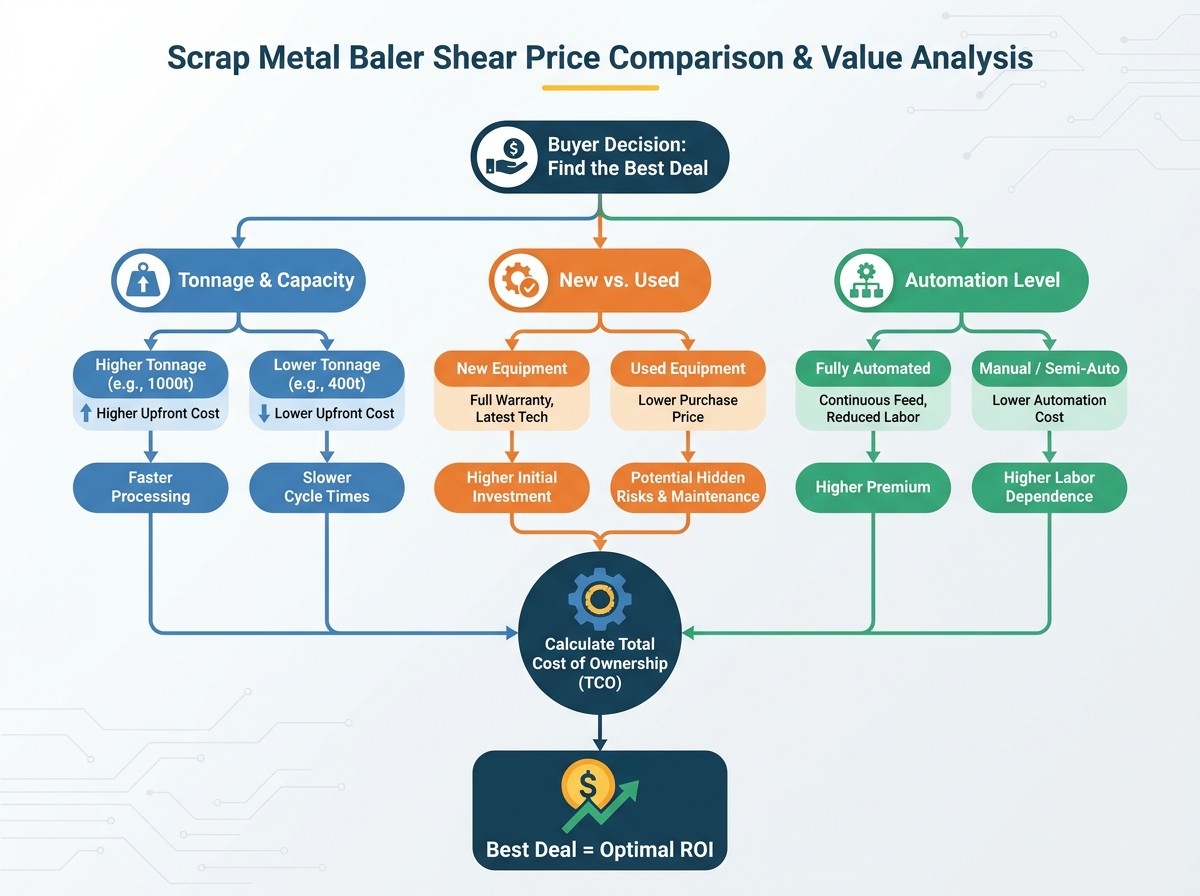
We must break down the market into actionable segments. This allows buyers to align their budgets directly with their operational scale. Not every facility needs a million-dollar machine. Selecting the right tier prevents costly over-specification.
Equipment Tier | Target User | Estimated Shear Force | Automation Level |
|---|---|---|---|
Entry-Level / Budget | Small to mid-sized scrap yards | 300 to 500 Tons | Manual / Semi-Auto |
Mid-Range Industrial | Regional recycling centers | 600 to 800 Tons | Standardized Automated |
Premium / Heavy-Duty | Steel mills and enterprise processors | 1000+ Tons | Fully Automated / Diagnostic Software |
Small to mid-sized scrap yards often gravitate toward entry-level options. These yards typically process lighter, non-ferrous metals or handle low daily volumes. You can expect a lower shear force, usually capping around 500 tons. Operators rely on manual or semi-auto controls. Cycle times remain slower compared to industrial models. These budget models fit perfectly when capital is tight. They serve as excellent starter machines. However, they struggle if you suddenly secure a contract for heavy structural steel.
High-volume regional recycling centers usually target mid-range performers. They process a mix of heavy and light ferrous scrap daily. You will find standardized automated features at this level. These machines include enhanced cooling systems built for continuous shifts. A reliable mid-range Scrap Metal Baler Shear strikes the perfect balance. It provides an optimal capital expenditure-to-output ratio. The robust frame handles moderate abuse. The hydraulics survive long hours without overheating.
Steel mills and enterprise-level scrap processors demand premium systems. These facilities cannot afford downtime. They expect 1000+ tons of cutting force to slice through massive beams effortlessly. Premium systems feature integrated feed conveyors. They utilize advanced diagnostic software to predict maintenance needs. They boast extreme durability. Manufacturers build them using specialized wear-resistant steel. The initial cost sits at the top of the market. Yet, the massive volume they process justifies the hefty price tag.
Buyers frequently face a common dilemma. Should you purchase surplus machinery or invest in brand-new equipment? Both paths offer distinct advantages. You must evaluate these options carefully to protect your investment.
Used equipment offers immense appeal due to its immediate availability. You skip the six-month manufacturing lead time. The lower initial purchase price frees up capital for other yard improvements. Many buyers find excellent deals on machines from liquidated facilities. A five-year-old machine might operate perfectly if the previous owner maintained it well. You can often secure a reputable brand at a fraction of the original cost.
We must view used machinery through a skeptical lens. Several hidden dangers lurk beneath a fresh coat of paint.
Inherited Metal Fatigue: Heavy-duty cycling causes micro-fractures in steel frames over time. These fractures are nearly impossible to detect visually.
Outdated Proprietary Software: Older PLC units often run obsolete software. Finding a technician to reprogram them becomes a nightmare.
Worn Hydraulic Seals: Leaking seals cause massive pressure drops. This reduces cutting force and wastes expensive hydraulic fluid.
You must factor refurbishment expenses into your budget. Replacing dull shear blades costs thousands of dollars. Upgrading outdated PLC units requires specialized engineering. Overhauling massive hydraulic cylinders demands heavy lifting equipment and expensive rebuild kits. Once you tally these refurbishment costs, the price gap quickly narrows. A heavily used machine might end up costing nearly as much as a new unit after necessary repairs.
You must move beyond the invoice price to understand the real-world costs of deployment. Buying the machine represents just one step. Getting it operational introduces several major financial variables. Failing to budget for these implementation realities leads to cash flow crises.
A heavy-duty shear requires a massive concrete foundation. You cannot simply place it on dirt or standard asphalt. Engineers must design heavily reinforced concrete pads to absorb extreme vibrations. This foundation work costs tens of thousands of dollars. You must also allocate significant yard space for the machine and material staging areas. High-voltage industrial motors demand robust electrical infrastructure. You might need to pay your local utility company for an electrical grid upgrade to handle the massive power draw.
Industrial machinery consumes parts and fluids constantly. You must factor in these recurring expenses.
Hydraulic Fluid Replacement: These machines hold hundreds of gallons of specialized fluid. Regular filtration and replacement represent a significant annual expense.
Shear Blade Replacement: Processing abrasive scrap dulls cutting blades quickly. You need a schedule for heavy-duty shear blade sharpening and replacement.
Wear-Liner Swaps: The feed box endures extreme friction. Sacrificial wear-liners made of Hardox steel protect the main frame. You must swap them out periodically.
Energy costs fluctuate wildly based on the technology you choose. Older hydraulic systems run the main pumps constantly. They draw maximum amperage even during idle times. Modern setups utilize variable-frequency drives (VFDs). A VFD system spins down the motors when the machine waits for scrap. This saves massive amounts of energy. You also need to calculate operator wages. Slower machines demand more hours to clear the yard, inflating your weekly payroll.
Navigating the final decision stage requires a strict evaluation framework. You should treat the procurement process as a strategic partnership. The right supplier ensures your equipment runs smoothly for decades.
Rule out over-specifying your machine. You must ensure the capabilities align tightly with your facility's primary scrap profile. If you exclusively process light iron and aluminum siding, do not buy a 1000-ton shear. It wastes money and energy. Conversely, if you process heavy HMS 1 scrap daily, an underpowered machine will stall continuously. Document your exact material flow before speaking to sales engineers. Give them hard data on your daily tonnage requirements.
Never accept a lump-sum quote. Instruct buyers to request fully itemized proposals. You need to separate the machine cost from all other expenses. Demand clear line items for shipping freight, heavy crane installation, and factory commissioning. Ask for a breakdown of operator training fees. Transparent quoting exposes hidden markups. It allows you to negotiate specific elements. If a manufacturer refuses to provide an itemized quote, consider it a massive red flag.
The relationship begins after the installation. Stress the importance of warranty length in your negotiations. Ask for guaranteed response times for field service technicians. A broken machine halts yard production, costing you thousands daily. You must verify the domestic availability of spare parts. Ask the supplier where they stock their hydraulic valves and cylinders. If they ship parts from overseas, expect crippling downtime during breakdowns.
Finding the ideal deal on a Scrap Metal Baler Shear demands careful strategic planning. You must match the shear capacity strictly to accurate volume projections. Prioritizing hydraulic reliability and automation yields higher profitability over the equipment's lifespan. Avoid chasing a rock-bottom base price if it compromises build quality. Assess your facility's infrastructure readiness before committing to high-tonnage machines. Focus heavily on aftermarket support and component availability. We encourage you to request a customized site assessment today. Reach out to an application engineer and ask for an itemized operational expense comparison to secure your yard's future.
A: Prices vary widely depending on tonnage. Entry-level models start between $50,000 and $100,000. Mid-range industrial shears range from $150,000 to $400,000. Heavy-duty mill applications easily exceed $1,000,000. Shipping and installation are usually extra.
A: Custom-built or high-tonnage machines often require four to eight months for manufacturing, factory testing, and ocean freight. Buyers must factor this timeline into their capital expenditure planning early.
A: Lifespan depends entirely on the material processed and daily operating hours. Clean scrap extends blade life, while contaminated scrap degrades it rapidly. Regular rotation and routine maintenance remain crucial for maximizing blade longevity.
A: Yes. Standard B2B equipment leasing and financing structures are widely available. Operational savings from reduced labor and lower energy consumption often offset the monthly financing costs completely.


