


Views: 0 Author: Site Editor Publish Time: 2026-11-20 Origin: Site


Growing scrap yards often face a predictable processing bottleneck. They struggle to scale material reduction without linearly scaling labor and maintenance costs. You might notice mounting piles of oversized metal waiting for processing. This backlog chokes yard flow and limits revenue. Historically, operators relied on traditional manual, alligator, or basic mechanical shears to break down materials. Today, heavy-duty, automated equipment transforms these operations. Upgrading your yard requires careful thought. Choosing between a Gantry Shear and traditional equipment goes beyond a simple feature comparison. It represents a major capital allocation decision. You must base this choice on strict throughput metrics, specific material density, and your facility infrastructure. We will explore how these machines handle ferrous versus non-ferrous metals. You will learn how to evaluate your current setup and identify when an upgrade makes financial sense.
Volume dictates necessity: Gantry shears are engineered for continuous, high-tonnage processing of heavy ferrous scrap and steel plates, delivering maximum ROI for high-volume yards.
Labor efficiency vs. CapEx: While traditional shears require lower initial capital investment, they operate with higher manual intervention, increasing long-term operational costs (OpEx).
Infrastructure demands: Upgrading to a gantry shear requires significant site preparation, including concrete foundations and dedicated high-voltage power supplies.
Material specificity: Traditional shears remain highly relevant for specialized non-ferrous sorting, whereas gantry systems excel at bulk structural steel reduction.
Let us briefly define traditional shears. They encompass alligator shears, basic guillotines, and manual-feed mechanical machines. They rely heavily on operators feeding material piece by piece into the cutting zone. They work well for small jobs and non-ferrous sorting. However, they struggle to keep pace as your yard volume grows.
How do you identify the tipping point? Watch for key operational symptoms indicating you have outgrown your setup:
Massive backlogs of oversized scrap taking up valuable yard space.
Excessive labor hours and overtime wages spent per processed ton.
High blade-wear rates and broken pivot pins from overloading small jaws.
Inability to bid on lucrative heavy structural demolition contracts.
Inefficiency carries a steep price tag. Manual feeding limits daily tonnage output. Batch-processing restrictions throttle your processing speed. In fluctuating scrap metal markets, slow processing reduces overall profit margins. You lose the ability to capitalize on sudden price spikes. Every hour spent manually feeding scrap eats directly into your bottom line. You must move volume fast to survive in the commodity market.
Let us look at the fundamental design of heavy machinery. The core mechanism includes a heavy-duty pressing lid, a continuous hydraulic feeding system, and an automated cutting cycle. An operator loads bulky scrap into the feed box using a material handler. The pressing lid descends to compress the material. The hydraulic pusher advances it into the cutting zone. The heavy blade then cycles automatically.
This design drastically accelerates throughput. Automated feeding eliminates constant manual intervention on the ground. Continuous cutting cycles process significantly more tons per hour. Manual batching simply cannot compete. You move from processing scrap piece by piece to continuous volume reduction. A well-fed Gantry Shear keeps running as long as the material handler supplies it.
Material capabilities also expand dramatically. It excels at handling heavy structural steel. It easily slices through thick plates, I-beams, and mixed bulky scrap. Smaller traditional units would jam, bend, or suffer severe damage from these materials. You gain the ability to process heavier, more valuable ferrous scrap. Buying heavier unprepared scrap and upgrading it yields better profit margins.
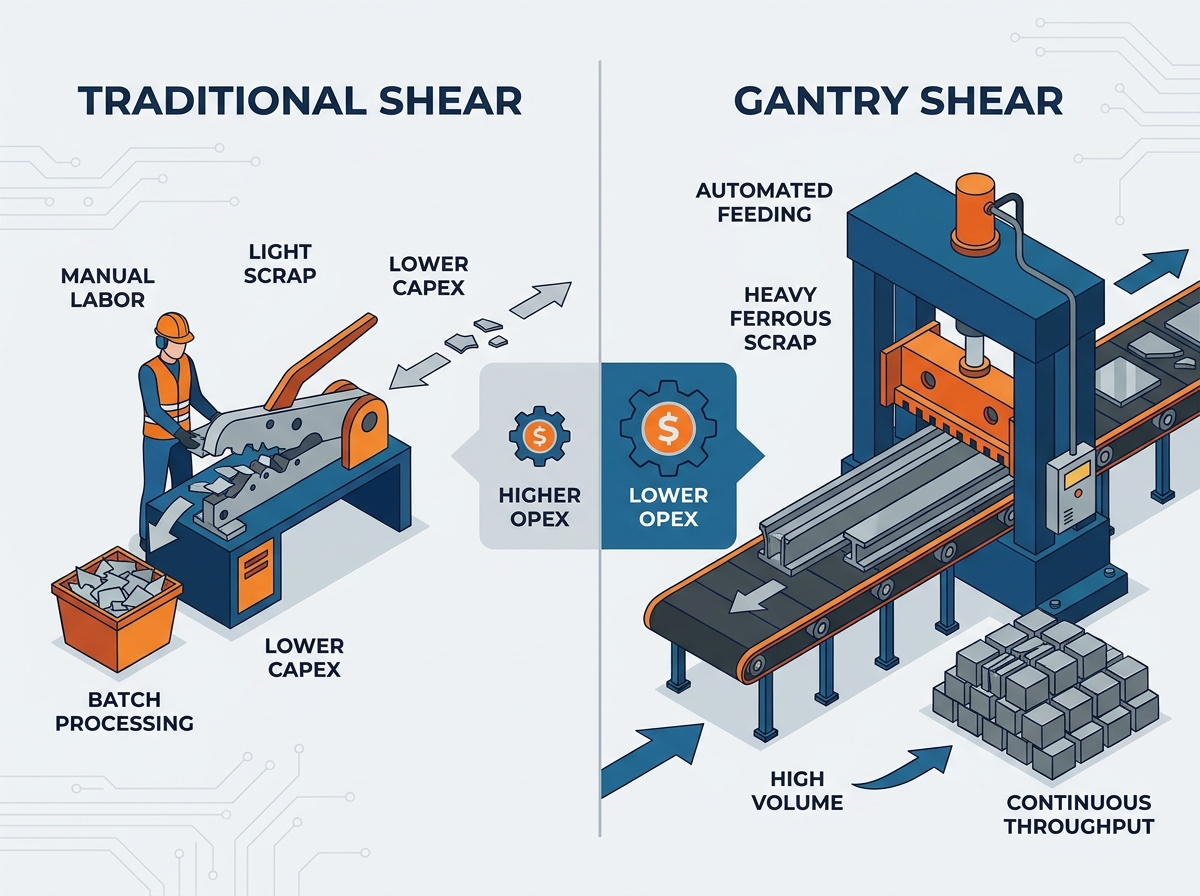
Comparing these systems requires looking at hard metrics. You must evaluate cutting force, labor requirements, and physical footprint carefully before upgrading your yard.
Gantry shears deliver incredible high-tonnage hydraulic force. They often generate between 400 and 1,000+ tons of cutting pressure. They can slice through dense, heavy-gauge materials effortlessly. This raw power prevents material jams. Traditional units offer much lower cutting force. This limits their utility to lighter gauge metals, wiring, and non-ferrous sorting. Pushing traditional shears beyond their limits causes mechanical failure.
Automation drives modern yard efficiency. Heavy-duty systems require minimal operators. You usually need just a single crane operator to feed the hopper. One system monitor watches the automated cycle from a safe distance. This reduces safety liabilities and slashes labor overhead. Traditional models remain highly manual. They require direct operator interaction for feeding and sorting. This increases injury risks and drives up your labor-per-ton costs.
Physical space dictates your equipment choices. Stationary shears require extensive site preparation. You must pour reinforced concrete foundations. They occupy a massive spatial footprint in your yard. Traditional machines require a smaller footprint. They often feature plug-and-play installation. Some models offer limited mobility, letting you move them across different yard zones quickly.
Equipment Comparison Metrics
Metric | Gantry Shears | Traditional Shears |
|---|---|---|
Primary Use | Heavy ferrous, structural steel, plates | Non-ferrous, light gauge, wire |
Throughput Speed | High (Continuous feed) | Low (Batch/Manual feed) |
Labor Needs | Low (Crane operator + Monitor) | High (Manual feeding/sorting) |
Infrastructure | Heavy concrete foundation | Minimal, often plug-and-play |
Buyers often confuse stationary gantry machines with enclosed container shears. Also known as box shears, container units serve a different primary purpose. You must understand these alternatives clearly before making a purchase.
Consider continuous versus batch processing. Gantry shears excel at continuous length reduction of long materials. You keep feeding, and the machine keeps cutting. The side press and lid gather long pipes and beams efficiently. Container shears optimize for rapid, enclosed batch compression. You fill the box, close the heavy lids, compress the scrap horizontally, and cut it. They work incredibly well for mixed, loose scrap that needs densification.
Installation realities differ significantly. Container shears often sidestep heavy foundation requirements. They act as an excellent bridge solution. They work well for yards facing lease restrictions. They also suit locations suffering from poor soil bearing capacity. If you cannot pour thick concrete, a container model provides heavy-duty cutting. You can even relocate them if you move your yard to a new property.
Upgrading your yard involves serious planning. You must evaluate the practical realities of owning heavy machinery to avoid sudden disruptions.
Let us start with Capital Expenditure (CapEx). A high-tonnage machine demands a substantial upfront investment. You must budget for freight, heavy assembly, and foundation pouring. Site engineering alone can cost tens of thousands of dollars. You need cranes for assembly. You must hire specialized technicians for commissioning.
Hydraulic system maintenance requires strict discipline. You must follow preventative maintenance schedules precisely. You are dealing with high-pressure hydraulic fluid, massive pumps, and heavy-duty seals. Ignoring maintenance invites catastrophic downtime. Fluid contamination destroys expensive internal components rapidly. You must monitor fluid temperature and change filters routinely.
Consumables and wear parts need constant attention. You must track blade flipping and replacement frequency. Liner wear occurs over time as steel scrapes against the feed box. You must maintain an on-site inventory of critical spare parts. Waiting for parts stops production entirely. You lose money every minute the machine sits idle.
Operator training takes time. Moving from mechanical shear operation to managing a modern machine presents a learning curve. Your staff must learn to manage a PLC-controlled hydraulic processing center. They need training to recognize system warnings, adjust cutting strokes, and optimize cycle times. Proper training prevents expensive operator errors.
How do you make the final call? Follow this step-by-step framework to evaluate your operation and ensure you select the best processing tool.
Assess Material Profile: Analyze your incoming scrap. Are you processing 80% heavy ferrous structural steel? A heavy-duty setup favors this mix. Do you handle mostly non-ferrous and light scrap? Traditional setups remain better suited for you.
Calculate Target Throughput: Look at your contracted daily outbound volume. Determine if this volume justifies the processing speed of a continuous system. Empty hoppers waste expensive energy. Ensure you have enough incoming supply to keep the machine fed.
Evaluate Site Viability: Audit your physical facility. Do you have adequate space for a large feed conveyor? Check for stable ground to support heavy foundation work. Ensure you have adequate three-phase power availability to run massive electric motors.
Next Steps: Book a site consultation. Speak with an equipment manufacturer directly. Run a custom ROI analysis based on localized labor rates and scrap commodity values. Request layout drawings to see how the machine fits your workflow.
The choice between a heavy-duty system and a traditional shear depends on your specific growth stage. You must base this on your target volume and primary material focus. High-tonnage shears represent the definitive choice for enterprise-level yards processing heavy steel. They automate processing, increase safety, and boost daily tonnage. Traditional shears remain indispensable for granular, non-ferrous operations. They offer flexibility and precise manual sorting capabilities.
Evaluate your current processing bottlenecks today. Assess your labor costs and material backlog. Request a technical spec sheet from a trusted manufacturer. Schedule a facility audit to match machinery tonnage precisely to your exact scrap profile. Taking action now positions your yard for profitable growth in a highly competitive market.
A: The primary difference lies in power delivery. Hydraulic units use pressurized fluid to generate immense, sustained cutting force. Mechanical shears use kinetic energy stored in a spinning flywheel. Hydraulic models cut slower but deliver much higher force. They are perfectly suited for crushing and slicing heavy structural scrap metal without stalling.
A: While fully capable, using them for light non-ferrous scrap is highly inefficient. It wastes massive amounts of electricity and hydraulic energy. Traditional manual or alligator shears handle non-ferrous sorting much better. They offer the speed and precision needed for lighter, high-value materials.
A: These heavy machines require extensive site engineering. You must pour thick, reinforced concrete pads. These foundations are specially designed to absorb massive continuous shock loads and severe vibration. Poor soil requires deep pilings. Always consult structural engineers before attempting installation.
A: ROI timing depends on several variables. These include local labor savings, increased scrap value from denser shipping weights, and reduced processing time. High-volume yards often see ROI significantly faster than anticipated. The massive jump in daily processed tonnage quickly offsets the high initial capital expenditure.


