


Views: 0 Author: Site Editor Publish Time: 2026-11-04 Origin: Site


Investing in industrial recycling equipment is a high-capital decision. It dictates facility throughput, labor allocation, and freight efficiency. Moving beyond basic waste management requires strategic equipment selection. You need to optimize scrap revenue and reduce cycle times effectively. This guide provides a clear framework to evaluate equipment. We base this on material density and daily volume. We strip away marketing claims to focus on operational reality. You will learn how to match machine capabilities to your specific scrap profile. We will explore how automation impacts your daily labor costs. By the end of this article, you will understand exactly how to select the right machinery for your facility.
Volume Thresholds: Horizontal balers become economically viable when daily scrap volume exceeds the practical labor limits of vertical balers (typically 2+ tons per day).
Material Matching: Ram pressure and shear design must align with your primary scrap type (e.g., non-ferrous aluminum vs. high-tensile steel).
True ROI: Profitability relies on maximizing transport payloads and minimizing manual tying labor, not just the initial machine purchase price.
Facility Constraints: Proper implementation requires factoring in operational footprint, continuous feed setups, and 3-phase power availability.
Facility managers often struggle to identify the exact moment to upgrade their recycling equipment. You must evaluate your current labor costs against potential automation benefits. A vertical baler works well for low-volume operations. However, it requires constant manual intervention. Operators must manually load the chamber, wait for the cycle, and tie off each bale. This batch-loading process drains labor hours quickly.
A Horizontal Metal Baler changes this dynamic entirely. It allows for continuous feeding. You can load material using conveyors, skid steers, or tippers while the machine operates. This eliminates the dead time associated with batch loading. We typically see a distinct economic shift when a facility processes more than two tons of scrap daily. At this volume, the labor savings from continuous feeding begin to outweigh the higher initial capital expenditure.
You must also analyze your specific scrap material profiles. Different metals behave differently under pressure. Aluminum extrusions require different shearing forces than copper wire. Steel turnings present unique compaction challenges compared to tin cans. A horizontal system provides the necessary shearing blades to cut oversized materials. It also delivers the massive compaction force needed to eliminate memory in high-tensile metals. If your facility handles rigid, bulky, or high-memory metals, a horizontal machine becomes an operational necessity rather than a luxury.
Common Mistake: Many buyers underestimate their future volume. They purchase a machine suited for today's tonnage. Two years later, they outgrow the equipment. Always calculate your projected growth over a five-year horizon before making a final selection.
Selecting the right equipment requires a deep dive into technical specifications. You cannot rely on brochure summaries alone. You must understand how ram pressure, automation, and hydraulics interact.
Pressing force directly dictates your final bale weight. Manufacturers measure this force in tons. Higher ram pressure compresses metal more tightly, removing air pockets. This creates denser bales. Denser bales link directly to freight cost reductions. Logistics companies charge by the truckload. If you load light, fluffy bales, you hit the volume limit before the weight limit. You end up paying to ship air. High ram pressure ensures you max out legal truck weight limits every time. This maximizes your freight efficiency.
Labor is your most expensive ongoing operational cost. You must assess the labor cost offset of auto-tie systems for high-volume operations. Manual-tie machines require an operator to thread and secure wires for every bale. This halts production. Auto-tie systems handle this automatically, allowing continuous extrusion.
Tying System Comparison
System Type | Labor Requirement | Throughput Speed | Ideal Application |
|---|---|---|---|
Manual-Tie | High (Dedicated operator needed) | Slower (Stops for tying) | Low to medium volume facilities |
Auto-Tie | Low (Occasional wire spool changes) | Fast (Continuous operation) | High-volume MRFs and scrap yards |
You must also evaluate continuous loading mechanisms. Hoppers and feed conveyors dictate how efficiently material enters the chamber. Pit conveyors allow operators to push scrap directly into the feed system. Incline conveyors lift material from the floor level. Magnetic sorting conveyors can separate ferrous from non-ferrous metals before baling. Choose a feed system matching your floor layout and material handling vehicles.
The hydraulic system acts as the heart of your baler. Multi-shift operations push these systems to their thermal limits. You must evaluate three critical hydraulic components:
Cylinder Size: Larger cylinders deliver more force but require more fluid volume. They must be sized correctly for your target cycle times.
Cycle Times: Faster cycle times increase daily throughput. However, they generate more heat within the hydraulic fluid.
Cooling Systems: Air or water chillers prevent thermal failure. Overheated hydraulic fluid loses viscosity, causing pressure drops and seal damage.
Equipment sizing must align with your facility's specific operational scale. A machine built for a massive scrap yard will overwhelm a small manufacturing plant. Conversely, a small baler will bottleneck a large recovery facility.
Manufacturing plants usually generate scrap as a byproduct of their main operations. They do not process scrap as their primary business. For these environments, closed-door horizontal balers offer the best solution. These machines process material in batches. The door remains closed during compaction, creating highly dense, uniform bales.
You should prioritize versatility here. A mid-sized facility might process aluminum offcuts one day and steel stampings the next. The machine must handle mixed-metal processing without jamming. Furthermore, smaller facility footprints demand compact equipment designs. Closed-door models typically require less floor space than continuous extrusion models. They fit easier into existing production workflows.
Materials Recovery Facilities (MRFs) and dedicated scrap yards operate on a different scale entirely. Throughput is their primary metric. For these environments, you should focus on heavy-duty, open-end auto-tie balers or two-ram balers.
Open-end balers extrude bales continuously. The friction of the material passing through the chamber creates the backpressure needed for compaction. Two-ram balers offer even greater versatility. They use one ram to compact the material and a second ram to eject and tie the bale. Emphasize high-shear capabilities when evaluating these machines. They must slice through bulky items like appliances or large extrusions without hesitation. Continuous throughput is non-negotiable for large-scale operations. Any bottleneck in the baling process backs up the entire yard.
Purchasing industrial recycling equipment requires a strict financial justification. You must look beyond the machine's base price. True return on investment comes from transforming your daily operational efficiencies.
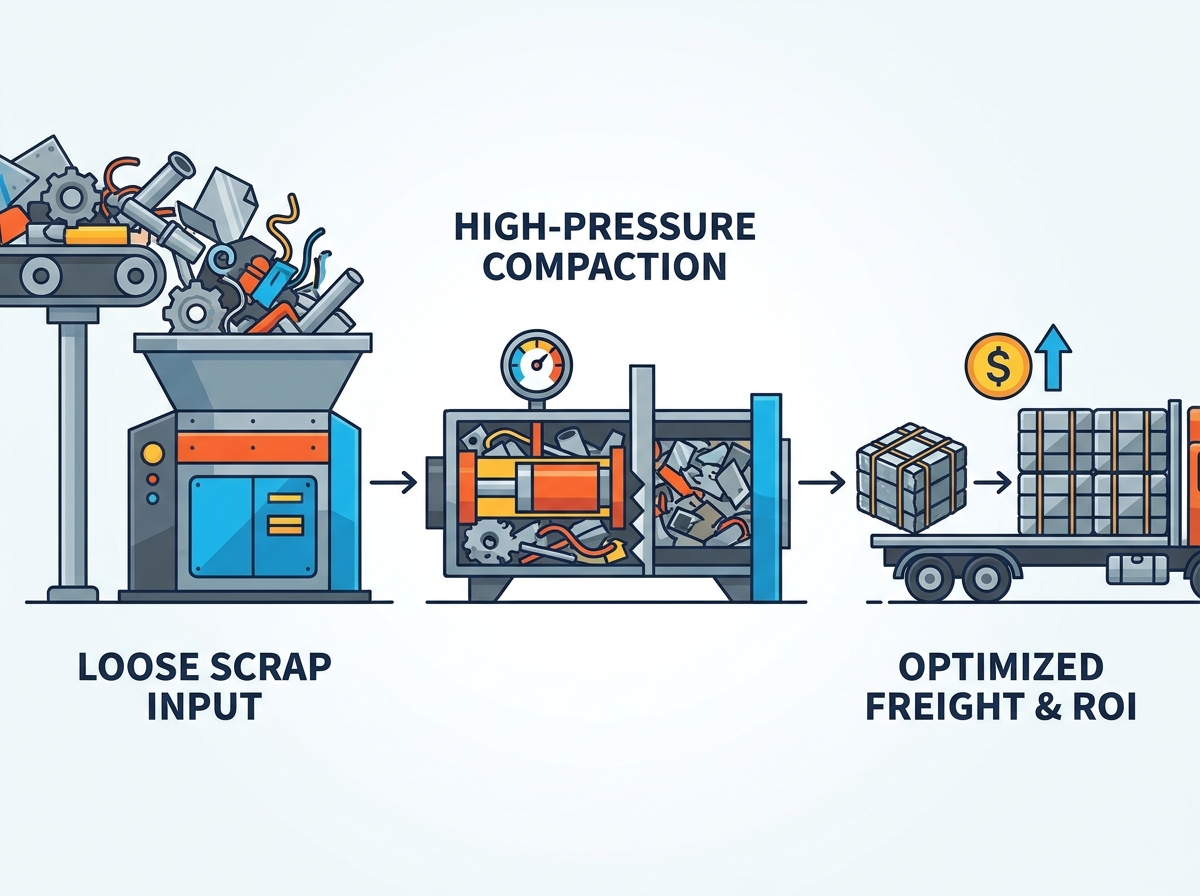
Freight costs destroy recycling profit margins if left unmanaged. You must understand the logic of scrap volume reduction. Loose scrap takes up immense space. A standard dry van might hold only 10,000 pounds of loose aluminum before reaching its volume capacity. The truck is visually full, but legally underweight.
By compressing that same aluminum into dense bales, you change the equation. You can easily fit 40,000 pounds of baled aluminum into the same trailer. This reduces your pickup frequency by 75%. You pay for one truck instead of four. This dramatic reduction in transportation fees accelerates your ROI faster than any other factor.
Manual scrap handling drains your workforce. You must quantify the hours saved by transitioning to automated baling. Consider a facility where three workers spend four hours daily breaking down, moving, and loading loose scrap. That equals 60 labor hours per week.
An automated horizontal system with a feed conveyor can reduce this to one operator spending two hours a day. You save 50 labor hours weekly. You can reallocate these workers to revenue-generating production tasks. This labor shift directly improves your bottom line.
Foundries and recyclers prefer standardized, mill-ready bales. Loose scrap requires the buyer to process it before melting. They pass this processing cost back to you through lower purchasing rates.
Mill-ready bales drop directly into furnaces. They require no additional handling by the buyer. Because you have already done the processing work, buyers pay a premium per ton. When calculating your ROI, you must factor in this increased per-ton revenue. Over thousands of tons, this premium significantly offsets the initial equipment investment.
Buying the machine is only the first step. Proper installation dictates your future success. Poor site preparation leads to delayed commissioning, unsafe workflows, and premature equipment failure.
Many buyers look only at the machine's dimensions. This is a critical error. You must detail the necessity of clearance space. The operational footprint is much larger than the equipment itself. You need a dedicated loading zone for wheel loaders or forklifts to maneuver safely. You need staging areas for incoming loose scrap and outgoing finished bales.
You also need clearance for maintenance. Technicians must access hydraulic panels, change wire spools, and replace shear blades. If you install the machine tight against a wall, routine maintenance becomes incredibly difficult and dangerous. Always map out the turning radius of your largest forklift when designing the workflow.
Industrial balers consume massive amounts of power. You must highlight the need for appropriate industrial power supplies. Most commercial machines require 3-phase electrical connections. Standard facility wiring will not suffice. You must consult a licensed electrician to verify your panel can handle the amperage spikes during the compaction stroke.
Furthermore, these machines generate severe vibration and weigh tens of thousands of pounds. Standard warehouse floors will crack under the stress. You need stable, reinforced concrete foundations. Check the manufacturer's requirements for concrete PSI and thickness. Pouring a specialized concrete pad is often necessary before delivery.
High-pressure hydraulic equipment presents serious workplace hazards. You must outline compliance requirements. OSHA standards dictate specific safety protocols for baling equipment. Your machine must feature functional safety interlocks. If an access door opens, the machine must shut down instantly. Emergency stop buttons must be accessible from multiple angles.
Do not underestimate the learning curve. Operating these machines requires specialized knowledge. Operators must understand hydraulic pressure gauges, wire tying mechanisms, and jam clearing procedures. Inadequate training leads to severe injuries and catastrophic machine damage. Demand comprehensive, on-site operator training from your equipment supplier during commissioning.
Selecting industrial recycling equipment requires a methodical approach. You should start by defining your daily tonnage and your primary material type. Use these metrics to determine your baseline compaction needs. Next, filter your options by your available facility footprint and power infrastructure. Finally, validate your choice by calculating your freight savings and labor reallocation.
Do not rush this decision. We recommend taking actionable next steps before signing a purchase order. Request a customized site audit from a reputable manufacturer. Have them evaluate your floor plan and electrical capacity. Submit actual material samples to the manufacturer for test baling. This proves the machine can achieve your desired bale density. By following this structured evaluation framework, you will secure equipment that optimizes your recycling operations for years to come.
A: A well-maintained industrial baler typically lasts 10 to 15 years. Lifespan depends heavily on operational hours and maintenance routines. Machines running single shifts last longer than those running 24/7. Strict adherence to preventative maintenance, like changing hydraulic fluid and replacing worn shear blades, significantly extends equipment longevity.
A: Yes, but with limitations. Two-ram systems handle mixed metals better than single-ram systems. However, you must carefully manage the transition between materials to prevent cross-contamination. Baling copper immediately after steel without clearing the chamber reduces the scrap value of your non-ferrous bales.
A: Installation typically takes three to five days once the machine arrives. However, site preparation takes weeks. You must pour concrete pads, upgrade electrical panels, and adjust facility layouts beforehand. Operator training usually requires an additional two days after physical installation is complete.
A: Closed-door balers process material in distinct batches against a reinforced door, making them ideal for lower volumes and mixed materials. Open-end balers extrude material continuously through a restricted channel. They suit high-volume facilities needing non-stop processing and automated tying systems.


