


Views: 0 Author: Site Editor Publish Time: 2026-11-09 Origin: Site


Selecting the wrong metal cutting equipment creates severe operational bottlenecks for any industrial facility. It leads to excessive maintenance downtime, stalled production schedules, and introduces significant safety liabilities for your workforce. An Alligator Shear represents a major capital expenditure for your business. Making the right choice requires carefully balancing cutting force, cycle times, and physical facility constraints against your specific scrap profile. Buying too small limits your processing capability, while buying too large wastes valuable capital and floor space. We built this guide to help you navigate these complex purchasing decisions effectively. You will learn how to evaluate your true capacity needs and compare alternative cutting solutions available in the market today. We also provide an evidence-based framework to evaluate, compare, and shortlist manufacturers for scrap yards, recycling centers, and fabrication workshops.
Match cutting force (tonnage) and blade length strictly to your maximum material thickness and tensile strength, not just average daily volume.
Alligator shears excel in versatility and footprint, but high-volume, continuous-feed operations may require evaluating gantry or container shears instead.
Prioritize vendors that offer transparent service Level Agreements (SLAs), readily available spare parts, and verifiable safety compliance (e.g., CE/OSHA standards).
Every successful equipment purchase begins by analyzing your current operational limitations. You must understand your material flow before evaluating machine specifications. This prevents you from buying an over-engineered machine or one incapable of handling your toughest jobs.
You need to define the exact metals you process daily. Scrap yards handle a vast mix of materials, from soft non-ferrous metals like copper and aluminum to heavy steel profiles and reinforced rebar. You should categorize your scrap inventory by size, shape, and grade. Tensile strength dictates the required hydraulic cutting force. For example, cutting high-carbon steel rebar requires significantly more tonnage than slicing through aluminum extrusions of the exact same diameter. Keep a detailed log of the thickest and hardest materials you encounter. This data forms the baseline for your tonnage requirements.
Calculate your required throughput per hour to identify actual bottlenecks. Many facility managers mistakenly blame machine speed when manual handling causes the real slowdown. Assess whether your current bottleneck stems from machine cycle time or the manual feeding process. If an operator takes twenty seconds to position a bulky piece of scrap, buying a machine capable of a three-second cycle time will not improve overall throughput. You must balance machine speed against realistic human loading capabilities. High cycle times only benefit operations utilizing automated feeding systems or pre-sorted, easily handled scrap materials.
Evaluate the physical footprint available in your fabrication workshop or scrap yard. Industrial cutting machines require substantial infrastructure. Consider the following facility constraints before finalizing your selection:
Power Availability: Confirm you have the correct 3-phase power infrastructure to handle industrial hydraulic pumps. Voltage mismatches require expensive transformers.
Clearance Zones: Operators need safe clearance zones around the machine to maneuver long pieces of scrap without obstruction.
Foundation Strength: High-tonnage machines generate intense vibrations. You may need reinforced concrete pads to prevent structural damage over time.
Environmental Exposure: Determine if the machine will operate indoors or outdoors. Outdoor setups require specialized weatherproofing for electrical and hydraulic components.
You must ensure an alligator shear actually fits your processing methodology. Different scrap volumes and shapes demand different cutting technologies. Comparing alternatives helps validate your investment decision.
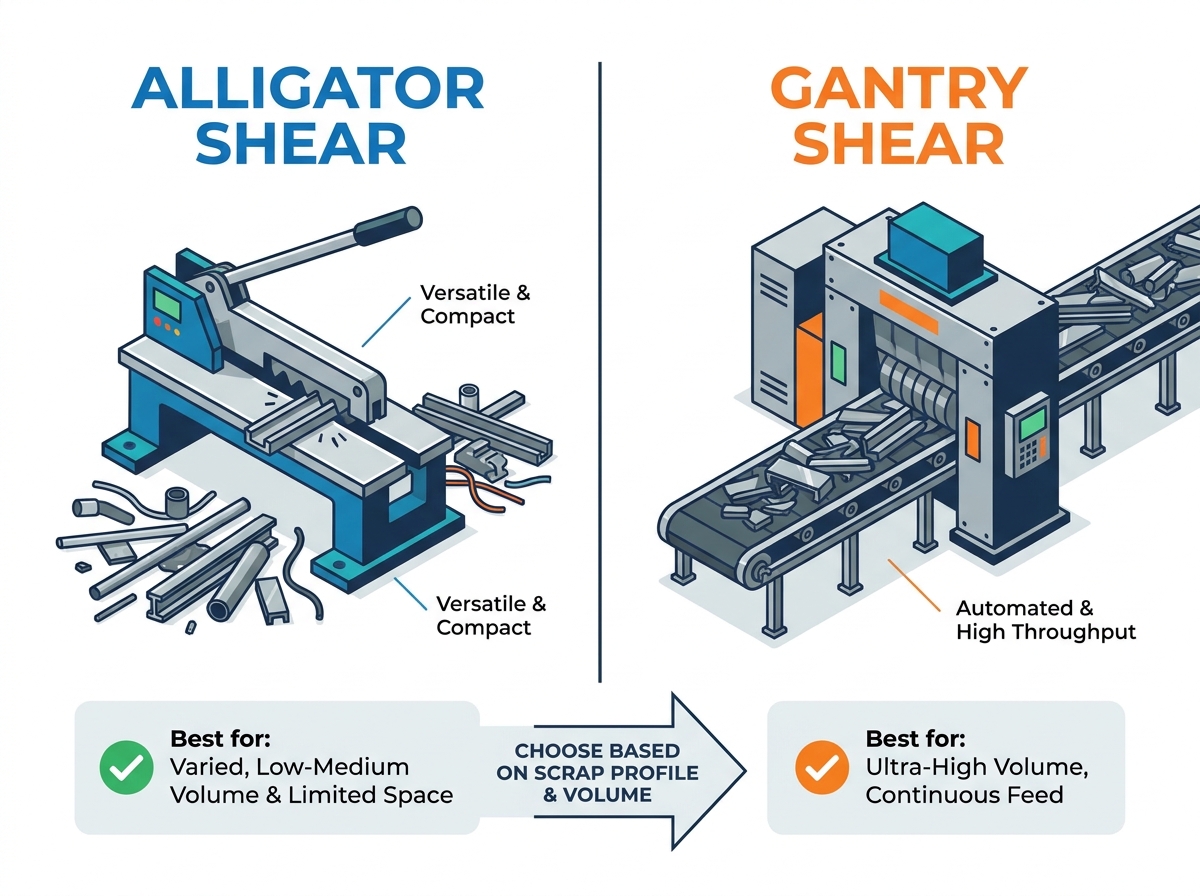
You should choose an alligator shear for varied, lower-to-medium volume scrap processing. They excel at cleaning specific parts, separating mixed metals, and operating in facilities lacking expansive floor space. They require a much lower upfront capital investment compared to larger automated systems. Their simple lever-action design makes them highly versatile for irregular shapes.
You should avoid an Alligator Shear if you manage ultra-high volume, continuous heavy-duty scrap processing. Manual feeding becomes highly inefficient at massive scales. A gantry shear utilizes an automated feed and continuous cutting cycle. This automation yields a much better return on investment for large-scale operations handling hundreds of tons per day. Manual feeding limits your maximum daily throughput.
Alligator shears utilize a hinged jaw, creating a lever-action cut. This design easily accommodates bulky, irregular, and oversized scrap metal. The open-jaw design allows operators to feed oddly shaped pipes and structural steel from multiple angles.
Guillotine shears operate differently. They feature a blade dropping vertically along a straight guide path. This mechanism is perfect for precise, straight cuts on flat sheet metal or uniform plates. However, guillotine shears struggle with bulky, three-dimensional scrap because their fixed throat limits material entry. If your primary goal involves volume reduction of irregular shapes, the alligator design remains superior.
Cutting Equipment Comparison Chart
Feature | Alligator Shear | Gantry Shear | Guillotine Shear |
|---|---|---|---|
Primary Use Case | Irregular scrap, cleaning parts | High-volume continuous scrap | Flat sheet metal cutting |
Feeding Mechanism | Manual feed | Automated / Crane feed | Manual or Conveyor feed |
Space Requirement | Small to Medium footprint | Very Large footprint | Medium footprint |
Upfront Cost | Low to Moderate | High | Moderate to High |
Once you confirm an alligator machine fits your operational model, you must evaluate technical specifications. Buying the right model prevents premature equipment failure and ensures maximum operator safety. Focus heavily on tonnage, blade dynamics, and mandatory safety features.
Do not buy a machine based on maximum capacity alone if that heavy material only represents five percent of your total volume. Apply a practical framework for sizing. You should size the machine for your eighty percent use case. If you primarily process light aluminum frames, a massive 600-ton shear wastes energy and capital. However, ensure the machine possesses a safety margin for occasional heavy cuts. Pushing a machine to its maximum tonnage continuously degrades hydraulic seals and stresses structural pivots. A 20% buffer above your standard processing needs extends machine lifespan significantly.
Blade length directly impacts operator throughput and cutting physics. Longer blades allow operators to position multiple smaller pieces per cut. This speeds up processing for items like small pipes or wire bundles. However, you must understand the fulcrum effect. The cutting force is highest deep in the throat of the jaw, near the pivot point. The force decreases significantly at the blade tip. Therefore, longer blades require much higher overall machine tonnage to maintain sufficient cutting force at the far end of the jaw. A wide jaw opening also helps accommodate bulky items, but ensure the hydraulic cylinder has the stroke capacity to close the jaw efficiently.
Industrial shears pose severe pinch-point hazards. You must prioritize safety mechanisms during your evaluation. Look for manufacturers adhering to recognized industry safety guidelines, such as CE certifications or OSHA machine guarding standards. Mandatory evaluation points include:
Heavy-duty blade guards: These prevent operators from accidentally reaching into the cutting zone during operation.
Foot-pedal controls: Hands-free operation allows workers to secure materials safely. The pedal must feature an integrated emergency stop (E-stop) function.
Anti-tie-down mechanisms: These systems prevent operators from bypassing safety controls by taping down buttons or pedals.
Hydraulic overload protection: Relief valves automatically bypass fluid if the machine attempts to cut material exceeding its structural capacity, preventing catastrophic failure.
Buyers frequently debate whether to purchase brand-new equipment or source used machinery from the secondary market. Both paths offer distinct advantages, but understanding the hidden lifecycle costs protects your operational budget.
Used equipment offers immediate capital expenditure savings. You can often acquire a high-tonnage machine for a fraction of its original retail price. However, these savings carry substantial hidden risks. Used machines often suffer from severe hydraulic pump wear, cylinder wall scoring, and degraded seals. You also face unseen metal fatigue in the main jaw pivot assembly. A sudden pivot failure halts production entirely and requires extensive metallurgical repair.
You must factor in the cost of immediate repairs when evaluating used models. A used shear almost always requires immediate blade replacements and comprehensive hydraulic fluid flushes. Furthermore, the lack of a factory warranty exposes you to sudden repair bills. If a main directional valve fails on a used machine, you bear the total cost of parts and emergency technician labor. New machines mitigate these issues through comprehensive warranties and factory-fresh components designed for thousands of hours of trouble-free service.
Follow a strict decision framework when navigating the new versus used dilemma. Consider these sequential rules:
Opt for used equipment only if the seller provides a fully documented maintenance log spanning the machine's entire history.
Never purchase a used shear without inspecting it under a heavy cutting load to check for pressure drops or pivot deflection.
Calculate your daily duty cycles. For operations running single shifts occasionally, a high-quality used machine might suffice.
For high-duty cycles involving constant daily use, the factory warranty and modern electrical efficiency of a new machine typically yield a much stronger three-year return on investment.
Buying the machine is only the first step. Successfully integrating it into your workflow requires careful planning. You must account for operator ergonomics, maintenance schedules, and facility preparation.
Acknowledge that these shears require active manual feeding. Human interaction remains constant throughout the shift. Outline the necessity of strict safety protocols before the machine ever powers on. Create ergonomic setups to prevent operator fatigue and musculoskeletal injuries. Install material support stands or roller tables at the exact height of the shear's lower blade. This prevents workers from constantly bending and lifting heavy scrap. Proper ergonomics directly increase daily throughput and dramatically reduce workplace injury claims.
Highlight the reality of daily and weekly maintenance routines. Industrial shears cannot survive neglect. Operators must grease all main pivot points daily to flush out metallic dust and maintain smooth articulation. Maintenance staff must check hydraulic fluid levels and monitor operating temperatures constantly. Most importantly, technicians must adjust blade gaps regularly. An improper blade gap allows thin materials to fold between the blades instead of cutting cleanly. This folding creates massive lateral stress, eventually causing blade chipping or jaw misalignment.
Account for practical lead times when planning your installation. Site preparation takes time. Larger models require specialized concrete pads that need several weeks to cure properly before bearing dynamic loads. You must also schedule licensed electricians to wire heavy-duty disconnect switches and run appropriate conduit. Failing to align equipment delivery with site readiness results in machines sitting idle on your loading dock.
Choosing the right manufacturing partner ensures long-term operational success. The procurement process requires active diligence to separate reliable vendors from pure machinery brokers.
Never purchase an industrial shear based solely on a glossy brochure. You must request physical proof of capability. Send a sample of your toughest, most abrasive scrap material directly to the manufacturer. Demand a video-documented test cut showing their machine processing your specific sample. The video should demonstrate smooth cutting without engine laboring or excessive machine vibration. If a vendor refuses to perform a test cut, immediately remove them from your shortlist.
Ask highly specific questions about post-sale support infrastructure. Inquire about their spare parts inventory strategy. Ask if consumable items like blades, bolts, and hydraulic seals are stocked locally or shipped internationally. Extended shipping times for basic wear parts paralyze your production line. Furthermore, question their technical support response times. You need a vendor capable of deploying field technicians or providing immediate remote diagnostic support during critical breakdowns.
Differentiate carefully between structural warranties and wear-parts coverage. Manufacturers often advertise impressive five-year structural warranties covering the main steel frame. However, they frequently limit coverage on hydraulic pumps, valves, and electrical relays to just one year or less. Blades and seals are generally considered consumable wear items and receive no warranty at all. Read the fine print to understand exactly what financial protections you hold during the first 24 months of operation.
Selecting the ideal industrial shear requires a methodical, evidence-based approach. The right choice strictly aligns with your specific material profile and facility constraints rather than just the lowest sticker price. By understanding your volume bottlenecks, prioritizing operator safety, and evaluating long-term operational expenses, you secure equipment that genuinely enhances productivity.
Take immediate action by auditing your current scrap volume. Document your thickest materials and calculate your required hourly throughput. Prepare a diverse material sample list. Armed with this concrete data, you can confidently contact vendors for technical consultations and demand precise equipment recommendations tailored to your operational realities.
A: It depends entirely on the machine's tonnage and the material's tensile strength. A 500-ton shear handles significantly thicker mild steel than a 200-ton shear. You cannot rely on a universal thickness rule. Always refer to the manufacturer's specific capacity chart for different metal grades.
A: Blade lifespan varies heavily by usage and material. Cutting clean aluminum extends blade life considerably. Cutting abrasive, dirty, or hardened steel requires more frequent rotation or replacement. Fortunately, most industrial blades feature four usable edges. You can rotate them three times before requiring complete replacement.
A: Yes, you can operate them outdoors, but it requires specific preparation. You need robust weatherproofing for all electrical components and control panels. Additionally, cold weather increases hydraulic fluid viscosity. You may necessitate integrated hydraulic fluid heaters to maintain optimal operating temperatures during winter months.
A: Standard models may be in stock and available within 1 to 3 weeks. However, custom builds or ultra-high-tonnage models typically take 8 to 16 weeks to manufacture and deliver. Delivery timelines depend heavily on the manufacturer's global supply chain and current order backlog.


