


Views: 0 Author: Site Editor Publish Time: 2026-11-12 Origin: Site


Industrial recycling presents a high-stakes reality. Purchasing a Scrap Metal Baler Shear represents a massive capital expenditure for any yard. Make the wrong choice, and you will face severe processing bottlenecks. You will experience excessive downtime and rapidly shrinking profit margins. Today, modern recycling facilities process increasingly complex materials. You must operate under tighter financial constraints than ever before. We know you must process mixed metals faster while keeping overhead remarkably low.
Meeting these demands requires robust machinery. You must tailor it precisely to your facility's daily material flow. This guide provides a vendor-neutral, evidence-based framework. You will learn how to evaluate, compare, and confidently select the right equipment. We will help you align new machinery directly with your target volume. You will match it to your unique material types and strict facility constraints effortlessly.
Assessing material density and daily throughput is the required baseline before comparing machine tonnage.
Machine architecture (Single-box, Two-ram, Vertical, or Versatile Shear/Logger) dictates both footprint requirements and labor efficiency.
True ROI is measured not by initial capital cost, but by calculating cost-per-ton processed, accounting for hydraulic efficiency, energy consumption, and maintenance downtime.
Successful implementation requires early auditing of facility foundations, electrical capacity, and operator safety protocols.
You must define your processing bottlenecks early. Manufacturers often promote peak capacity numbers. They test machines under perfect, uninterrupted conditions. Real-world daily operational throughput looks much different. You must account for material loading delays. Operator fatigue also reduces daily output significantly. Minor material jams slow down the entire production line. We recommend discounting peak manufacturer claims by at least twenty percent. This gives you a realistic daily production target.
Next, you must evaluate your material composition profile accurately. The specific mix of metals dictates your machinery needs. Processing light aluminum scrap requires less shearing force. However, processing heavy-duty structural steel demands massive hydraulic power. You need to identify your primary intake materials.
Ferrous metals: Heavy steel beams, cast iron, and automotive panels.
Non-ferrous metals: Aluminum extrusions, copper wire, and brass fixtures.
Mixed light scrap: White goods and thin sheet metal.
Finally, establish clear success criteria. You need hard key performance indicators (KPIs) for your new equipment. Clear KPIs guide objective buying decisions. Set a concrete goal to reduce pre-sorting time by twenty percent. Aim to increase bale density to maximize your freight payloads. You might target lowering energy consumption per ton processed. Measure these metrics closely during the trial phase.
Common Mistake: Do not assume peak throughput equals your daily average. You will fall short on client delivery contracts if you ignore real-world loading times.
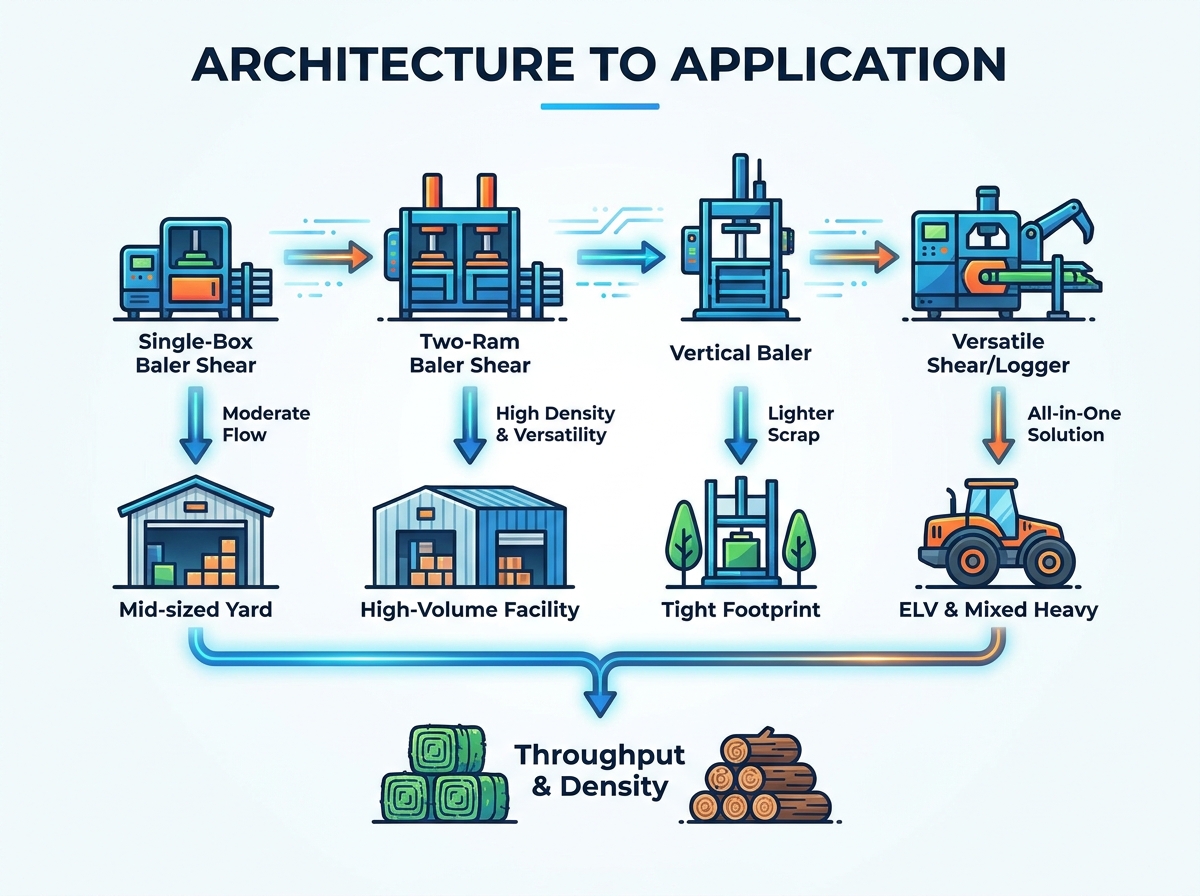
Machine architecture dictates your facility footprint. It also controls your labor efficiency. You must match the design to your specific application. A heavy-duty yard needs different equipment than a specialized non-ferrous facility. Let us break down the primary machine categories.
Table: Comparison of Scrap Baler Shear Architectures
Machine Type | Best Suited For | Primary Limitations |
|---|---|---|
Single-Box | Mid-sized yards needing standard baling capabilities. | Slower cycle times compared to continuous feed systems. |
Two-Ram | High-volume recycling requiring high bale density. | Requires a much larger footprint and higher upfront cost. |
Vertical | Tight footprints and lighter non-ferrous scrap. | Cannot handle heavy structural steel effectively. |
Versatile Shear/Logger | Processing end-of-life vehicles and mixed heavy scrap. | Complex maintenance requires highly specialized technicians. |
Single-Box Baler Shears are highly popular. They work best for mid-sized yards. These facilities need standard baling with moderate shearing capabilities. They offer great value for general scrap. However, they have distinct limitations. They suffer from slower cycle times compared to continuous systems. Operators must wait for the box to clear before reloading.
Two-Ram Baler Shears dominate large operations. They are best for high-volume, large-scale recycling operations. They provide incredibly high bale density. They offer excellent multi-material versatility. You can switch from aluminum to steel quickly. The main limitations include a massive facility footprint. They also carry a significantly higher upfront purchase price.
You must also choose between Vertical vs. Horizontal Configurations. Vertical machines are best for tight footprints. They excel at processing lighter non-ferrous scrap securely. Horizontal machines are better for heavy-duty, continuous feed operations. They accommodate conveyors easily. They handle massive volumes of steel scrap without jamming.
Finally, consider Versatile Shear/Baler/Loggers. These machines are best for specific demanding environments. Facilities needing an all-in-one solution love them. They excel at processing end-of-life vehicles (ELVs). They handle mixed heavy scrap efficiently. They fold, compress, and shear car bodies in minutes.
Many buyers focus exclusively on sheer pressing force. This is a critical mistake. You must look beyond raw tonnage. Sustained operational success relies on multiple hidden factors. We will explore the critical dimensions you must evaluate.
The hydraulic system acts as the heart of your machine. Hydraulic block design matters more than isolated shear force numbers. A poorly designed hydraulic block leaks frequently. It causes pressure drops during critical shear cycles. You must also evaluate cooling efficiency carefully. High-volume operations generate immense heat. You must choose between air cooling and water cooling. Water cooling systems maintain lower fluid temperatures efficiently. Air coolers work fine for intermittent use. Sustained continuous operation demands premium thermal management. Overheated hydraulic fluid destroys seals rapidly.
Speed determines your daily profitability. You must compare manual operation against PLC-controlled automation. Manual systems rely heavily on operator skill. Operators grow tired as shifts progress. This fatigue slows down cycle times drastically. Programmable Logic Controllers (PLCs) automate the pressing cycle. Automated continuous-feed systems offset high labor costs. The PLC optimizes ram speeds automatically. It prevents material jams by sensing pressure spikes. This automation protects the Scrap Metal Baler Shear from accidental structural damage.
Processing scrap metal destroys weak steel quickly. You will replace wear parts regularly. You must highlight the importance of maintenance accessibility. Easily accessible shear blades save hours of downtime. Workers should change blades without dismantling the entire head. You must demand high-grade steel wear liners. Hardox steel provides exceptional abrasion resistance. You should also insist on standard replacement parts. Proprietary hydraulic valves trap you into expensive service contracts. Standard parts allow you to source replacements locally. This minimizes preventative maintenance downtime significantly.
Heavy machinery poses severe risks to your workforce. You must outline necessary safety interlocks before purchasing. Doors and access panels must feature automatic shutoffs. Emergency stop redundancies are strictly non-negotiable. Place stop buttons at multiple operator stations. You must also verify compliance with heavy machinery standards. Check the noise decibel ratings closely. Excessive noise violates local occupational safety laws. Evaluate the vibration damping systems. Uncontrolled vibration damages surrounding facility structures over time.
Buying a baler shear requires looking past the initial price tag. The sticker price tells a fraction of the story. You must calculate the ongoing operational costs accurately. True value comes from lowering your daily expenses. We will examine the factors driving operational profitability.
Energy Consumption directly impacts your monthly overhead. You must discuss evaluating motor efficiency closely. Ask vendors for the kilowatt (kW) per ton processed ratio. This metric reveals the machine's true electrical efficiency. You should also demand Variable Frequency Drives (VFDs). VFDs control motor speeds dynamically. They slow down motors during idle periods automatically. This simple addition slashes power bills dramatically. Standard motors run at full speed constantly, wasting massive amounts of electricity.
Optimizing your Freight and Downstream Margins boosts profits instantly. The physical size and density of your bales matter. Dense bales maximize standard trucking weight limits. You want to hit maximum legal payload limits every trip. Shipping loosely packed scrap wastes trailer space. Optimizing bale density directly impacts shipping costs to mills or foundries. Smelters also pay premium rates for uniform, high-density materials. Better compaction means fewer trucks leaving your yard. This efficiency ultimately drives higher net profits for your business.
Buying the machine is only the first step. Installing it successfully requires immense preparation. Many yards fail to prepare their sites properly. This failure leads to delayed launches and structural damage.
You must meet strict Foundation and Footprint Requirements. Heavy-duty shears generate violent physical forces. Detail the structural engineering required to support them. A standard concrete floor will crack immediately. You need specially reinforced concrete pads. These isolated pads absorb intense operational vibration. Hire a structural engineer early in the process. They will analyze soil stability beneath your facility. Doing this prevents catastrophic foundation failures later.
Your Power Infrastructure might need a total overhaul. Discuss the massive risk of undersized electrical panels. These heavy machines pull extreme amperage during startup. Weak electrical grids suffer from brownouts. You face the necessity of upgrading facility power grids prior to installation. Contact your local utility provider immediately. They must confirm your yard can handle the increased electrical load safely.
Do not ignore Operator Training and Adoption. Address the transition period proactively. Old manual machines forgave rough handling. Sophisticated PLC systems require specialized training. You must prevent early-stage operational errors. Untrained workers try to bypass safety sensors. They overfeed the hopper to speed up work. This equipment abuse voids expensive warranties quickly. Dedicate a full week to vendor-led operator training. Keep supervisors present during these critical sessions.
You have defined your needs and prepared your site. Now you must finalize your vendor selection. Comparing quotes requires strict objectivity. Do not rely on glossy marketing brochures.
Start by Requesting Material Tests. Advise buyers to request a live demonstration. You must use your specific scrap materials. Do not rely on generic factory tests. Manufacturers use clean, uniform metal during trade shows. Your yard processes dirty, tangled, unpredictable scrap. Send a truckload of your toughest material to their testing facility. Watch how the machine handles real-world contamination. Observe the actual cycle time in person.
Review the Service Level Agreements (SLAs) meticulously. Outline exactly what to look for in a vendor contract. You need guaranteed physical response times. Demand a technician on-site within twenty-four hours of failure. Verify their local parts availability. Ensure they stock critical components domestically. Review warranty inclusions and exclusions closely. Many warranties exclude hydraulic hoses and wear liners completely.
Use a Final Decision Matrix. Provide a brief checklist for comparing the top two or three vendor quotes objectively. Follow these steps:
Compare hydraulic efficiency: Rank machines by cooling capacity and standard valve usage.
Evaluate service proximity: Give higher scores to vendors with localized service fleets.
Analyze material density: Choose the unit delivering the heaviest payload per cubic yard.
Review structural integrity: Check the thickness of the steel plating on the shear head.
Calculate electrical costs: Favor systems utilizing advanced VFD motor technology.
Selecting the right machinery determines your long-term success. A properly chosen Scrap Metal Baler Shear bridges the critical gap between raw scrap and market-ready commodities. It turns chaotic yard waste into highly profitable, transportable inventory.
We urge decision-makers to look past the sticker price. You must prioritize long-term hydraulic reliability above all else. Emphasize maintenance access over slight discounts on the initial purchase price. Cheap machines cost fortunes in unexpected downtime.
Take action today to secure your operational future. Consult with a qualified structural engineer to assess your foundation. Begin auditing your current yard throughput realistically. Document your material flow, record your exact bottlenecks, and start scheduling live vendor demonstrations immediately.
A: A premium heavy-duty machine generally lasts between 10 to 15 years. This equates to roughly 30,000 to 50,000 operational hours. Strict preventative maintenance extends this life significantly. You must change hydraulic fluids regularly. You must also replace wear liners before structural steel grinds together. Neglecting daily greasing routines can cut the machine's lifespan in half.
A: Blade rotation frequency depends heavily on your material. Processing soft aluminum allows blades to last several months. Shearing heavy, abrasive structural steel requires rotation every 400 to 600 operating hours. You should inspect blade edges weekly. Flipping the blades exposes a fresh cutting edge. Once you exhaust all four edges, you must install entirely new blades.
A: Yes, multi-functional models and two-ram balers handle both effectively. They offer incredible versatility for mixed yards. However, you must schedule production runs carefully. You need complete system purging and cleaning between runs. Leaving steel fragments in the chamber contaminates expensive aluminum bales. This cross-contamination ruins your downstream pricing at the foundry.
A: You should expect a six to nine-month lead time. Manufacturing heavy equipment takes roughly four to six months. Shipping adds several weeks, especially for overseas builds. You must utilize this waiting period for site preparation. Pouring specialized concrete foundations takes weeks to cure properly. Final on-site assembly and testing usually require ten to fourteen days.


