


Views: 0 Author: Site Editor Publish Time: 2026-11-15 Origin: Site


Moving from basic scrap collection to high-margin recycling operations requires specialized processing power. Yard operators face constant pressure to deliver mill-ready materials efficiently. Upgrading to a combined baler and shear solves this fundamental industry challenge. It represents a strategic move to access premium mill pricing. You achieve this primarily by meeting strict density and sizing requirements.
We will provide a clear, evidence-based breakdown of these industrial machines. You will see where they drive the most verifiable returns across different material streams. We will show you how to evaluate them against alternative equipment options. Finally, you will learn what implementation realities to expect during installation and daily operation.
Automotive Dominance: Processing End-of-Life Vehicles (ELVs) remains the primary high-yield application due to the machine’s ability to crush and shear simultaneously.
Material Versatility: Different shear force ratings are required when transitioning between heavy ferrous structural steel and lighter non-ferrous profiles.
Equipment Consolidation: A scrap metal baler shear eliminates the need for sequential processing (separate pre-crushing and shearing), reducing material handling costs.
Selection Reality: Purchase decisions must hinge on verifiable metrics: cost-per-ton processed, blade replacement intervals, and hydraulic cycle times, rather than theoretical maximum throughputs.
End-of-Life Vehicles (ELVs) present a unique business problem for recycling yards. Car bodies are exceptionally bulky and inherently difficult to transport. Transporting whole car chassis wastes immense cargo space and drastically increases freight expenses. Smelters and foundries demand massive size reduction before they accept these materials. They require dense, uniform scrap to operate their furnaces efficiently.
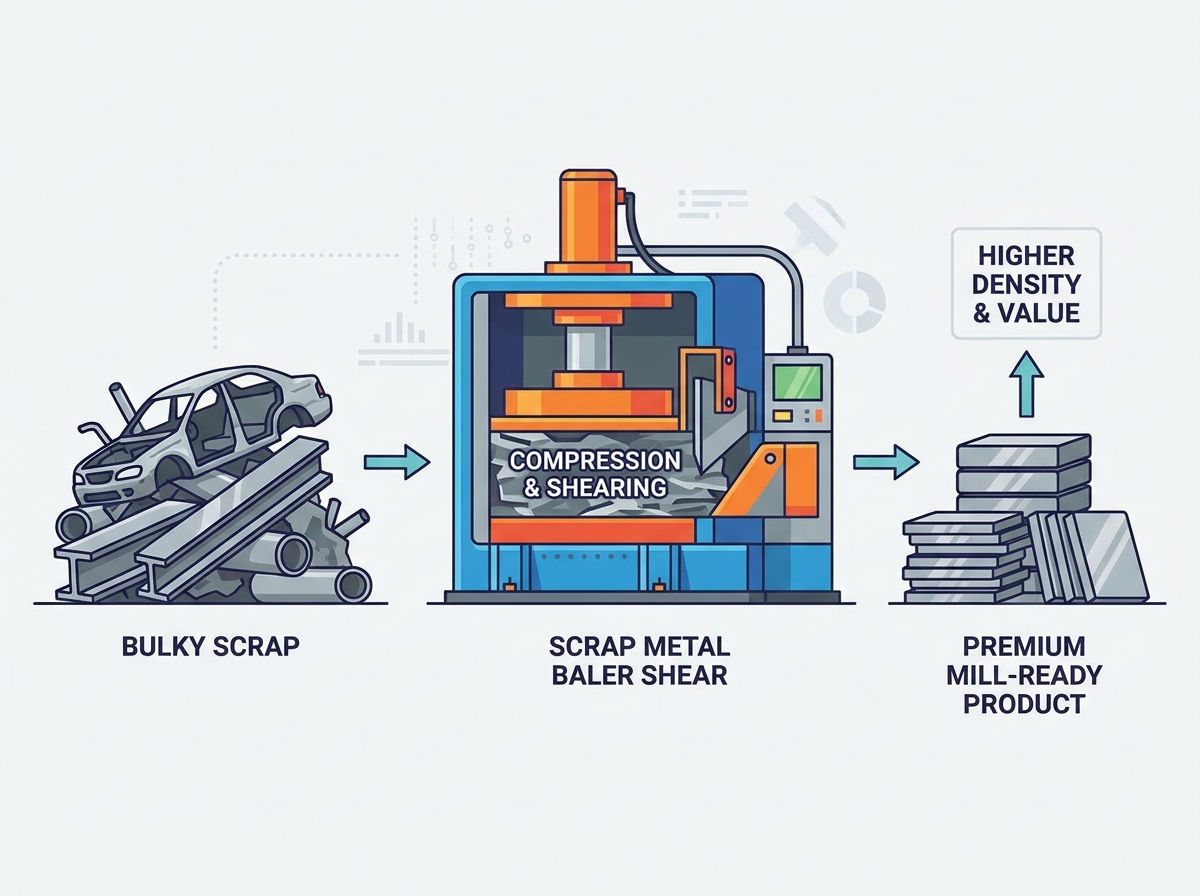
A Scrap Metal Baler Shear offers a definitive solution to this bottleneck. It first uses side and lid compression to crush the vehicle chassis into a highly dense log. Next, the guillotine shear mechanism slices this compacted log into mill-ready, high-density pieces. This dual-action process turns a hollow car body into profitable commodity slices in minutes.
You must evaluate specific performance metrics before dedicating a machine to automotive processing. Consider the following crucial factors:
Assess the required cutting force for automotive applications. You typically need 500 to 800 tons of shear force to cut through reinforced vehicle frames.
Evaluate the feed box size against your average scrap intake. The box must accommodate whole car bodies without requiring excessive manual pre-cutting.
Calculate the hydraulic cycle time. Faster cycle times directly increase your daily processed tonnage.
Implementation carries specific risks you must mitigate. Hidden uncrushables pose the greatest danger to your equipment. Solid steel components, heavy engine blocks, or rogue axles cause severe wear-and-tear. These items damage blades and strain hydraulic cylinders if not pre-sorted. You must enforce strict intake inspections. Train your crane operators to identify and remove hazardous or uncrushable materials before feeding the hopper.
Recycling yards process vastly different materials throughout the week. Handling heavy ferrous structural steel requires a different approach than processing lighter non-ferrous metals. Demolition sites frequently produce massive I-beams, heavy plate steel, and thick rebar. These ferrous materials demand extreme mechanical power.
When processing structural steel, your primary application involves slicing thick, unyielding metals. Success criteria for this application include exceptionally high shear force and robust hold-down clamps. The hold-down clamp secures the material precisely during the cutting stroke. You also need rigid blade tolerances. Tight tolerances prevent heavy plate steel from folding or wedging between the cutting edges.
Processing aluminum and copper profiles presents a completely different challenge. You might bale and shear extruded window frames, manufacturing offcuts, or copper wire. These non-ferrous materials yield easily under pressure. Success here depends on processing speed rather than extreme crushing force. You should look for machines offering fast hydraulic cycle times. High speed maintains maximum throughput for lighter, bulkier materials.
Yard managers face specific operational trade-offs during equipment selection. Follow these assessment steps to determine your optimal machine configuration:
Audit your incoming material ratio. Determine the exact percentage of heavy ferrous versus light non-ferrous scrap.
Assess your processing schedules. Decide if you will run dedicated material batches or mixed daily loads.
Evaluate variable-pressure systems. These advanced systems allow operators to adjust hydraulic force based on the current material stream.
Determine blade clearance requirements. Lighter non-ferrous metals often require tighter blade gaps to achieve clean cuts.
Construction and demolition (C&D) scrap arrives in highly irregular shapes and unpredictable lengths. This chaos creates immediate yard bottlenecks. Unprocessed C&D metal consumes valuable ground space and creates unsafe working conditions. Furthermore, loading this jagged material into trucks results in highly inefficient transport loads. You end up paying to transport empty air.
A heavy-duty Scrap Metal Baler Shear effectively neutralizes these bottlenecks. Modern units feature continuous or semi-continuous feeding capabilities. Operators can continuously drop long pipes, bent rebar, and demolished roofing into the feed box. The machine aggressively compresses and shears this chaotic pile into uniform, stackable batches. This transformation maximizes payload weights for outgoing freight.
You must address several implementation realities before installing these machines for C&D applications. Stationary units require extensive foundation work. They generate massive kinetic energy and vibration during the shearing stroke. You must pour reinforced concrete foundations to absorb this shock safely. Mobile or transportable shears offer flexibility for demolition sites. However, they possess lower maximum shear forces and smaller feed box capacities.
Proper integration remains critical for C&D recovery success. You must pair the shear with appropriately sized material handlers and grapples. A high-capacity shear starves if your crane operator cannot feed it fast enough. You must match the crane's lifting capacity and cycle time to the shear's processing speed.
Selecting the right processing equipment often confuses newer yard operators. They frequently debate between standard balers, container shears, and combined baler shears. Each machine serves a specific industrial purpose. Understanding their limitations prevents costly operational mismatches.
Standard balers excel at compacting light materials into dense cubes. However, their primary limitation is their inability to cut. They only compact material; they do not reduce the actual length or size of heavy structural steel. You should choose a baler shear when your yard requires both multi-dimensional densification and precise sizing to meet exact foundry specifications.
Container shears, often called guillotine shears or inclined shears, focus purely on cutting. Their main limitation lies in their lower density outputs compared to combined baler shears. They often lack the initial multi-dimensional side and lid compression. You should choose a baler shear when space optimization in shipping containers or railcars drives your primary profitability.
Equipment Comparison: Densification and Sizing Capabilities
Equipment Type |
Primary Function |
Key Limitations |
Best Use Case |
|---|---|---|---|
Standard Baler |
Compacts materials into dense, rectangular cubes. |
Cannot cut or reduce the length of heavy steel. |
Light manufacturing offcuts and thin sheet metal. |
Container Shear |
Uses gravity feed to continuously cut long scrap. |
Lacks multi-dimensional pre-compression. Lower density. |
Long pipes, rebar, and loose structural demolition scrap. |
Baler Shear |
Combines multi-axis compression with powerful shearing. |
Requires higher initial capital investment. |
Mixed yards needing high density and precise sizing. |
You must apply a strict cost-benefit framework when evaluating these options. Compare the upfront capital expenditure of a combined baler shear directly against operating separate machines. Look at the combined labor, fuel, and maintenance costs required to run a standalone baler plus a standalone shear. Consolidating into one machine frequently reduces operator headcount and halves diesel consumption.
Procuring heavy recycling machinery requires diligent technical evaluation. You cannot rely solely on marketing brochures. You must interrogate the engineering choices made by the manufacturer. Hydraulic system integrity stands out as the most critical evaluation metric. The hydraulic system acts as the heart and muscle of the machine.
You should specifically look for standardized, readily available hydraulic components. Reputable manufacturers use globally recognized brands like Rexroth or Parker for their pumps and valves. Avoid proprietary, closed-box hydraulic systems. Proprietary systems lock you into expensive manufacturer parts and cause severe delays during emergency breakdowns.
Blade maintenance directly impacts your operational uptime. Assess the cutting tool design carefully. You want blades offering multiple cutting edges. Premium machines feature 4-edge reversible blades. When one edge dulls, operators simply unbolt the blade, rotate it 90 degrees, and resume shearing. You must ask manufacturers about the required downtime for this rotation process.
Buyers must critically analyze throughput claims. You should heavily discount manufacturer theoretical maximums. These numbers assume perfect, uninterrupted feeding of ideally sized, heavy scrap. Calculate your expected throughput based on reality. Factor in your yard's specific material density, your crane operator's feeding efficiency, and daily maintenance pauses.
Chart: Evaluation Metrics Weighting for Equipment Selection
Evaluation Criteria |
Importance Factor |
Key Question to Ask Manufacturer |
|---|---|---|
Hydraulic Standardization |
Critical (High) |
Are replacement pumps available at local fluid power shops? |
Blade Reversibility |
High |
How many labor hours are required to rotate all blade edges? |
Real-World Throughput |
High |
What is the average tonnage per hour for mixed ELV scrap? |
Structural Rigidity |
Medium |
What is the thickness of the feed box floor plates? |
Take concrete next-step actions before signing purchase orders. Request a live trial run using your specific scrap materials if possible. At minimum, ask vendors for reference sites. You want to speak with existing customers who currently process identical scrap profiles in similar environmental conditions.
A Scrap Metal Baler Shear represents a significant capital expense for any recycling operation. This equipment pays off only when matched precisely to your yard's dominant material stream. You must align the machine's capabilities with local mill requirements to maximize your profit margins. Consolidating your crushing and cutting processes into one machine streamlines yard logistics.
Your immediate next step requires precise data collection. We encourage yard operators to conduct a comprehensive one-month material audit. Track your daily incoming tonnage, material types, and average scrap dimensions. Armed with this hard data, you can engage vendors for formal RFQs confidently. You will bypass theoretical sales pitches and demand equipment tailored to your exact operational reality.
A: Blade lifespan heavily depends on material hardness and contamination levels. However, operators typically require blade rotation or full replacement every 300 to 500 operating hours. Processing clean, low-carbon steel extends this lifespan, while heavily contaminated scrap drastically reduces it.
A: Factor in the premium paid by mills for higher-density and perfectly sized scrap. Subtract the machine's operating costs, including electricity or diesel fuel, routine maintenance, and required labor. Finally, account for your specific finance terms and equipment depreciation.
A: Stationary units require significant civil engineering before installation. You must pour reinforced concrete foundations to absorb the massive kinetic vibration generated during shearing. Additionally, the site requires adequate industrial power supply, often demanding a dedicated three-phase high voltage connection.
A: Yes, it can process white goods, but it is often overkill. A standard baler or specialized shredder is usually much more cost-effective for appliances. You should only use a baler shear for white goods if they are heavily mixed with heavy ferrous structural materials.


