


Views: 0 Author: Site Editor Publish Time: 2026-10-26 Origin: Site


Investing in a Stainless Steel Baler represents a substantial capital expenditure. This decision profoundly impacts your daily operational efficiency and long-term profitability. Facility managers often encounter a unique core challenge when processing this specific material. Stainless steel possesses incredibly high tensile strength and formidable shear resistance. Consequently, it requires specialized, highly calibrated hydraulic force to compress effectively. Attempting to process these resilient alloys through standard scrap baling equipment frequently leads to disastrous results. You risk premature machine wear, severely warped compaction chambers, and sudden mechanical breakdowns. You simply cannot afford unexpected downtime when processing high-value scrap materials. This article delivers a highly technical, objective framework to guide your equipment evaluation process. We will help you analyze crucial technical specifications, assess potential implementation risks, and evaluate operational expenses before you request a vendor quote. You will discover exactly how to match machine capabilities to your specific facility constraints.
Material properties dictate force: Stainless steel requires significantly higher hydraulic shear force than aluminum or mild steel.
Match machine to throughput: Facility constraints and scrap volume determine whether a heavy-duty, compact, or portable unit is viable.
Look beyond sticker price: TCO—including liner wear, hydraulic maintenance, and energy consumption—is the true metric of ROI.
Vendor verification is critical: Demand verifiable cycle times and robust warranty coverage for wear parts.
You must establish a concrete operational baseline before evaluating equipment catalogs. Facilities often purchase incorrectly sized machines because they fail to map out their exact material flow.
Document your current daily stainless steel scrap generation accurately. You should project your expected volume growth over the next three to five years. Avoid over-specifying your machine requirements based on rare peak days. Buying excessive capacity inflates your initial capital expenditure (CapEx) unnecessarily. Conversely, under-sizing the machine creates dangerous bottlenecks during your busiest production shifts. Calculate a reliable daily average and select a machine capable of handling it efficiently.
Not all stainless scrap behaves the same way under pressure. You need to define the exact grade, gauge, and physical form of your waste. For example, 304 and 316 series alloys differ in hardness and memory retention. Identify whether you process thin stamping skeletons, loose turnings, or bulky offcuts. Thick-gauge offcuts demand immense shear force to bend. Loose turnings require specific chamber designs to prevent the material from slipping past the ram during compaction.
Define what a successful implementation looks like for your facility. Clear metrics ensure you evaluate vendors objectively. Consider adopting these common success parameters:
Maximized Payload Density: Achieving specific bale densities to maximize shipping container payloads, thereby slashing freight rates.
Floor Space Recovery: Reducing valuable floor space clutter by at least 40% through rapid, efficient scrap removal.
Labor Efficiency: Minimizing operator handling time by implementing automated feeding mechanisms.
Safety Improvements: Eliminating manual cutting and sorting of sharp metal edges to reduce workplace injuries.
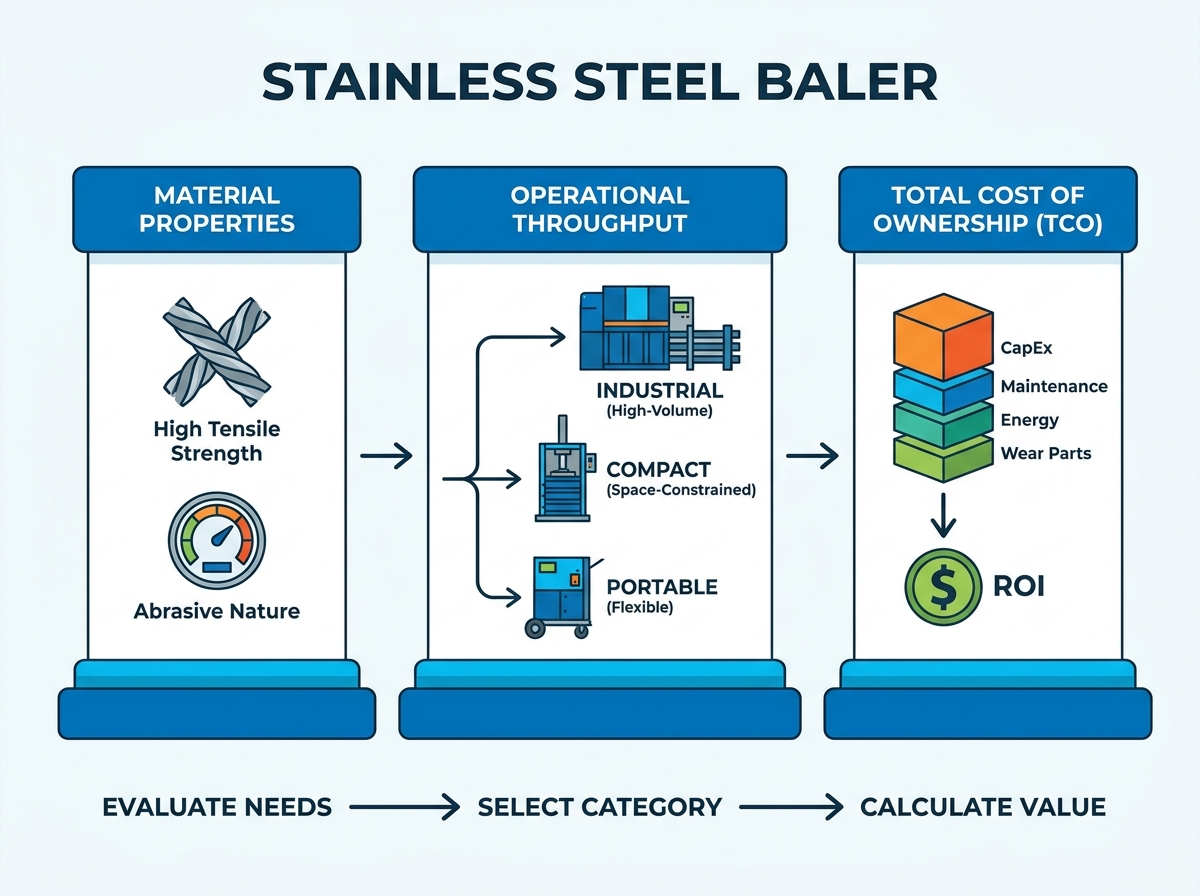
Matching the equipment class to your operational environment prevents over-investment. Different facility sizes and material types dictate different structural requirements.
Facilities running continuous, multi-shift manufacturing lines need unparalleled reliability. An Industrial Stainless Steel Baler excels in large-scale recycling centers. These machines handle constant abuse. The key features to look for include fully automated continuous feed systems and extremely heavy-duty wear liners. Manufacturers typically use Hardox 500 or equivalent abrasion-resistant steel to withstand the relentless friction.
When processing high-tensile, thick-gauge alloys, standard machines will fail structurally. You require a Heavy Duty Stainless Steel Baler designed specifically for structural rigidity. These units feature oversized, high-pressure hydraulic cylinders. They also incorporate heavily reinforced chamber walls. This reinforcement prevents the steel from warping or bowing under extreme compaction pressures.
Small-to-medium enterprises (SMEs) often lack the floor space for sprawling automated systems. If your plant has limited square footage but generates consistent scrap, a Compact Stainless Steel Baler provides the perfect balance. Your primary evaluation criteria should weigh the vertical footprint against cycle time efficiency. These vertical units utilize ceiling height to deliver high pressing force without consuming valuable aisle space.
Some operations span sprawling salvage yards or involve rotating work sites. A Portable Stainless Steel Baler allows operators to bring the machine directly to the scrap. Evaluate these units based on power source flexibility (diesel vs. electric). You must also scrutinize the chassis stability. The frame must safely absorb high-pressure vibrations without needing a permanent concrete anchor.
For operations producing minimal waste, you might consider a Manual Stainless Steel Baler. However, remain highly skeptical of this application. Manual processing is only viable for very thin gauge stainless steel foil or minimal trimmings. Acknowledge the severe physical limitations involved. Operator fatigue risks increase dramatically compared to fully hydraulic models. Manual units cannot achieve the dense compaction ratios necessary for optimal freight savings.
Equipment Category | Best Suited For | Primary Evaluation Feature |
|---|---|---|
Industrial Models | Continuous, multi-shift manufacturing plants | Automated feed systems and Hardox liners |
Heavy Duty Models | Thick-gauge, high-tensile offcuts | Reinforced chamber integrity and massive cylinder bore |
Compact Models | Space-constrained SMEs | Vertical footprint and cycle time ratio |
Portable Models | Large yards requiring mobile processing | Chassis stability and power flexibility |
Manual Models | Light gauge foil and ultra-low volumes | Operator safety limits and leverage mechanisms |
Sales brochures often mask structural inadequacies behind flashy marketing terms. You must strip away the rhetoric and evaluate the raw engineering data.
The hydraulic system acts as the heart of any baling press. Check the system pressure ratings carefully, noting both the PSI (or Bar) and the cylinder bore size. Do not accept vague claims like "high power" or "heavy duty." Demand exact tonnage ratings for the main pressing cylinder. Furthermore, look for name-brand, easily replaceable hydraulic components. Reputable manufacturers use globally recognized valves and pumps. This ensures you can source replacement parts locally, minimizing future downtime.
Stainless steel acts as a highly abrasive agent during the compaction cycle. As the metal scrapes against the chamber walls, it shreds standard mild steel. Verify the inclusion of replaceable, high-Brinell-hardness wear plates. Hardox 450 or 500 plates are industry standards. Ensure the machine design allows your maintenance crew to unbolt and replace these liners easily without cutting or re-welding the main frame.
Modern equipment relies heavily on sophisticated electrical controls. Evaluate the included Programmable Logic Controller (PLC) systems rigorously. A robust control suite protects the machine from operator error. When reviewing the PLC, verify it includes:
Jam-clearing functions: Automated reversing sequences when material binds.
Auto-start capabilities: Photo-eye sensors initiating cycles to save labor.
Diagnostic alerts: Real-time screen notifications for low oil, high temperature, or filter bypasses.
User access levels: Password-protected menus to prevent unauthorized pressure adjustments.
Electrical draw impacts your monthly overhead significantly. Compare the motor sizes against the stated cycle times. A massive motor pulling high amperage might look impressive on paper. However, a faster cycle time utilizing a smaller, more highly efficient motor yields a better long-term return on investment. Evaluate regenerative hydraulic circuits. These clever designs route fluid back into the system during the retraction phase, dramatically speeding up cycle times while saving electrical energy.
Installing heavy industrial equipment requires meticulous preparation. Ignoring facility constraints during the purchasing phase causes costly installation delays.
Assess your electrical infrastructure early. Most heavy machinery requires dedicated 3-phase power availability. Upgrading your electrical panels after the machine arrives wastes weeks of production time. Next, evaluate your foundation requirements. Due to immense operating weight and continuous low-frequency vibration, these presses often require reinforced concrete pads. Placing a heavy-duty press on a standard 4-inch warehouse floor will inevitably crack the concrete and misalign the machine.
Industrial safety is non-negotiable. Scrutinize the machine for necessary safety interlocks and physical guarding. Verify the inclusion of easily accessible emergency stops at every operator station. Ensure the equipment holds certification for your local safety standards. Depending on your region, look for definitive OSHA compliance documentation or verified CE marks. Cutting corners on safety compliance exposes your business to massive liability and operational shutdowns.
You must integrate the machine into your existing maintenance schedule. Identify the required frequency of hydraulic fluid changes and filter replacements. Ask the vendor about the real-world lifespan of the cutting blades when processing stainless steel specifically. As a critical risk mitigation strategy, ensure your maintenance team has adequate clearance around the machine. They need space to safely access side panels, pull out long hydraulic cylinders, and replace heavy wear plates.
Procurement must evaluate the holistic financial impact rather than just the initial purchase price. A cheaper machine often costs more over its lifespan.
You can model your financial return using a comprehensive formula. Calculate your Return on Investment (ROI) by combining the increased resale value of dense bales, your ongoing freight savings, and your direct labor savings. Subtract your initial CapEx, routine maintenance costs, and energy consumption from that total. Dense bales maximize trucking weight limits, meaning fewer pickups per month. This freight reduction often justifies the equipment purchase alone within the first year.
Never accept a warranty at face value. Scrutinize the fine print meticulously. Vendors often explicitly exclude wear parts—like liners, blades, and seals—from standard coverage. Determine exactly what the structural warranty covers. More importantly, evaluate the vendor's local service network. Ask about their parts availability and average lead times. A great warranty means nothing if the technician takes three weeks to cross the country to fix your machine.
Do not buy a machine based entirely on a PDF brochure. Request a physical test run or a material trial. Reputable manufacturers will gladly run a sample batch of your specific stainless steel scrap at their facility. They should provide video evidence or allow you to visit in person. This trial proves their density claims and verifies the actual cycle time before you commit capital.
Selecting the ideal scrap press remains a strict engineering decision, not merely a standard procurement exercise. The unique physical properties of your material demand robust, purpose-built machinery. Prioritize structural machine rigidity and verified hydraulic reliability over the lowest initial bid. Cheap equipment will fail under the immense stress of high-tensile alloys. Start your journey by meticulously documenting your material specifications and precise facility constraints. Use these detailed parameters to initiate structural, data-driven conversations with thoroughly vetted suppliers. By demanding proof of performance, you protect your capital and ensure seamless daily operations.
A: Processing stainless steel typically requires a minimum of 100 to 150 tons of pressing force just for light-gauge material. This tonnage scales sharply upward. If you process thick-gauge skeletons or high-tensile structural offcuts, you may require systems generating over 300 tons to achieve stable bale integrity.
A: Baling reduces your scrap volume drastically, typically achieving reduction ratios ranging from 4:1 up to 10:1. This massive increase in density allows you to completely max out the legal weight limits of shipping containers, cutting your freight transport costs significantly.
A: Standard mild-steel balers will fail prematurely when processing stainless steel. The extreme hardness and tensile strength of stainless cause rapid abrasion to standard chamber walls, leading to warped frames, blown hydraulic seals, and costly unexpected downtime.
A: Wear liner lifespan depends heavily on your daily volume and material gauge. High-quality Hardox liners typically last between 3,000 and 5,000 operating hours before requiring replacement. You must monitor wear patterns regularly to prevent permanent damage to the machine's structural frame.


