


Views: 0 Author: Site Editor Publish Time: 2026-08-07 Origin: Site


Upgrading scrap yard equipment requires massive capital expenditure. You cannot treat this investment lightly. Correct sizing is never a basic spec-matching exercise. It is a critical operational decision. This choice directly shapes your daily throughput, labor costs, and long-term financial returns. A poorly sized machine cripples efficiency. We often see yards struggle because they bought a machine based purely on price or maximum claims. Our goal is different.
We provide a realistic, evidence-based framework for evaluating sizing requirements. You need to understand your true operational demands. Relying on inflated capacity claims from manufacturers leads to costly mistakes. You will learn how to assess hydraulic force, cycle times, and site footprint accurately. This guide delivers practical steps to ensure you choose a reliable forward push metal baler. By the end, you will know exactly how to match machine capabilities to your scrap yard's daily reality.
Align throughput with peak volume: Sizing must account for your yard’s highest-volume days, not just annual averages, to avoid operational bottlenecks.
Material density dictates force: Aluminum extrusions and heavy steel require entirely different hydraulic compression forces.
Footprint goes beyond the machine: True sizing includes space allocation for material staging, loading equipment, and safe operator clearance.
Customization minimizes retrofitting: A custom forward push metal baler often yields better ROI than a standard model if your yard has unique space constraints or specialized material streams.
Scrap yards face immense financial risks when sizing equipment incorrectly. Oversized machines drain profits silently. They waste massive amounts of electrical energy during operation. They also tie up valuable capital. You could deploy this capital elsewhere to grow your business. Running a massive machine for a small scrap volume makes zero financial sense. The hydraulic pumps run inefficiently. The wear parts degrade regardless of the light load.
Undersized machines create louder, more obvious problems. You will experience frequent material jams. Operators must stop the machine to clear blockages manually. These jams create severe manual labor bottlenecks. Your staff spends time fixing issues instead of processing scrap. Furthermore, pushing a small machine beyond its limits accelerates wear. Hydraulic seals blow out faster. Structural welds crack under repeated over-stress. You end up replacing the machine years before you planned.
We define a properly sized baler using clear success criteria. Your machine should run at 75-85% capacity during normal shifts. This operational sweet spot ensures maximum energy efficiency. It also leaves a reliable buffer. You will need this buffer to handle peak surges safely. Surges happen during seasonal shifts or large industrial cleanouts. You must be ready for them.
Proper sizing delivers predictable ROI timelines. You should expect a standard payback period of 18 to 36 months. Increased material density drives this payback. Denser bales mean you fit more tonnage into every shipping container. You reduce your outbound freight costs significantly. Smelters also pay premiums for perfectly sized, dense bales. Choosing the right machine accelerates your path to profitability.
Evaluating forward push metal baler specifications requires looking beyond marketing brochures. You must break down the core technical metrics logically. We focus on dimensions impacting your daily operations. Let us examine the vital metrics you need for decision-making.
Hydraulic Force & Cylinder Specs: You evaluate main cylinder thrust in tons. A 200-ton thrust handles light aluminum easily. However, heavy steel stamping scrap requires 400 tons or more. You must match the thrust against your primary scrap type. Weak cylinders fail to compress heavy steel adequately.
Bale Size and Density: You must match output dimensions to smelter requirements. Standard shipping container payload limits also dictate bale size. If your bales are too large, they waste container space. If they are too light, you ship empty air. Dense, uniform bales maximize your freight economics.
Cycle Times: Manufacturers often quote laboratory machine cycle times. These numbers assume perfect conditions. You must calculate true hourly throughput differently. Base your calculations on realistic loading times. Factor in crane movement and operator fatigue. Real-world cycle times are always slower than lab speeds.
Power Consumption: Evaluate the motor size carefully. Compare the kilowatts (kW) or horsepower (HP) against your operational energy costs. Massive motors consume huge amounts of electricity. If your local grid rates are high, an overly powerful machine destroys your margins.
Best practices dictate requesting real-world operational logs. Ask the supplier for data from a yard similar to yours. Common mistakes include ignoring the return stroke speed. The cylinder must retract quickly to allow the next load. Slow return strokes kill your hourly throughput.
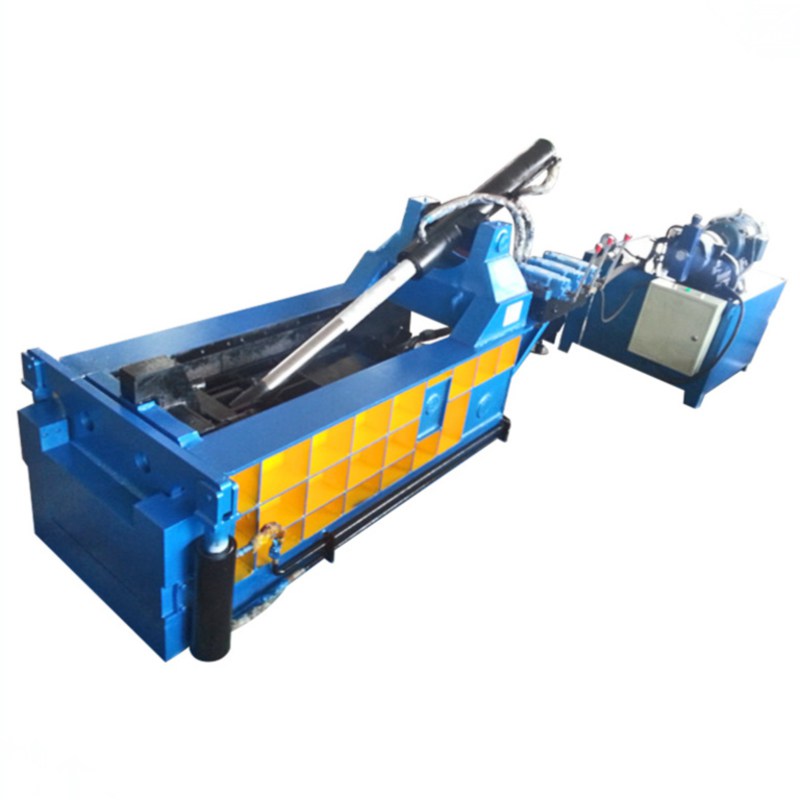
Different materials directly impact the required machine size. A scrap yards forward push metal baler must align with your input feed. Delineating these applications prevents costly missteps. You cannot treat all scrap equally.
Ferrous and non-ferrous materials demand distinct engineering approaches. Heavy steel stamping scrap requires extremely high shear force. The baler must cut through thick steel plates before compressing them. You also need thicker wear liners inside the compression chamber. Steel acts like sandpaper against the machine walls. Conversely, used beverage cans (UBCs) or copper wire are soft. They compress easily. They do not require extreme shear force or overly thick liners.
Mixed material streams present unique challenges. Many yards process aluminum in the morning and steel in the afternoon. You must assess machines offering variable pressure settings. Variable pressure allows you to adjust the hydraulic force dynamically. You use low pressure for aluminum to save energy. You switch to high pressure for steel to ensure dense bales. A fixed-pressure machine limits your flexibility.
We must address wear and tear realities transparently. Abrasive materials destroy standard steel hoppers quickly. You need specific hopper reinforcements. Hardox steel provides excellent abrasion resistance. Installing Hardox liners upfront costs more. However, it prevents catastrophic chamber wear down the line. Replacing a worn-out chamber stops your production for weeks.
Here is a material impact summary detailing these differences:
Scrap Material Type | Required Hydraulic Force | Liner Requirement | Primary Challenge |
|---|---|---|---|
UBCs (Aluminum Cans) | Low (100 - 150 Tons) | Standard Steel | Achieving max speed and fast cycle times. |
Copper Wire / Tubing | Medium (150 - 250 Tons) | Standard Steel | Preventing material tangling in the hopper. |
Heavy Steel Stamping | High (400+ Tons) | Hardox 450/500 | High shear force needed to cut material. |
Mixed Yard Scrap | Variable (Adjustable) | Hardox 400 | Balancing force to avoid over-crushing soft metals. |
You must decide between off-the-shelf and engineered-to-order solutions. This decision shapes your operational layout. Solution categories vary widely based on your specific needs.
The case for standard models is compelling for many yards. Standard machines offer much faster lead times. You can often receive them in weeks. They boast proven parts availability. Standardized components are easy to find locally. Standard models also require a lower initial capital expenditure. They are best for yards with predictable, uniform scrap streams. If you process the same material every day in a large open space, a standard unit works perfectly.
However, the case for a custom build is equally strong for complex yards. Integrating a custom forward push metal baler solves unique layout problems. You might need it to integrate seamlessly with existing conveyor belts. Custom feed hoppers bridge the gap perfectly. You might have severe footprint restrictions. A custom build can alter the power pack location to save space. Sometimes, smelters demand non-standard output sizes. Only a custom compression chamber can meet those exact bale dimensions.
Weigh the upfront premium of customization against your operational reality. Paying extra for a custom hopper might save you thousands in manual sorting labor. A customized loading chute prevents material spillage. It keeps your yard cleaner and safer. You avoid expensive concrete retrofitting when the machine fits your existing foundation. Customization often provides operational harmony standard machines cannot match.
Here is a specification comparison chart regarding standard versus custom options:
Feature | Standard Off-the-Shelf Baler | Custom Engineered Baler |
|---|---|---|
Lead Time | 4 to 8 weeks typically | 12 to 24+ weeks typically |
Footprint Flexibility | Fixed dimensions | Highly adaptable power pack layout |
Integration Capability | Requires yard modifications to fit | Built to match existing conveyors |
Initial CapEx | Lower upfront cost | Higher upfront premium |
Signing the purchase order is only the beginning. Implementation considerations dictate your success. What happens after the purchase matters most. A poorly planned installation causes massive delays.
Site prep and installation require meticulous planning. You must meet strict foundation requirements. A heavy baler requires specific concrete depth, usually 10 to 12 inches of reinforced pad. You cannot place it on thin asphalt. Electrical grid upgrades are often necessary. These machines draw immense startup current. You usually need dedicated 400V or 480V 3-phase power. Hydraulic fluid logistics also matter. You must source and store hundreds of gallons of specialized hydraulic oil before the machine arrives.
Safety and compliance protect your workforce. Ensure the supplier meets regional safety standards like OSHA in the US or CE in Europe. The machine must feature accessible emergency stops. It needs robust physical guarding around moving parts. Light curtains protect operators from accidental shear blade exposure. Do not compromise on safety features.
Choosing the right forward push metal baler supplier mitigates these risks. Use strict shortlisting criteria.
Demand documented uptime Service Level Agreements (SLAs).
Verify domestic parts availability to avoid overseas shipping delays.
Check their field service response times. If they take weeks to send a technician, your yard loses money.
Ask for references from yards processing similar materials.
Your next-step actions should move from internal evaluation to external validation. Request site audits from your shortlisted vendors. Invite them to your yard. Let them measure the space. Finally, demand material testing. Send a sample of your toughest scrap to their facility. Watch how their machine handles it before you buy.
The best baler perfectly fits your current operations and your projected five-year growth. Buying a machine that only meets today's volume guarantees a bottleneck tomorrow. Always factor in your peak surges and future contracts when finalizing your size requirements.
Never rely on brochures alone. We strongly advise decision-makers to demand physical material tests. Review detailed case studies from suppliers before finalizing any specifications. Seeing the equipment handle your specific scrap type removes the guesswork from the purchasing process.
Take action today to protect your investment. Contact a qualified sales engineer to schedule a comprehensive facility capacity audit. They will help you determine your exact sizing requirements and optimize your yard's workflow.
A: A forward push baler ejects the compressed bale straight out the front of the chamber. This creates a linear footprint, ideal for narrow yards. Side push balers eject bales laterally. Forward push models generally integrate better with straight-line automated conveyor systems.
A: Apply a simple rule of thumb. Take the machine's exact physical footprint and multiply it by 1.5. This extra space accommodates safe operator clearance, raw material staging areas, and room for loading equipment like excavators or forklifts.
A: Yes, but only if it features variable hydraulic pressure capabilities. Aluminum requires lower pressure, while steel needs maximum force. You must also ensure the compression chamber uses hardened wear plates (like Hardox) to withstand the abrasive nature of heavy steel.
A: Lead times vary based on customization. Standard stock models typically ship in 4 to 8 weeks. Custom builds or heavily modified machines require significant engineering and manufacturing time. Expect realistically between 12 and 24 weeks for a custom unit.


