


Views: 0 Author: Site Editor Publish Time: 2026-11-05 Origin: Site


Upgrading to a Horizontal Metal Baler is a major capital expenditure. It directly impacts your facility’s throughput, freight costs, and operational safety. Unlike vertical balers designed for low-volume or lightweight materials, horizontal machines handle continuous, high-capacity metal processing. They excel at compacting bulky scrap, aluminum turnings, and thick steel extrusions into dense blocks.
However, selecting the wrong specifications can bottleneck production quickly. You might face excessive energy consumption or premature component failure if the machine lacks the right hydraulic power. Knowing exactly what to look for protects your investment. This guide breaks down the critical technical specifications and evaluation criteria required. We will help you understand hydraulic forces, throughput limits, and electrical necessities. Ultimately, you will make an evidence-based procurement decision tailored to your specific recycling operations and logistical goals.
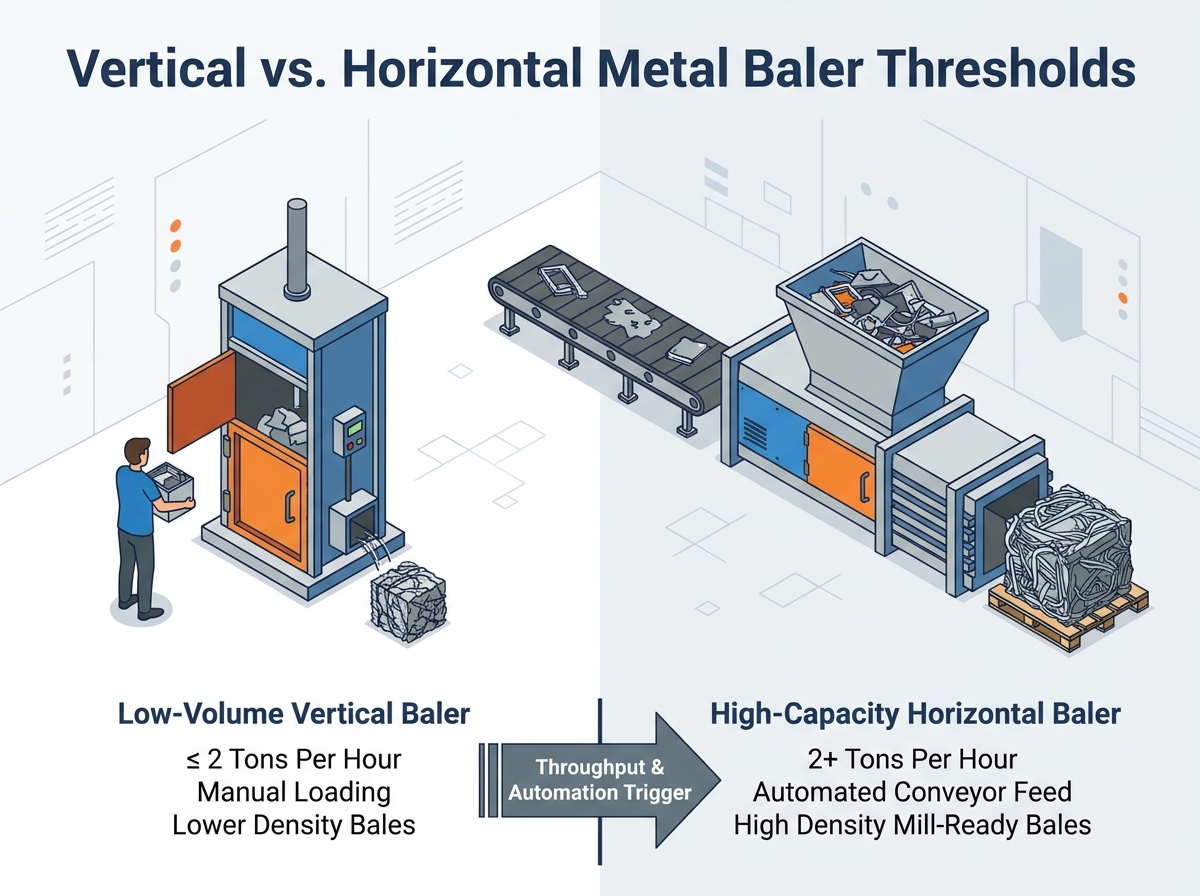
Volume dictates the design: Horizontal metal balers are necessary when processing continuously high volumes (typically 2+ tons per hour) that exceed manual loading capacities.
Force isn't the only metric: While ram pressure (tonnage) is critical, cycle times and motor horsepower equally define actual daily throughput.
Bale dimensions drive ROI: Optimizing bale size and weight to match specific shipping container dimensions maximizes freight efficiency.
Installation requires facility readiness: High-capacity horizontal balers demand specific 3-phase electrical infrastructure, reinforced flooring, and adequate clearance for automated infeed systems.
Understanding when to transition from vertical to horizontal equipment is crucial for scaling your scrap operations. Relying on the wrong machine type limits daily capacity and drains labor resources. We must analyze exact operational thresholds to justify this upgrade.
Volume directly determines your equipment needs. Vertical balers usually fail to keep up once your facility processes more than two tons of metal scrap per hour. They require manual feeding, manual tying, and extended cycle times. Once your daily quotas reach high-tonnage levels, continuous feeding becomes mandatory. A Horizontal Metal Baler operates continuously. You can dump materials via conveyor or grapple directly into the hopper while the machine runs. This eliminates the waiting periods associated with vertical baler batch processing.
Manual loading consumes excessive labor hours. Vertical systems demand constant operator attention. Workers must load scrap by hand, wait for compaction, and manually eject the bale. Horizontal systems automate these repetitive tasks. Conveyor-fed capabilities mean one forklift operator can feed the system while managing other yard tasks. The baler compacts, shears, and ejects bales automatically. This drastically reduces your labor cost per ton processed.
Certain metals possess a high "memory effect." Aluminum extrusions, rigid steel turnings, and heavy copper wire want to spring back to their original shapes. Vertical balers lack the multi-directional compaction force required to tame these metals. Horizontal balers are superior for bulky, memory-heavy metals. They utilize massive hydraulic rams and heavy-duty shear blades. These systems compress scrap from multiple angles, ensuring the materials stay compacted once baled.
We must acknowledge the larger footprint of horizontal balers. They require significantly more floor space than vertical units. However, you should frame this footprint as a necessary trade-off. The space dedicated to a horizontal machine yields continuous processing, higher bale density, and automated material handling. The resulting increase in daily output easily justifies the floor space allocation.
Metal Baler Comparison: Vertical vs. Horizontal Systems
Specification | Vertical Baler | Horizontal Baler |
|---|---|---|
Processing Method | Batch processing (manual) | Continuous processing (automated) |
Average Throughput | Under 2 tons per hour | 2 to 20+ tons per hour |
Footprint | Compact (upward design) | Large (horizontal extension) |
Material Focus | Cardboard, light aluminum | Heavy steel, extrusions, bulky scrap |
Procuring heavy recycling machinery requires strict attention to technical details. You cannot rely on broad marketing claims. You must inspect the specific mechanical and hydraulic capabilities of the equipment.
Tonnage correlates directly to material density. Press force measures the sheer pushing power of the hydraulic ram. In the metal recycling industry, horizontal baler tonnage typically ranges from 50 tons up to 400+ tons. Lower tonnage machines (50-80 tons) serve perfectly well for aluminum cans or light non-ferrous trim. However, compacting heavy steel scrap, automotive panels, or structural beams requires high tonnage. You need a baseline of at least 150 to 300+ tons to process heavy metals efficiently. Without adequate pressure, bales will fall apart during transport.
You must map bale dimensions to standard logistics and mill requirements. Common sizes include 16"x16" and 24"x24" configurations. Smelters and foundries often dictate specific sizes based on their furnace openings. Furthermore, consistent bale density prevents load shifting during transit. Loose bales break apart in trucks, causing safety hazards and rejected loads. Dense, uniformly sized bales allow you to stack materials securely. This maximizes your payload weight limits and dramatically reduces freight costs per ton.
Cycle time refers to the seconds required for the ram to complete one full forward and reverse stroke. It heavily impacts tons-per-hour (TPH) metrics. A faster cycle time theoretically means more bales per hour. However, we warn against evaluating cycle time in a vacuum. It must be paired with hopper capacity and feed rates. A five-second cycle time is useless if your conveyor takes twenty seconds to refill the hopper. You must balance the machine's speed with your material feeding infrastructure.
Actual compaction force stems from motor horsepower (HP) and hydraulic pump efficiency. Heavy-duty horizontal balers often utilize dual-motor setups for redundancy and sustained power. If one motor fails, the system can sometimes limp along to finish a batch. Additionally, we must highlight the importance of hydraulic cooling systems. Continuous multi-shift operations generate immense heat in hydraulic oil. You must choose between air coolers and water coolers. Water cooling generally offers better thermal control for heavy, 24/7 operations, preventing fluid degradation.
A baler's internal components dictate its lifespan. Metal processing is an abrasive, violent environment. The machine must withstand daily punishment without buckling under the strain.
The bale chamber experiences intense friction as metal grinds against its walls. You must look for replaceable, high-abrasion-resistant steel liners. Hardox steel is an industry standard for this application. Once these wear liners thin out, you simply unbolt and replace them. This simple maintenance step protects the actual structural frame of the machine. Failing to maintain liners will eventually destroy the baler's primary weldments, leading to catastrophic failure.
When loading scrap continuously, some pieces inevitably hang over the edge of the compaction chamber. You must evaluate the quality of integrated shear blades. These hardened steel blades cut oversized materials during the forward compaction stroke. If the blades are dull or made from inferior steel, the machine will jam. High-quality shear blades slice cleanly through rogue steel beams and extrusions, keeping the cycle moving smoothly.
Modern balers no longer rely on manual relays. We must discuss the necessity of Programmable Logic Controllers (PLCs). A robust PLC system handles automated cycling and jam prevention logic. If the ram meets too much resistance, the PLC automatically retracts it, shifts the material, and tries again. Furthermore, advanced diagnostic screens allow technicians to perform remote troubleshooting. They can monitor hydraulic pressure spikes and identify failing sensors before a total breakdown occurs.
Heavy machinery draws massive amounts of electricity. You should assess systems equipped with variable frequency drives (VFDs). A VFD controls the electric motors based on current demand. During idle phases—such as waiting for the conveyor to drop more scrap—the VFD reduces power consumption. It keeps the hydraulics ready without running motors at full throttle. This technological advancement slashes utility bills without sacrificing machine responsiveness.
Budgeting for a heavy-duty scrap baler involves much more than the sticker price. We need to analyze both the upfront expenditures and the recurring operational expenses to build an accurate return on investment calculation.
You can expect varying price brackets based on tonnage, automation levels, and custom infeed configurations. A standard 100-ton horizontal baler for non-ferrous metals sits in a much lower price bracket than a 400-ton behemoth designed for steel bodies. CapEx also includes custom hoppers and conveyor integration. Customizing the feed system to match your specific yard layout increases initial costs but improves long-term flow.
Many buyers ignore the financial burden of installation. You must factor in heavy equipment rigging to get the machine off the truck and into position. Electrical drops require certified industrial electricians. Furthermore, large horizontal balers require hundreds of gallons of hydraulic fluid for their initial fill. Depending on your facility, you might also face potential foundation reinforcement costs. Some machines require specialized concrete pads to handle intense vibrational loads.
Ongoing costs will dictate your monthly cash flow. You need to estimate the daily power draw required to run massive dual-motor setups. Preventative maintenance forms a significant portion of OpEx. This includes frequent greasing, hydraulic filter replacements, and system cleaning. Additionally, budget for consumable wear-part replacements. Shear blades, wear liners, and cylinder seals require regular swapping to maintain peak performance.
You can frame the payback period clearly by looking at efficiency gains. Here are the core pillars of an effective ROI model:
Reduced freight costs: Denser, uniform bales allow you to hit maximum weight limits on outgoing trucks. You ship less "air."
Decreased labor hours: Automated feeding and ejection remove multiple manual workers from the processing line.
Higher scrap premiums: Mills and foundries pay a premium for clean, mill-ready bales that meet their precise dimension and density requirements.
Increased throughput: Processing more tons per shift allows you to take on new supplier contracts.
Bringing a large piece of industrial machinery into your plant requires careful preparation. Your facility must meet strict infrastructural and safety standards before the equipment arrives.
You must account for more than just the machine's dimensions. Proper layout planning requires space for infeed conveyors and staging areas for raw scrap. You also need dedicated safety perimeters around all moving parts. Crucially, ensure ample forklift access at the ejection port for rapid bale removal. If the forklift cannot maneuver easily, finished bales will block the machine and stop production.
Standard commercial power will not suffice. Specify the need for robust 3-phase electrical power. High-amperage motor startups create massive initial power draws. You must install dedicated breakers and correctly sized transformers. Failing to upgrade your electrical infrastructure will result in tripped breakers, voltage drops, and damaged baler electronics.
Worker safety remains the highest priority. Ensure the equipment meets OSHA (or your regional equivalent) standards. The baler must feature easily accessible emergency stop buttons around its entire perimeter. Automated infeed areas often require light curtains to detect unauthorized entry. Furthermore, robust lockout/tagout (LOTO) accessibility is mandatory. Maintenance personnel must be able to physically isolate electrical and hydraulic power before entering the compaction chamber.
Transitioning to a Horizontal Metal Baler requires specialized training. You cannot put untrained staff on these machines. Training curriculums must cover:
Hydraulic safety protocols and high-pressure fluid hazard awareness.
PLC operation, including reading diagnostic codes and clearing minor faults.
Proper jam-clearing protocols using designated safety tools.
Daily visual inspection routines for wear liners and fluid levels.
Buying a horizontal metal baler is an exercise in matching machine specifications to specific material flows and logistical goals. You must analyze your daily tonnage, floor space, and material types. A high-tonnage machine excels at dense steel, while lower-tonnage, fast-cycle machines handle aluminum efficiently.
We advise buyers to prioritize manufacturers who offer transparent cycle times and standard, non-proprietary hydraulic components. Proprietary parts lead to supply chain bottlenecks when repairs are needed. You want robust post-sale support and readily available wear parts to minimize downtime.
As a next-step action, recommend requesting a material test or a site audit from the manufacturer. Send a sample of your toughest scrap. Validate their throughput claims before finalizing the purchase order. This guarantees the machine will perform exactly as expected in your environment.
A: With proper maintenance, a high-quality machine typically lasts 10 to 15 years, or even longer. This lifespan heavily depends on timely wear liner replacements, daily cleaning, and strict adherence to hydraulic fluid maintenance schedules. Neglecting abrasive dust buildup or running contaminated oil will severely shorten this timeframe.
A: Yes, many machines can handle both. However, you need variable pressure settings. Compacting delicate aluminum requires less force than rigid steel. You must also manage the risk of cross-contamination. You must thoroughly clean the hopper and chamber when switching between ferrous and non-ferrous materials to maintain scrap purity.
A: Hydraulic systems demand strict attention. You must perform daily visual checks for leaks and unusual vibrations. Monthly routines should include changing or cleaning filters. We also recommend annual fluid analysis to check for microscopic metal shavings or water contamination, which indicate internal wear.
A: You should set realistic expectations for procurement. Lead times usually range from 12 to 24 weeks. This timeframe varies based on supply chain factors, the manufacturer's backlog, and the level of custom infeed engineering required for your specific facility layout.


