


Views: 0 Author: Site Editor Publish Time: 2026-11-10 Origin: Site


Every scrap metal recycling operation eventually faces a critical crossroad. Do you invest capital into a brand-new metal cutting machine? Or do you hunt for a bargain on the secondary market? Balancing the immediate expense of new equipment against the hidden maintenance risks of an older unit remains a primary dilemma. Scrap yard managers, demolition contractors, and recycling facility operators face this challenge daily. They handle varying volumes of ferrous and non-ferrous metals. Profit margins rely heavily on consistent equipment performance. Machine failures halt production and drain resources.
We wrote this article to provide a balanced, evidence-based evaluation framework. We will help you choose the right equipment. You must base this decision on your processing volume, material types, and in-house maintenance capabilities. You will learn how to calculate long-term financial impacts accurately. This approach ensures your yard maintains efficiency without overspending.
Lifecycle Cost Over Sticker Price: The initial savings of a used alligator shear can be quickly offset by hydraulic failure and unscheduled downtime if not properly vetted.
Volume Dictates the Choice: High-volume, continuous cutting operations generally require the reliability and cooling systems of a new unit, while low-volume or intermittent operations can achieve strong ROI with a refurbished model.
Safety and Compliance: New models come with modern, compliant safety guards and automated hold-downs, whereas older used models may require costly retrofitting to meet current workplace safety standards.
Component Availability: Sourcing replacement blades, seals, and hydraulic cylinders for discontinued used models is a significant implementation risk.
Scrap processing profitability relies entirely on equipment uptime. Throughput efficiency drives revenue directly. When machines stop working, operators stand idle. Deliveries fall behind schedule. Consequently, evaluating machinery requires looking far beyond the initial price tag.
You must adopt a comprehensive financial model. This model tracks every expense associated with the equipment over its entire lifespan. A complete assessment includes several key factors:
Initial purchase price and freight charges.
Installation, operator training, and safety calibration expenses.
Consumables like blade wear, grease, and hydraulic fluid.
The cost of unscheduled downtime and lost processing hours.
Evaluating a shear strictly on cutting force leads to severe operational bottlenecks. Comparing a 500-ton machine against a 600-ton machine provides an incomplete picture. You must factor in cycle times. Hydraulic cooling capacity plays a massive role. A machine boasting massive force but suffering slow cycle times will choke high-volume production lines. Heat buildup degrades hydraulic fluid quickly. This degradation reduces cutting power over extended shifts. True operational costs emerge when you analyze overall system capability rather than isolated metrics.
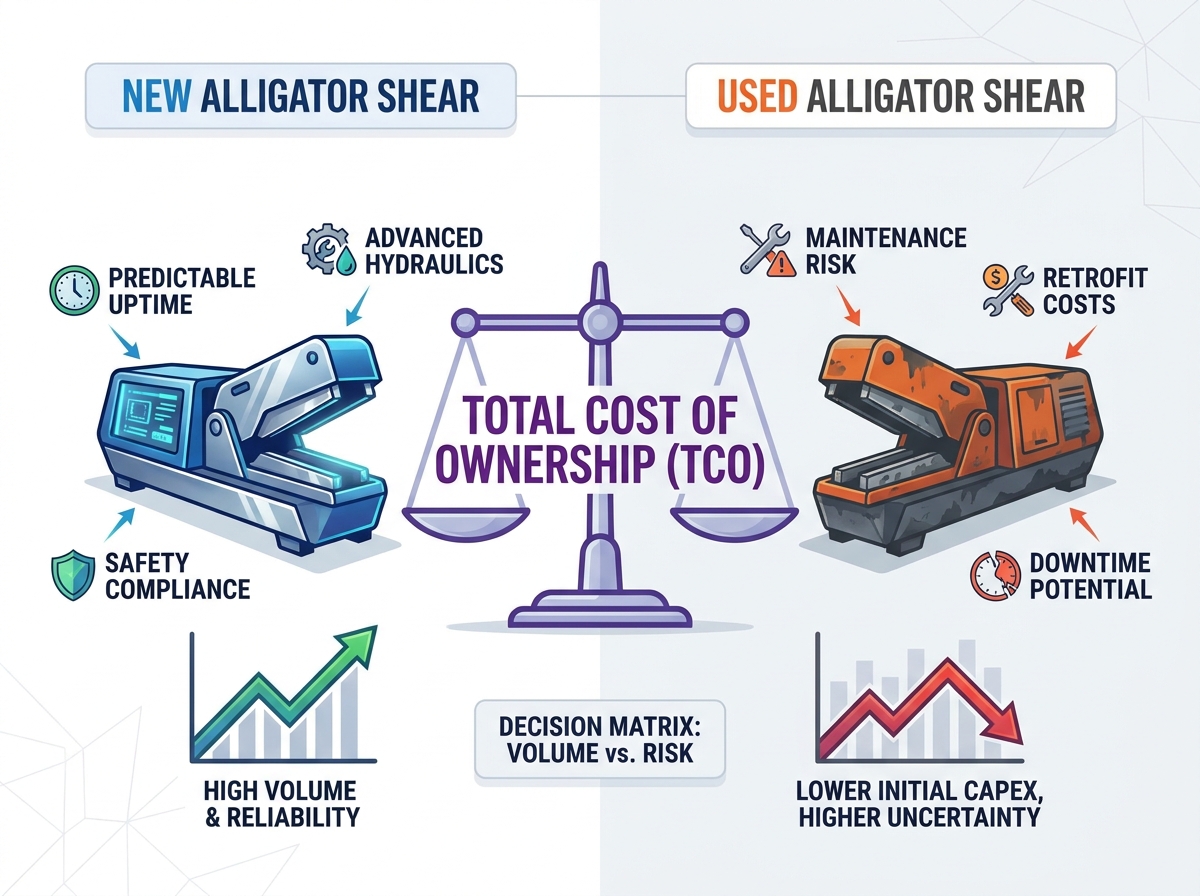
Purchasing factory-fresh machinery eliminates guesswork. Predictable uptime transforms yard operations. OEM warranties protect your investment against premature failures. Guaranteed parts availability reduces stress for maintenance teams. High-volume scrap cutting demands this baseline reliability. When processing hundreds of tons weekly, equipment must perform flawlessly.
Modern hydraulic systems deliver superior performance. They provide significantly faster cycle times. Upgraded cooling circuits dissipate heat effectively. This prevents the hydraulic oil from thinning out during summer operations. Furthermore, modern pumps offer enhanced energy efficiency. You consume less electricity per cut. Over several years, these electrical savings accumulate dramatically.
Safety compliance remains a top priority for facility operators. New units arrive ready for immediate deployment. They feature integrated safety systems. Think shielded foot-pedal controls. Automated material hold-downs prevent heavy scrap from kicking back during a cut. Protective shielding keeps operators safe from flying debris. These features keep your facility compliant with strict OSHA and CE regulations.
The best fit for new equipment involves high-volume yards. Facilities processing heavy scrap continuously need this robust construction. Cutting thick steel pipes stresses older machinery. Heavy structural beams and dense automotive parts require uncompromised hydraulic power. If your yard processes tough ferrous materials continuously, a new Alligator Shear guarantees the necessary throughput.
Secondary market machinery offers compelling financial advantages. Lower initial capital expenditure stands out immediately. Buying a used machine frees up capital significantly. You can redirect these funds into other yard improvements. You might purchase secondary processing equipment instead. Growing yards often prefer this agile financial approach.
Immediate availability solves urgent capacity problems. Manufacturing lead times for new equipment sometimes stretch into months. Used models bypass this delay entirely. They often sit ready for immediate freight. You can finalize a purchase and start cutting material within days. Rapid deployment helps yards handle sudden influxes of scrap material efficiently.
The depreciation curve favors used equipment buyers. A used unit has already absorbed the steepest part of its depreciation. Consequently, it holds its resale value relatively well. If you maintain the machine properly, you can often resell it later with minimal financial loss. This makes used machinery an excellent short-term scaling strategy.
Smaller operations benefit most from used models. Specialized non-ferrous sorting requires less sheer force. Cutting copper wire or aluminum extrusions poses little threat to older hydraulics. Furthermore, used units serve perfectly as secondary or backup shears. They handle intermittent peak volumes efficiently without requiring massive upfront investments.
Comparing new and used machinery requires structured inspection. You must evaluate specific mechanical systems thoroughly.
Inspect used blades closely. You should look for micro-fractures along the cutting edge. Shimming issues indicate poor maintenance history. When operators fail to adjust the blade gap, materials fold instead of cutting. Poor jaw alignment ruins clean cuts. Compare the jaw length and cutting capacity against your actual daily throughput. A new machine guarantees perfect factory alignment and fresh, four-edge reversible blades.
Used hydraulic systems hide expensive risks. Watch carefully for micro-leaks around cylinder seals. Scored cylinders require expensive machining or complete replacement. Degraded rubber hoses burst unpredictably under high pressure. Flushing and rebuilding a compromised hydraulic system costs thousands of dollars. Conversely, a factory-sealed new system provides immediate peace of mind. It utilizes pristine hydraulic fluid and modern filtration systems.
Heavy scrap applications test the physical limits of cast steel. Identifying stress fractures early prevents catastrophic failure. Pay specific attention to the main pivot pin. This acts as a critical failure point in heavy applications. Continuous cutting of dense steel elongates the pivot hole over time. A compromised pivot assembly destroys blade alignment permanently.
Component | New Equipment Baseline | Used Equipment Risks |
|---|---|---|
Blades | Factory gap, reversible 4-edge | Micro-fractures, incorrect shimming |
Hydraulics | Sealed, warranty-backed, modern cooling | Scored cylinders, micro-leaks, degraded oil |
Pivot Pin | Zero tolerance, fresh bronze bushings | Elongation, stress fractures, lack of grease |
Safety Guards | OSHA/CE compliant out of the box | Missing shields, bypassed interlocks |
Adopting used equipment involves real-world challenges. We see facilities make expensive miscalculations frequently. Operational realities often differ from initial spreadsheet projections.
The retrofit trap ruins budgets quickly. Upgrading an older machine to meet current OSHA or CE safety standards costs money. You might need custom-fabricated safety guards. Automated hold-downs require complex hydraulic modifications. Installing two-hand controls involves complete electrical rewiring. These mandatory upgrades often negate your initial cost savings entirely.
Consider your maintenance burden carefully. Used machinery demands in-house mechanical expertise. Facilities lacking an on-site mechanic face severe disadvantages. When a used shear fails, you must hire specialized hydraulic technicians. You might lose days waiting for their availability. Every lost day destroys profit margins. New machinery minimizes this burden through reliability and comprehensive technical support.
Documentation matters immensely for troubleshooting. Missing operational manuals plague the secondary market. Maintenance logs rarely accompany used machines. Operators end up guessing at service intervals. Electrical schematics disappear over time. Without these schematics, troubleshooting electrical faults becomes a frustrating, time-consuming nightmare.
Making the right choice requires objectivity. We developed a clear decision framework for shortlisting your options.
If processing over 10 tons per day of heavy steel: Buy New. Continuous stress demands warranty protection and modern cooling capacity.
If budget is strictly limited, processing is intermittent, and an in-house mechanic is available: Buy Used/Refurbished. Your team can handle the maintenance quirks. You save capital.
If material requires precise, safe handling with multiple operators: Buy New. Updated safety controls and automated hold-downs protect your workforce and reduce liability.
Your actionable next step involves data gathering. Audit your yard's current material influx. Calculate the exact cost of one week of downtime. Factor in lost revenue and idle labor costs. Perform this calculation before requesting any vendor quotes. Understanding your exact financial vulnerability clarifies the buying decision immediately.
The choice between a used or new Alligator Shear is fundamentally a choice between capital preservation and operational predictability. Used machines save money upfront but introduce maintenance variables. New machines require heavier capital but guarantee throughput.
Buyers must look far beyond the initial price tag. You must assess hydraulic health meticulously. Safety compliance cannot be ignored. Expected daily throughput dictates the necessary machine specifications.
Take proactive steps to protect your operation. Request full diagnostic reports when evaluating used machinery. Demand on-site testing before transferring funds. If choosing new equipment, consult with an OEM directly. They will help you size the unit properly based on your specific scrap materials. Careful evaluation prevents costly operational bottlenecks.
A: A new unit easily lasts 15 to 20 years under normal conditions. This lifespan depends heavily on strict maintenance intervals. You must rotate blades regularly to prevent structural stress. Consistent greasing of the pivot pin and timely hydraulic fluid replacements extend longevity significantly.
A: Yes, retrofitting remains mechanically feasible. However, custom fabrication costs add up quickly. Adding automated hold-downs requires tapping into the existing hydraulic circuit. Installing complex interlocks sometimes slows down older control systems, slightly impacting overall cycle times.
A: The main pivot pin demands your closest attention. This component handles immense stress. You must also inspect hydraulic cylinder seals for weeping fluid. Finally, check jaw alignment; misaligned jaws indicate a warped frame or worn pivot bushings.
A: Not necessarily. Cutting force must balance with jaw length and cycle speed. A massive 600-ton force matters for solid steel blocks. However, processing lighter aluminum extrusions benefits more from faster cycle times rather than excessive crushing power.


